

forces generated by the stress fiber are utilized in many processes such as cell
adhesion (development of the adhesion) or crawling (contraction of the cell body).
The similarity among the constituents between muscle and the contractile nature of
the stress fiber has suggested that the stress fiber is a prototype of muscle [105].
Within the cell, stress fibers are linked to the cluster of integrin heterodimers. The
integrin cluster plays a central role in forming a specialized structure called focal
adhesion. As described before, the extracellular partner of the integrin heterodimer
varies according to the combination of alpha- and beta-integrin. For example, alpha5- beta-1-integrin binds to an extracellular matrix protein, fibronectin. The binding
alters the conformation of integrin and as a result, the intracellular signaling pathways are activated [83, 84]. This leads to the formation of stress fibers [105].
The cytoplasmic domain of integrin is linked to stress fiber through a protein
called talin (see next paragraph). Other proteins residing at the focal adhesion
include kindlin, vinculin and focal adhesion kinase, to name a few ([105–107]).
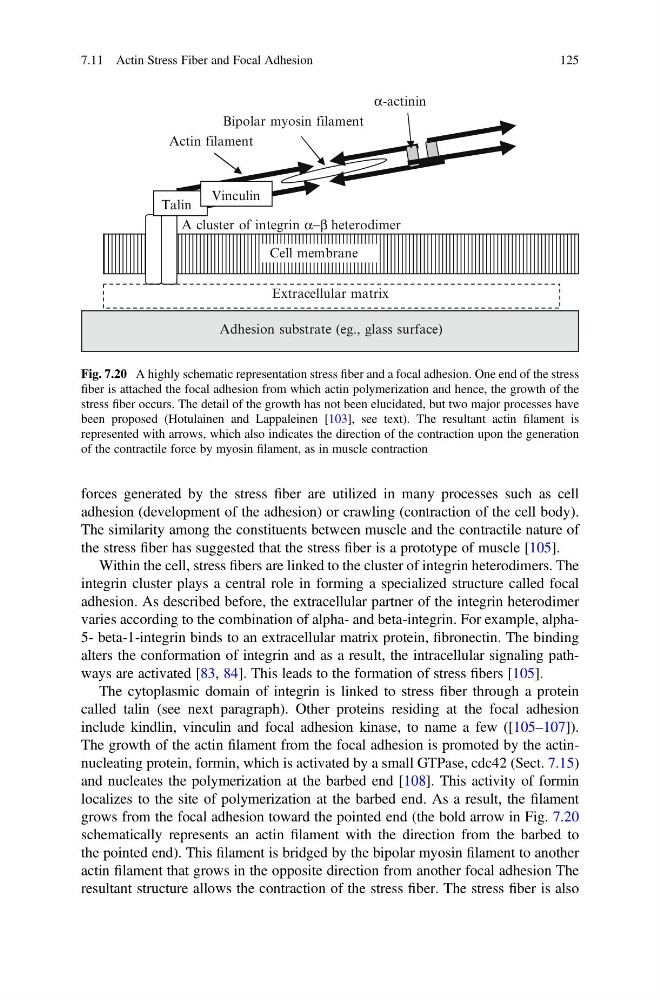
The growth of the actin filament from the focal adhesion is promoted by the actinnucleating protein, formin, which is activated by a small GTPase, cdc42 (Sect. 7.15)
and nucleates the polymerization at the barbed end [108]. This activity of formin
localizes to the site of polymerization at the barbed end. As a result, the filament
grows from the focal adhesion toward the pointed end (the bold arrow in Fig. 7.20
schematically represents an actin filament with the direction from the barbed to
the pointed end). This filament is bridged by the bipolar myosin filament to another
actin filament that grows in the opposite direction from another focal adhesion The
resultant structure allows the contraction of the stress fiber. The stress fiber is also
α-actinin
Bipolar myosin filament
Actin filament
Vinculin
Cell membrane
Adhesion substrate (eg., glass surface)
Extracellular matrix
A cluster of integrin α−β heterodimer
Talin
Fig. 7.20 A highly schematic representation stress fiber and a focal adhesion. One end of the stress
fiber is attached the focal adhesion from which actin polymerization and hence, the growth of the
stress fiber occurs. The detail of the growth has not been elucidated, but two major processes have
been proposed (Hotulainen and Lappaleinen [103], see text). The resultant actin filament is
represented with arrows, which also indicates the direction of the contraction upon the generation
of the contractile force by myosin filament, as in muscle contraction
7.11 Actin Stress Fiber and Focal Adhesion
125
adhesion (development of the adhesion) or crawling (contraction of the cell body).
The similarity among the constituents between muscle and the contractile nature of
the stress fiber has suggested that the stress fiber is a prototype of muscle [105].
Within the cell, stress fibers are linked to the cluster of integrin heterodimers. The
integrin cluster plays a central role in forming a specialized structure called focal
adhesion. As described before, the extracellular partner of the integrin heterodimer
varies according to the combination of alpha- and beta-integrin. For example, alpha5- beta-1-integrin binds to an extracellular matrix protein, fibronectin. The binding
alters the conformation of integrin and as a result, the intracellular signaling pathways are activated [83, 84]. This leads to the formation of stress fibers [105].
The cytoplasmic domain of integrin is linked to stress fiber through a protein
called talin (see next paragraph). Other proteins residing at the focal adhesion
include kindlin, vinculin and focal adhesion kinase, to name a few ([105–107]).
The growth of the actin filament from the focal adhesion is promoted by the actinnucleating protein, formin, which is activated by a small GTPase, cdc42 (Sect. 7.15)
and nucleates the polymerization at the barbed end [108]. This activity of formin
localizes to the site of polymerization at the barbed end. As a result, the filament
grows from the focal adhesion toward the pointed end (the bold arrow in Fig. 7.20
schematically represents an actin filament with the direction from the barbed to
the pointed end). This filament is bridged by the bipolar myosin filament to another
actin filament that grows in the opposite direction from another focal adhesion The
resultant structure allows the contraction of the stress fiber. The stress fiber is also
α-actinin
Bipolar myosin filament
Actin filament
Vinculin
Cell membrane
Adhesion substrate (eg., glass surface)
Extracellular matrix
A cluster of integrin α−β heterodimer
Talin
Fig. 7.20 A highly schematic representation stress fiber and a focal adhesion. One end of the stress
fiber is attached the focal adhesion from which actin polymerization and hence, the growth of the
stress fiber occurs. The detail of the growth has not been elucidated, but two major processes have
been proposed (Hotulainen and Lappaleinen [103], see text). The resultant actin filament is
represented with arrows, which also indicates the direction of the contraction upon the generation
of the contractile force by myosin filament, as in muscle contraction
7.11 Actin Stress Fiber and Focal Adhesion
125