

6
1 Green and Ecological Infrastructures and Water Security …
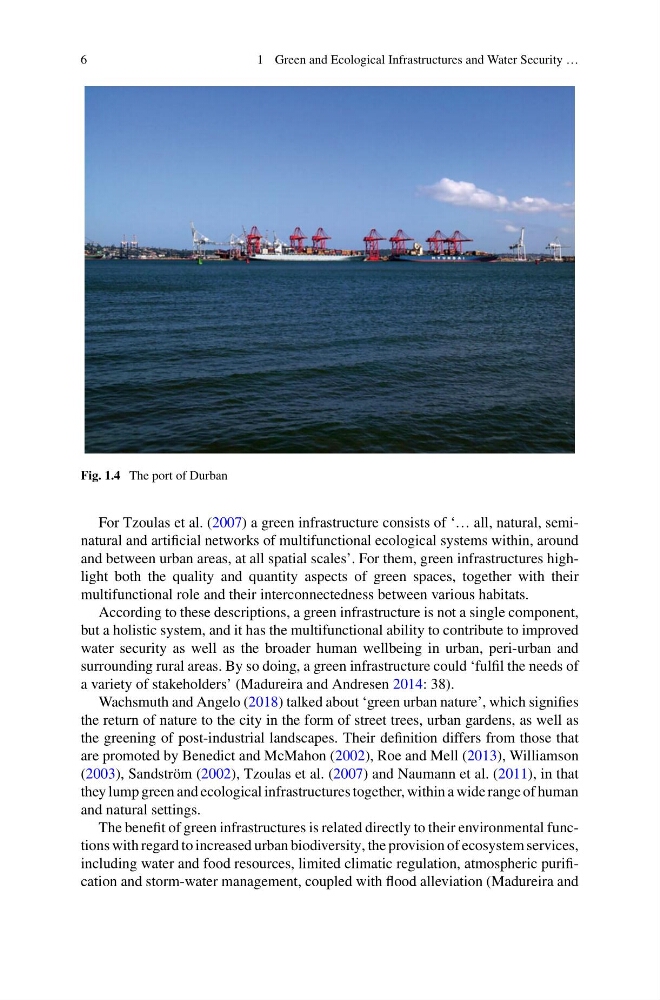
Fig. 1.4 The port of Durban
For Tzoulas et al. (2007) a green infrastructure consists of ‘… all, natural, seminatural and artificial networks of multifunctional ecological systems within, around
and between urban areas, at all spatial scales’. For them, green infrastructures highlight both the quality and quantity aspects of green spaces, together with their
multifunctional role and their interconnectedness between various habitats.
According to these descriptions, a green infrastructure is not a single component,
but a holistic system, and it has the multifunctional ability to contribute to improved
water security as well as the broader human wellbeing in urban, peri-urban and
surrounding rural areas. By so doing, a green infrastructure could ‘fulfil the needs of
a variety of stakeholders’ (Madureira and Andresen 2014: 38).
Wachsmuth and Angelo (2018) talked about ‘green urban nature’, which signifies
the return of nature to the city in the form of street trees, urban gardens, as well as
the greening of post-industrial landscapes. Their definition differs from those that
are promoted by Benedict and McMahon (2002), Roe and Mell (2013), Williamson
(2003), Sandström (2002), Tzoulas et al. (2007) and Naumann et al. (2011), in that
they lump green and ecological infrastructures together, within a wide range of human
and natural settings.
The benefit of green infrastructures is related directly to their environmental functions with regard to increased urban biodiversity, the provision of ecosystem services,
including water and food resources, limited climatic regulation, atmospheric purification and storm-water management, coupled with flood alleviation (Madureira and
1 Green and Ecological Infrastructures and Water Security …
Fig. 1.4 The port of Durban
For Tzoulas et al. (2007) a green infrastructure consists of ‘… all, natural, seminatural and artificial networks of multifunctional ecological systems within, around
and between urban areas, at all spatial scales’. For them, green infrastructures highlight both the quality and quantity aspects of green spaces, together with their
multifunctional role and their interconnectedness between various habitats.
According to these descriptions, a green infrastructure is not a single component,
but a holistic system, and it has the multifunctional ability to contribute to improved
water security as well as the broader human wellbeing in urban, peri-urban and
surrounding rural areas. By so doing, a green infrastructure could ‘fulfil the needs of
a variety of stakeholders’ (Madureira and Andresen 2014: 38).
Wachsmuth and Angelo (2018) talked about ‘green urban nature’, which signifies
the return of nature to the city in the form of street trees, urban gardens, as well as
the greening of post-industrial landscapes. Their definition differs from those that
are promoted by Benedict and McMahon (2002), Roe and Mell (2013), Williamson
(2003), Sandström (2002), Tzoulas et al. (2007) and Naumann et al. (2011), in that
they lump green and ecological infrastructures together, within a wide range of human
and natural settings.
The benefit of green infrastructures is related directly to their environmental functions with regard to increased urban biodiversity, the provision of ecosystem services,
including water and food resources, limited climatic regulation, atmospheric purification and storm-water management, coupled with flood alleviation (Madureira and