

194
3 eThekwini’s Green and Ecological Infrastructure Policy Landscape
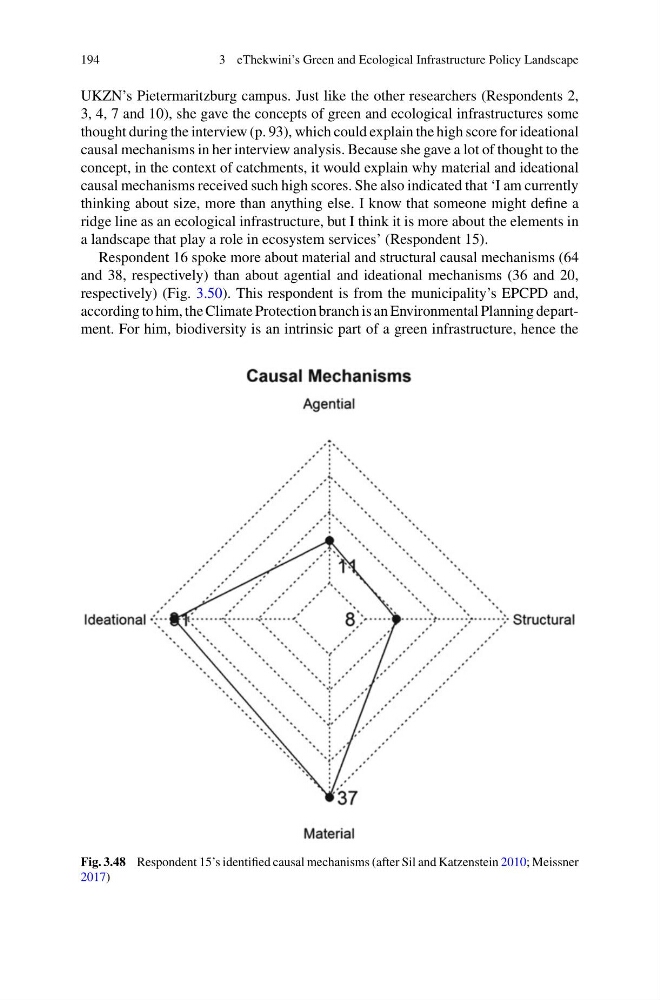
UKZN’s Pietermaritzburg campus. Just like the other researchers (Respondents 2,
3, 4, 7 and 10), she gave the concepts of green and ecological infrastructures some
thought during the interview (p. 93), which could explain the high score for ideational
causal mechanisms in her interview analysis. Because she gave a lot of thought to the
concept, in the context of catchments, it would explain why material and ideational
causal mechanisms received such high scores. She also indicated that ‘I am currently
thinking about size, more than anything else. I know that someone might define a
ridge line as an ecological infrastructure, but I think it is more about the elements in
a landscape that play a role in ecosystem services’ (Respondent 15).
Respondent 16 spoke more about material and structural causal mechanisms (64
and 38, respectively) than about agential and ideational mechanisms (36 and 20,
respectively) (Fig. 3.50). This respondent is from the municipality’s EPCPD and,
according to him, the Climate Protection branch is an Environmental Planning department. For him, biodiversity is an intrinsic part of a green infrastructure, hence the
Fig. 3.48 Respondent 15’s identified causal mechanisms (after Sil and Katzenstein 2010; Meissner
2017)
3 eThekwini’s Green and Ecological Infrastructure Policy Landscape
UKZN’s Pietermaritzburg campus. Just like the other researchers (Respondents 2,
3, 4, 7 and 10), she gave the concepts of green and ecological infrastructures some
thought during the interview (p. 93), which could explain the high score for ideational
causal mechanisms in her interview analysis. Because she gave a lot of thought to the
concept, in the context of catchments, it would explain why material and ideational
causal mechanisms received such high scores. She also indicated that ‘I am currently
thinking about size, more than anything else. I know that someone might define a
ridge line as an ecological infrastructure, but I think it is more about the elements in
a landscape that play a role in ecosystem services’ (Respondent 15).
Respondent 16 spoke more about material and structural causal mechanisms (64
and 38, respectively) than about agential and ideational mechanisms (36 and 20,
respectively) (Fig. 3.50). This respondent is from the municipality’s EPCPD and,
according to him, the Climate Protection branch is an Environmental Planning department. For him, biodiversity is an intrinsic part of a green infrastructure, hence the
Fig. 3.48 Respondent 15’s identified causal mechanisms (after Sil and Katzenstein 2010; Meissner
2017)