

182
3 eThekwini’s Green and Ecological Infrastructure Policy Landscape
instance, she said that she has ‘framed’ the concept ‘as an ecological infrastructure’
and that a green infrastructure is ‘in my mind…when city planners are thinking of
putting in green open spaces to try and provide a whole lot of ecosystem services’.
In this regard, Respondent 3 constructed the concept of green and ecological infrastructures within an academic or scientific context. She noted that: ‘I’ve learned about
it [an ecological infrastructure] from a science point of view’ (Respondent 3), which
is in line with the SANBI definition and the writings of Graham Jewitt. She also
spoke about ‘band-wagoning’ when people use the term ‘green infrastructure’ in the
‘…battle for the environment…’ (Respondent 3). Some of the structural mechanisms
she mentioned are Durban’s policies and bylaws that protect coastal buffers, and she
also mentioned the ‘dual governance context’ between traditional authorities and the
municipality, which constitutes a structural causal mechanism (Respondent 3).
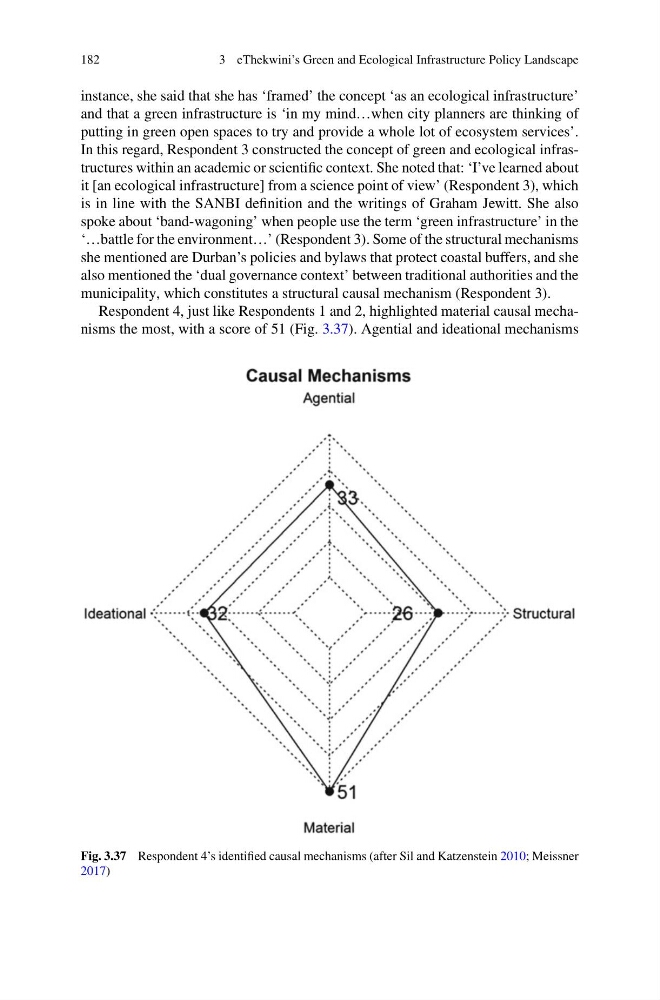
Respondent 4, just like Respondents 1 and 2, highlighted material causal mechanisms the most, with a score of 51 (Fig. 3.37). Agential and ideational mechanisms
Fig. 3.37 Respondent 4’s identified causal mechanisms (after Sil and Katzenstein 2010; Meissner
2017)
3 eThekwini’s Green and Ecological Infrastructure Policy Landscape
instance, she said that she has ‘framed’ the concept ‘as an ecological infrastructure’
and that a green infrastructure is ‘in my mind…when city planners are thinking of
putting in green open spaces to try and provide a whole lot of ecosystem services’.
In this regard, Respondent 3 constructed the concept of green and ecological infrastructures within an academic or scientific context. She noted that: ‘I’ve learned about
it [an ecological infrastructure] from a science point of view’ (Respondent 3), which
is in line with the SANBI definition and the writings of Graham Jewitt. She also
spoke about ‘band-wagoning’ when people use the term ‘green infrastructure’ in the
‘…battle for the environment…’ (Respondent 3). Some of the structural mechanisms
she mentioned are Durban’s policies and bylaws that protect coastal buffers, and she
also mentioned the ‘dual governance context’ between traditional authorities and the
municipality, which constitutes a structural causal mechanism (Respondent 3).
Respondent 4, just like Respondents 1 and 2, highlighted material causal mechanisms the most, with a score of 51 (Fig. 3.37). Agential and ideational mechanisms
Fig. 3.37 Respondent 4’s identified causal mechanisms (after Sil and Katzenstein 2010; Meissner
2017)