

174
3 eThekwini’s Green and Ecological Infrastructure Policy Landscape
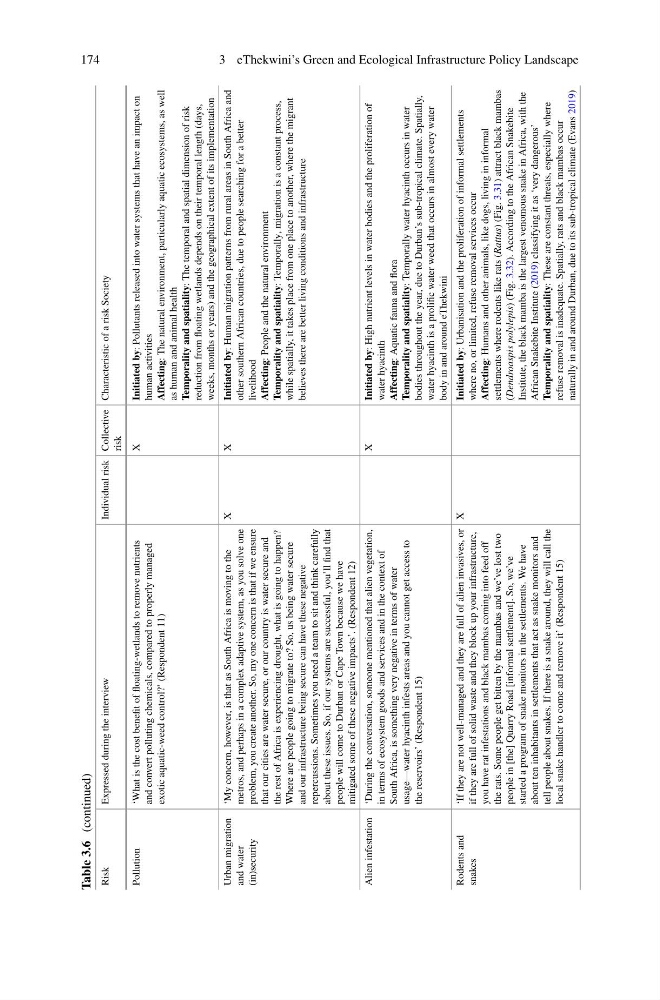
Table 3.6
(continued)
Risk
Expressed during the interview
Individual risk Collective
risk
Characteristic of a risk Society
Pollution
‘What is the cost benefit of floating-wetlands to remove nutrients
and convert polluting chemicals, compared to properly managed
exotic aquatic-weed control?’ (Respondent 11)
X
Initiated by:
Pollutants released into water systems that have an impact on
human activities
Affecting:
The natural environment, particularly aquatic ecosystems, as well
as human and animal health
Temporality and spatiality:
The temporal and spatial dimension of risk
reduction from floating wetlands depends on their temporal length (days,
weeks, months or years) and the geographical extent of its implementation
Urban migration
and water
(in)security
‘My concern, however, is that as South Africa is moving to the
metros, and perhaps in a complex adaptive system, as you solve one
problem, you create another. So, my one concern is that if we ensure
that our cities are water secure, or our country is water secure and
the rest of Africa is experiencing drought, what is going to happen?
Where are people going to migrate to? So, us being water secure
and our infrastructure being secure can have these negative
repercussions. Sometimes you need a team to sit and think carefully
about these issues. So, if our systems are successful, you’ll find that
people will come to Durban or Cape Town because we have
mitigated some of these negative impacts’. (Respondent 12)
X
X
Initiated by:
Human migration patterns from rural areas in South Africa and
other southern African countries, due to people searching for a better
livelihood
Affecting:
People and the natural environment
Temporality and spatiality:
Temporally, migration is a constant process,
while spatially, it takes place from one place to another, where the migrant
believes there are better living conditions and infrastructure
Alien infestation ‘During the conversation, someone mentioned that alien vegetation,
in terms of ecosystem goods and services and in the context of
South Africa, is something very negative in terms of water
usage—water hyacinth infests areas and you cannot get access to
the reservoirs’ (Respondent 15)
X
Initiated by:
High nutrient levels in water bodies and the proliferation of
water hyacinth
Affecting:
Aquatic fauna and flora
Temporality and spatiality:
Temporally water hyacinth occurs in water
bodies throughout the year, due to Durban’s sub-tropical climate. Spatially,
water hyacinth is a prolific water weed that occurs in almost every water
body in and around eThekwini
Rodents and
snakes
‘If they are not well-managed and they are full of alien invasives, or
if they are full of solid waste and they block up your infrastructure,
you have rat infestations and black mambas coming into feed off
the rats. Some people get bitten by the mambas and we’ve lost two
people in [the] Quarry Road [informal settlement]. So, we’ve
started a program of snake monitors in the settlements. We have
about ten inhabitants in settlements that act as snake monitors and
tell people about snakes. If there is a snake around, they will call the
local snake handler to come and remove it’ (Respondent 15)
X
Initiated by:
Urbanisation and the proliferation of informal settlements
where no, or limited, refuse removal services occur
Affecting:
Humans and other animals, like dogs, living in informal
settlements where rodents like rats (Rattus) (Fig. 3.31) attract black mambas
(Dendroaspis polylepis)
(Fig. 3.32). According to the African Snakebite
Institute, the black mamba is the largest venomous snake in Africa, with the
African Snakebite Institute (2019) classifying it as ‘very dangerous’
Temporality and spatiality:
These are constant threats, especially where
refuse removal is inadequate. Spatially, rats and black mambas occur
naturally in and around Durban, due to its sub-tropical climate (Evans 2019)
3 eThekwini’s Green and Ecological Infrastructure Policy Landscape
Table 3.6
(continued)
Risk
Expressed during the interview
Individual risk Collective
risk
Characteristic of a risk Society
Pollution
‘What is the cost benefit of floating-wetlands to remove nutrients
and convert polluting chemicals, compared to properly managed
exotic aquatic-weed control?’ (Respondent 11)
X
Initiated by:
Pollutants released into water systems that have an impact on
human activities
Affecting:
The natural environment, particularly aquatic ecosystems, as well
as human and animal health
Temporality and spatiality:
The temporal and spatial dimension of risk
reduction from floating wetlands depends on their temporal length (days,
weeks, months or years) and the geographical extent of its implementation
Urban migration
and water
(in)security
‘My concern, however, is that as South Africa is moving to the
metros, and perhaps in a complex adaptive system, as you solve one
problem, you create another. So, my one concern is that if we ensure
that our cities are water secure, or our country is water secure and
the rest of Africa is experiencing drought, what is going to happen?
Where are people going to migrate to? So, us being water secure
and our infrastructure being secure can have these negative
repercussions. Sometimes you need a team to sit and think carefully
about these issues. So, if our systems are successful, you’ll find that
people will come to Durban or Cape Town because we have
mitigated some of these negative impacts’. (Respondent 12)
X
X
Initiated by:
Human migration patterns from rural areas in South Africa and
other southern African countries, due to people searching for a better
livelihood
Affecting:
People and the natural environment
Temporality and spatiality:
Temporally, migration is a constant process,
while spatially, it takes place from one place to another, where the migrant
believes there are better living conditions and infrastructure
Alien infestation ‘During the conversation, someone mentioned that alien vegetation,
in terms of ecosystem goods and services and in the context of
South Africa, is something very negative in terms of water
usage—water hyacinth infests areas and you cannot get access to
the reservoirs’ (Respondent 15)
X
Initiated by:
High nutrient levels in water bodies and the proliferation of
water hyacinth
Affecting:
Aquatic fauna and flora
Temporality and spatiality:
Temporally water hyacinth occurs in water
bodies throughout the year, due to Durban’s sub-tropical climate. Spatially,
water hyacinth is a prolific water weed that occurs in almost every water
body in and around eThekwini
Rodents and
snakes
‘If they are not well-managed and they are full of alien invasives, or
if they are full of solid waste and they block up your infrastructure,
you have rat infestations and black mambas coming into feed off
the rats. Some people get bitten by the mambas and we’ve lost two
people in [the] Quarry Road [informal settlement]. So, we’ve
started a program of snake monitors in the settlements. We have
about ten inhabitants in settlements that act as snake monitors and
tell people about snakes. If there is a snake around, they will call the
local snake handler to come and remove it’ (Respondent 15)
X
Initiated by:
Urbanisation and the proliferation of informal settlements
where no, or limited, refuse removal services occur
Affecting:
Humans and other animals, like dogs, living in informal
settlements where rodents like rats (Rattus) (Fig. 3.31) attract black mambas
(Dendroaspis polylepis)
(Fig. 3.32). According to the African Snakebite
Institute, the black mamba is the largest venomous snake in Africa, with the
African Snakebite Institute (2019) classifying it as ‘very dangerous’
Temporality and spatiality:
These are constant threats, especially where
refuse removal is inadequate. Spatially, rats and black mambas occur
naturally in and around Durban, due to its sub-tropical climate (Evans 2019)