

3.4 Analysis
161
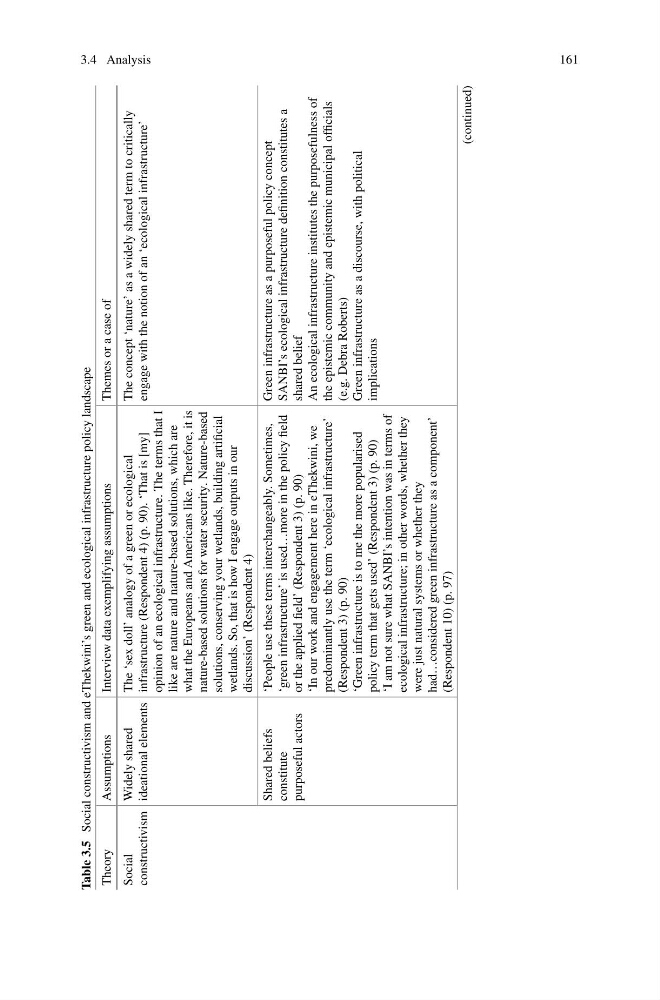
Table 3.5
Social constructivism and eThekwini’s green and ecological infrastructure policy landscape
Theory
Assumptions
Interview data exemplifying assumptions
Themes or a case of
Social
constructivism
Widely shared
ideational elements
The ‘sex doll’ analogy of a green or ecological
infrastructure (Respondent 4) (p. 90). ‘That is [my]
opinion of an ecological infrastructure. The terms that I
like are nature and nature-based solutions, which are
what the Europeans and Americans like. Therefore, it is
nature-based solutions for water security. Nature-based
solutions, conserving your wetlands, building artificial
wetlands. So, that is how I engage outputs in our
discussion’ (Respondent 4)
The concept ‘nature’ as a widely shared term to critically
engage with the notion of an ‘ecological infrastructure’
Shared beliefs
constitute
purposeful actors
‘People use these terms interchangeably. Sometimes,
‘green infrastructure’ is used…more in the policy field
or the applied field’ (Respondent 3) (p. 90)
‘In our work and engagement here in eThekwini, we
predominantly use the term ‘ecological infrastructure’
(Respondent 3) (p. 90)
‘Green infrastructure is to me the more popularised
policy term that gets used’ (Respondent 3) (p. 90)
‘I am not sure what SANBI’s intention was in terms of
ecological infrastructure; in other words, whether they
were just natural systems or whether they
had…considered green infrastructure as a component’
(Respondent 10) (p. 97)
Green infrastructure as a purposeful policy concept
SANBI’s ecological infrastructure definition constitutes a
shared belief
An ecological infrastructure institutes the purposefulness of
the epistemic community and epistemic municipal officials
(e.g. Debra Roberts)
Green infrastructure as a discourse, with political
implications
(continued)
161
Table 3.5
Social constructivism and eThekwini’s green and ecological infrastructure policy landscape
Theory
Assumptions
Interview data exemplifying assumptions
Themes or a case of
Social
constructivism
Widely shared
ideational elements
The ‘sex doll’ analogy of a green or ecological
infrastructure (Respondent 4) (p. 90). ‘That is [my]
opinion of an ecological infrastructure. The terms that I
like are nature and nature-based solutions, which are
what the Europeans and Americans like. Therefore, it is
nature-based solutions for water security. Nature-based
solutions, conserving your wetlands, building artificial
wetlands. So, that is how I engage outputs in our
discussion’ (Respondent 4)
The concept ‘nature’ as a widely shared term to critically
engage with the notion of an ‘ecological infrastructure’
Shared beliefs
constitute
purposeful actors
‘People use these terms interchangeably. Sometimes,
‘green infrastructure’ is used…more in the policy field
or the applied field’ (Respondent 3) (p. 90)
‘In our work and engagement here in eThekwini, we
predominantly use the term ‘ecological infrastructure’
(Respondent 3) (p. 90)
‘Green infrastructure is to me the more popularised
policy term that gets used’ (Respondent 3) (p. 90)
‘I am not sure what SANBI’s intention was in terms of
ecological infrastructure; in other words, whether they
were just natural systems or whether they
had…considered green infrastructure as a component’
(Respondent 10) (p. 97)
Green infrastructure as a purposeful policy concept
SANBI’s ecological infrastructure definition constitutes a
shared belief
An ecological infrastructure institutes the purposefulness of
the epistemic community and epistemic municipal officials
(e.g. Debra Roberts)
Green infrastructure as a discourse, with political
implications
(continued)