

3.4 Analysis
141
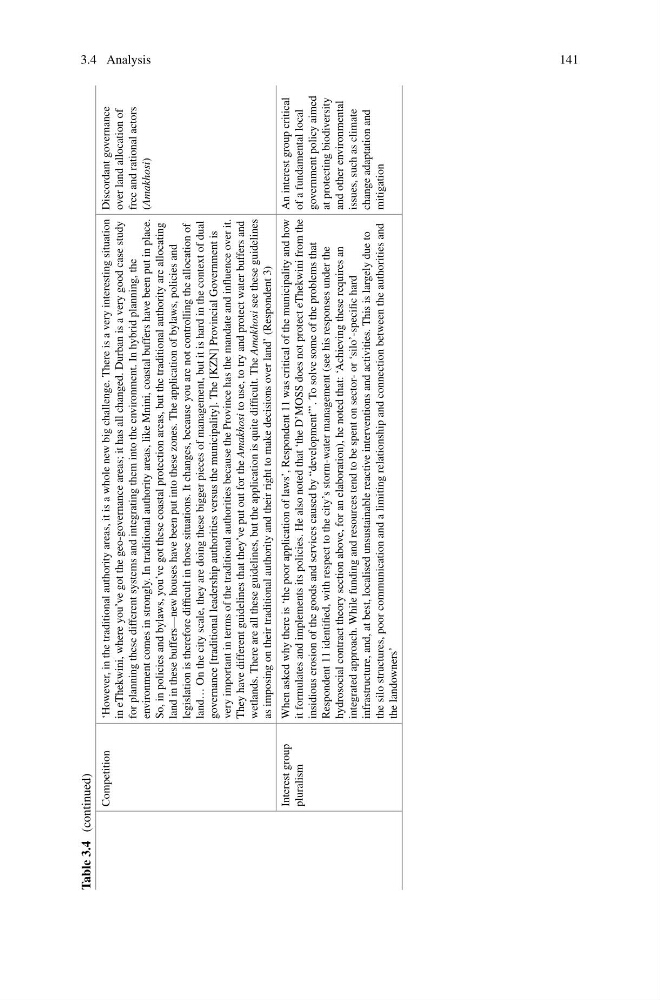
Table 3.4
(continued)
Competition
‘However, in the traditional authority areas, it is a whole new big challenge. There is a very interesting situation
in eThekwini, where you’ve got the geo-governance areas; it has all changed. Durban is a very good case study
for planning these different systems and integrating them into the environment. In hybrid planning, the
environment comes in strongly. In traditional authority areas, like Mnini, coastal buffers have been put in place.
So, in policies and bylaws, you’ve got these coastal protection areas, but the traditional authority are allocating
land in these buffers—new houses have been put into these zones. The application of bylaws, policies and
legislation is therefore difficult in those situations. It changes, because you are not controlling the allocation of
land… On the city scale, they are doing these bigger pieces of management, but it is hard in the context of dual
governance [traditional leadership authorities versus the municipality]. The [KZN] Provincial Government is
very important in terms of the traditional authorities because the Province has the mandate and influence over it.
They have different guidelines that they’ve put out for the Amakhosi
to use, to try and protect water buffers and
wetlands. There are all these guidelines, but the application is quite difficult. The Amakhosi
see these guidelines
as imposing on their traditional authority and their right to make decisions over land’ (Respondent 3)
Discordant governance
over land allocation of
free and rational actors
(Amakhosi)
Interest group
pluralism
When asked why there is ‘the poor application of laws’, Respondent 11 was critical of the municipality and how
it formulates and implements its policies. He also noted that ‘the D’MOSS does not protect eThekwini from the
insidious erosion of the goods and services caused by “development”’. To solve some of the problems that
Respondent 11 identified, with respect to the city’s storm-water management (see his responses under the
hydrosocial contract theory section above, for an elaboration), he noted that: ‘Achieving these requires an
integrated approach. While funding and resources tend to be spent on sector- or ‘silo’-specific hard
infrastructure, and, at best, localised unsustainable reactive interventions and activities. This is largely due to
the silo structures, poor communication and a limiting relationship and connection between the authorities and
the landowners’
An interest group critical
of a fundamental local
government policy aimed
at protecting biodiversity
and other environmental
issues, such as climate
change adaptation and
mitigation
141
Table 3.4
(continued)
Competition
‘However, in the traditional authority areas, it is a whole new big challenge. There is a very interesting situation
in eThekwini, where you’ve got the geo-governance areas; it has all changed. Durban is a very good case study
for planning these different systems and integrating them into the environment. In hybrid planning, the
environment comes in strongly. In traditional authority areas, like Mnini, coastal buffers have been put in place.
So, in policies and bylaws, you’ve got these coastal protection areas, but the traditional authority are allocating
land in these buffers—new houses have been put into these zones. The application of bylaws, policies and
legislation is therefore difficult in those situations. It changes, because you are not controlling the allocation of
land… On the city scale, they are doing these bigger pieces of management, but it is hard in the context of dual
governance [traditional leadership authorities versus the municipality]. The [KZN] Provincial Government is
very important in terms of the traditional authorities because the Province has the mandate and influence over it.
They have different guidelines that they’ve put out for the Amakhosi
to use, to try and protect water buffers and
wetlands. There are all these guidelines, but the application is quite difficult. The Amakhosi
see these guidelines
as imposing on their traditional authority and their right to make decisions over land’ (Respondent 3)
Discordant governance
over land allocation of
free and rational actors
(Amakhosi)
Interest group
pluralism
When asked why there is ‘the poor application of laws’, Respondent 11 was critical of the municipality and how
it formulates and implements its policies. He also noted that ‘the D’MOSS does not protect eThekwini from the
insidious erosion of the goods and services caused by “development”’. To solve some of the problems that
Respondent 11 identified, with respect to the city’s storm-water management (see his responses under the
hydrosocial contract theory section above, for an elaboration), he noted that: ‘Achieving these requires an
integrated approach. While funding and resources tend to be spent on sector- or ‘silo’-specific hard
infrastructure, and, at best, localised unsustainable reactive interventions and activities. This is largely due to
the silo structures, poor communication and a limiting relationship and connection between the authorities and
the landowners’
An interest group critical
of a fundamental local
government policy aimed
at protecting biodiversity
and other environmental
issues, such as climate
change adaptation and
mitigation