

140
3 eThekwini’s Green and Ecological Infrastructure Policy Landscape
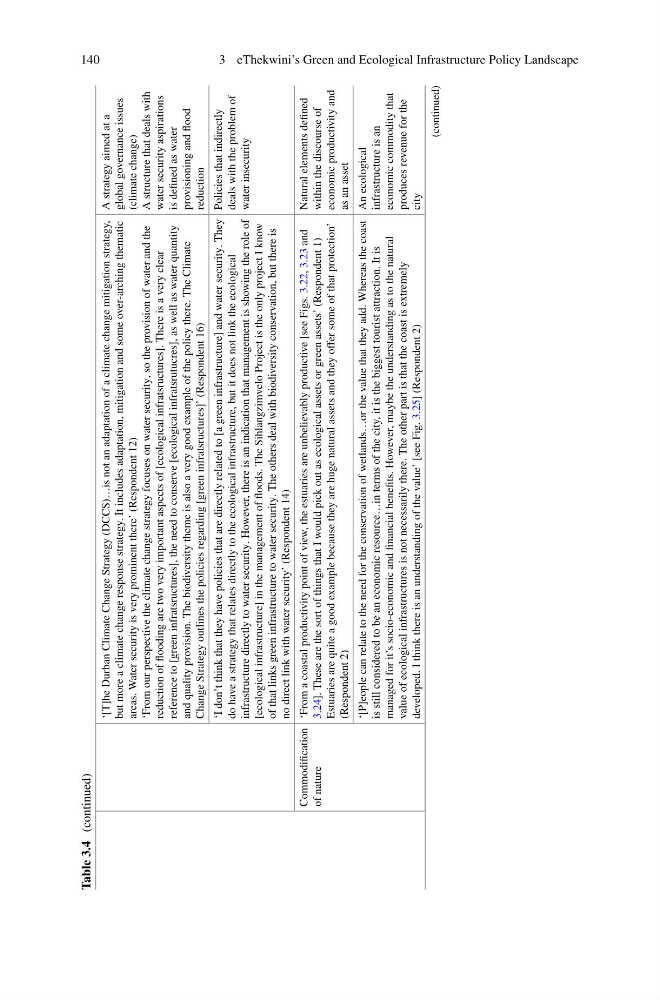
Table 3.4
(continued)
‘[T]he Durban Climate Change Strategy (DCCS)…is not an adaptation of a climate change mitigation strategy,
but more a climate change response strategy. It includes adaptation, mitigation and some over-arching thematic
areas. Water security is very prominent there’ (Respondent 12)
‘From our perspective the climate change strategy focuses on water security, so the provision of water and the
reduction of flooding are two very important aspects of [ecological infratsructures]. There is a very clear
reference to [green infratsructures], the need to conserve [ecological infratsrutucres], as well as water quantity
and quality provision. The biodiversity theme is also a very good example of the policy there. The Climate
Change Strategy outlines the policies regarding [green infratsructures]’ (Respondent 16)
A strategy aimed at a
global governance issues
(climate change)
A structure that deals with
water security aspirations
is defined as water
provisioning and flood
reduction
‘I don’t think that they have policies that are directly related to [a green infrastructure] and water security. They
do have a strategy that relates directly to the ecological infrastructure, but it does not link the ecological
infrastructure directly to water security. However, there is an indication that management is showing the role of
[ecological infrastructure] in the management of floods. The Sihlangzimvelo Project is the only project I know
of that links green infrastructure to water security. The others deal with biodiversity conservation, but there is
no direct link with water security’ (Respondent 14)
Policies that indirectly
deals with the problem of
water insecurity
Commodification
of nature
‘From a coastal productivity point of view, the estuaries are unbelievably productive [see Figs. 3.22, 3.23 and
3.24]. These are the sort of things that I would pick out as ecological assets or green assets’ (Respondent 1)
Estuaries are quite a good example because they are huge natural assets and they offer some of that protection’
(Respondent 2)
Natural elements defined
within the discourse of
economic productivity and
as an asset
‘[P]eople can relate to the need for the conservation of wetlands…or the value that they add. Whereas the coast
is still considered to be an economic resource…in terms of the city, it is the biggest tourist attraction. It is
managed for it’s socio-economic and financial benefits. However, maybe the understanding as to the natural
value of ecological infrastructures is not necessarily there. The other part is that the coast is extremely
developed. I think there is an understanding of the value’ [see Fig. 3.25] (Respondent 2)
An ecological
infrastructure is an
economic commodity that
produces revenue for the
city
(continued)
3 eThekwini’s Green and Ecological Infrastructure Policy Landscape
Table 3.4
(continued)
‘[T]he Durban Climate Change Strategy (DCCS)…is not an adaptation of a climate change mitigation strategy,
but more a climate change response strategy. It includes adaptation, mitigation and some over-arching thematic
areas. Water security is very prominent there’ (Respondent 12)
‘From our perspective the climate change strategy focuses on water security, so the provision of water and the
reduction of flooding are two very important aspects of [ecological infratsructures]. There is a very clear
reference to [green infratsructures], the need to conserve [ecological infratsrutucres], as well as water quantity
and quality provision. The biodiversity theme is also a very good example of the policy there. The Climate
Change Strategy outlines the policies regarding [green infratsructures]’ (Respondent 16)
A strategy aimed at a
global governance issues
(climate change)
A structure that deals with
water security aspirations
is defined as water
provisioning and flood
reduction
‘I don’t think that they have policies that are directly related to [a green infrastructure] and water security. They
do have a strategy that relates directly to the ecological infrastructure, but it does not link the ecological
infrastructure directly to water security. However, there is an indication that management is showing the role of
[ecological infrastructure] in the management of floods. The Sihlangzimvelo Project is the only project I know
of that links green infrastructure to water security. The others deal with biodiversity conservation, but there is
no direct link with water security’ (Respondent 14)
Policies that indirectly
deals with the problem of
water insecurity
Commodification
of nature
‘From a coastal productivity point of view, the estuaries are unbelievably productive [see Figs. 3.22, 3.23 and
3.24]. These are the sort of things that I would pick out as ecological assets or green assets’ (Respondent 1)
Estuaries are quite a good example because they are huge natural assets and they offer some of that protection’
(Respondent 2)
Natural elements defined
within the discourse of
economic productivity and
as an asset
‘[P]eople can relate to the need for the conservation of wetlands…or the value that they add. Whereas the coast
is still considered to be an economic resource…in terms of the city, it is the biggest tourist attraction. It is
managed for it’s socio-economic and financial benefits. However, maybe the understanding as to the natural
value of ecological infrastructures is not necessarily there. The other part is that the coast is extremely
developed. I think there is an understanding of the value’ [see Fig. 3.25] (Respondent 2)
An ecological
infrastructure is an
economic commodity that
produces revenue for the
city
(continued)