

138
3 eThekwini’s Green and Ecological Infrastructure Policy Landscape
Table 3.4
(continued)
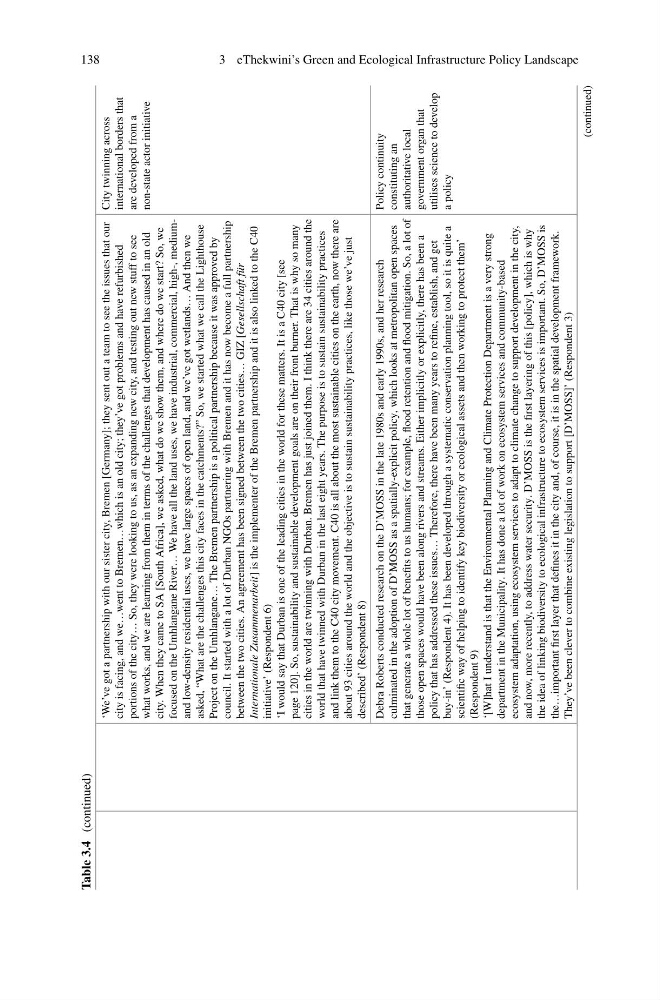
‘We’ve got a partnership with our sister city, Bremen [Germany]; they sent out a team to see the issues that our
city is facing, and we…went to Bremen…which is an old city; they’ve got problems and have refurbished
portions of the city… So, they were looking to us, as an expanding new city, and testing out new stuff to see
what works, and we are learning from them in terms of the challenges that development has caused in an old
city. When they came to SA [South Africa], we asked, what do we show them, and where do we start? So, we
focused on the Umhlangane River… We have all the land uses, we have industrial, commercial, high-, mediumand low-density residential uses, we have large spaces of open land, and we’ve got wetlands… And then we
asked, “What are the challenges this city faces in the catchments?” So, we started what we call the Lighthouse
Project on the Umhlangane… The Bremen partnership is a political partnership because it was approved by
council. It started with a lot of Durban NGOs partnering with Bremen and it has now become a full partnership
between the two cities. An agreement has been signed between the two cities… GIZ [Gesellschaft für
Internationale Zusammenarbeit]
is the implementer of the Bremen partnership and it is also linked to the C40
initiative’ (Respondent 6)
‘I would say that Durban is one of the leading cities in the world for these matters. It is a C40 city [see
page 120]. So, sustainability and sustainable development goals are on their front burner. That is why so many
cities in the world are twinning with Durban. Bremen has just joined them. I think there are 34 cities around the
world that have twinned with Durban in the last eight years. The purpose is to sustain sustainability practices
and link them to the C40 city movement. C40 is all about the most sustainable cities on the earth, now there are
about 93 cities around the world and the objective is to sustain sustainability practices, like those we’ve just
described’ (Respondent 8)
City twinning across
international borders that
are developed from a
non-state actor initiative
Debra Roberts conducted research on the D’MOSS in the late 1980s and early 1990s, and her research
culminated in the adoption of D’MOSS as a spatially-explicit policy, which looks at metropolitan open spaces
that generate a whole lot of benefits to us humans; for example, flood retention and flood mitigation. So, a lot of
those open spaces would have been along rivers and streams. Either implicitly or explicitly, there has been a
policy that has addressed these issues… Therefore, there have been many years to refine, establish, and get
buy-in’ (Respondent 4). It has been developed through a systematic conservation planning tool, so it is quite a
scientific way of helping to identify key biodiversity or ecological assets and then working to protect them’
(Respondent 9)
‘[W]hat I understand is that the Environmental Planning and Climate Protection Department is a very strong
department in the Municipality. It has done a lot of work on ecosystem services and community-based
ecosystem adaptation, using ecosystem services to adapt to climate change to support development in the city,
and now, more recently, to address water security. D’MOSS is the first layering of this [policy], which is why
the idea of linking biodiversity to ecological infrastructure to ecosystem services is important. So, D’MOSS is
the…important first layer that defines it in the city and, of course, it is in the spatial development framework.
They’ve been clever to combine existing legislation to support [D’MOSS]’ (Respondent 3)
Policy continuity
constituting an
authoritative local
government organ that
utilises science to develop
a policy
(continued)
3 eThekwini’s Green and Ecological Infrastructure Policy Landscape
Table 3.4
(continued)
‘We’ve got a partnership with our sister city, Bremen [Germany]; they sent out a team to see the issues that our
city is facing, and we…went to Bremen…which is an old city; they’ve got problems and have refurbished
portions of the city… So, they were looking to us, as an expanding new city, and testing out new stuff to see
what works, and we are learning from them in terms of the challenges that development has caused in an old
city. When they came to SA [South Africa], we asked, what do we show them, and where do we start? So, we
focused on the Umhlangane River… We have all the land uses, we have industrial, commercial, high-, mediumand low-density residential uses, we have large spaces of open land, and we’ve got wetlands… And then we
asked, “What are the challenges this city faces in the catchments?” So, we started what we call the Lighthouse
Project on the Umhlangane… The Bremen partnership is a political partnership because it was approved by
council. It started with a lot of Durban NGOs partnering with Bremen and it has now become a full partnership
between the two cities. An agreement has been signed between the two cities… GIZ [Gesellschaft für
Internationale Zusammenarbeit]
is the implementer of the Bremen partnership and it is also linked to the C40
initiative’ (Respondent 6)
‘I would say that Durban is one of the leading cities in the world for these matters. It is a C40 city [see
page 120]. So, sustainability and sustainable development goals are on their front burner. That is why so many
cities in the world are twinning with Durban. Bremen has just joined them. I think there are 34 cities around the
world that have twinned with Durban in the last eight years. The purpose is to sustain sustainability practices
and link them to the C40 city movement. C40 is all about the most sustainable cities on the earth, now there are
about 93 cities around the world and the objective is to sustain sustainability practices, like those we’ve just
described’ (Respondent 8)
City twinning across
international borders that
are developed from a
non-state actor initiative
Debra Roberts conducted research on the D’MOSS in the late 1980s and early 1990s, and her research
culminated in the adoption of D’MOSS as a spatially-explicit policy, which looks at metropolitan open spaces
that generate a whole lot of benefits to us humans; for example, flood retention and flood mitigation. So, a lot of
those open spaces would have been along rivers and streams. Either implicitly or explicitly, there has been a
policy that has addressed these issues… Therefore, there have been many years to refine, establish, and get
buy-in’ (Respondent 4). It has been developed through a systematic conservation planning tool, so it is quite a
scientific way of helping to identify key biodiversity or ecological assets and then working to protect them’
(Respondent 9)
‘[W]hat I understand is that the Environmental Planning and Climate Protection Department is a very strong
department in the Municipality. It has done a lot of work on ecosystem services and community-based
ecosystem adaptation, using ecosystem services to adapt to climate change to support development in the city,
and now, more recently, to address water security. D’MOSS is the first layering of this [policy], which is why
the idea of linking biodiversity to ecological infrastructure to ecosystem services is important. So, D’MOSS is
the…important first layer that defines it in the city and, of course, it is in the spatial development framework.
They’ve been clever to combine existing legislation to support [D’MOSS]’ (Respondent 3)
Policy continuity
constituting an
authoritative local
government organ that
utilises science to develop
a policy
(continued)