

3.4 Analysis
137
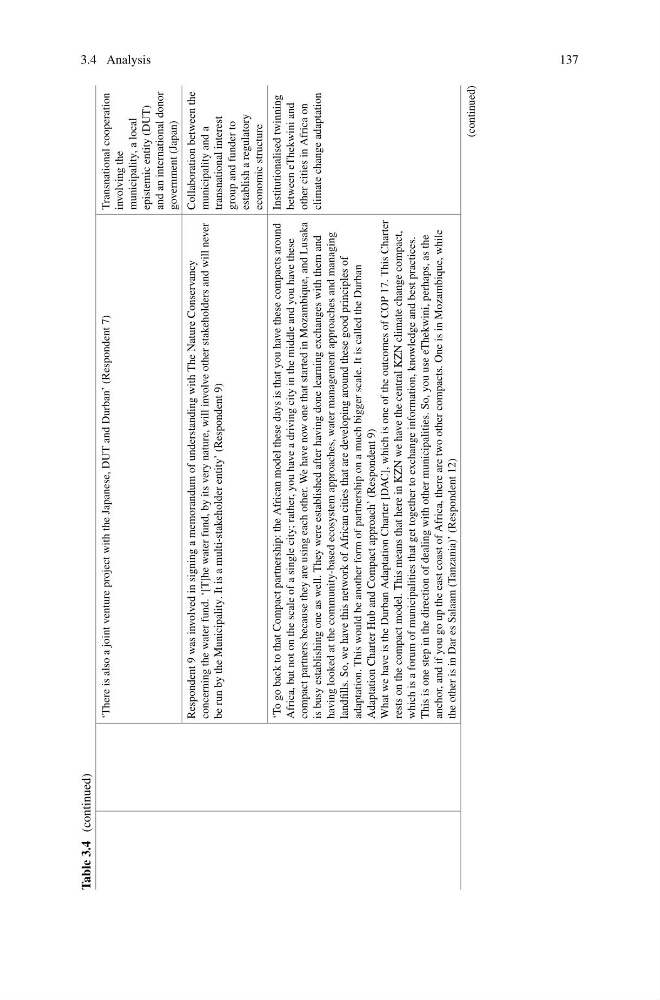
Table 3.4
(continued)
‘There is also a joint venture project with the Japanese, DUT and Durban’ (Respondent 7)
Transnational cooperation
involving the
municipality, a local
epistemic entity (DUT)
and an international donor
government (Japan)
Respondent 9 was involved in signing a memorandum of understanding with The Nature Conservancy
concerning the water fund. ‘[T]he water fund, by its very nature, will involve other stakeholders and will never
be run by the Municipality. It is a multi-stakeholder entity’ (Respondent 9)
Collaboration between the
municipality and a
transnational interest
group and funder to
establish a regulatory
economic structure
‘To go back to that Compact partnership: the African model these days is that you have these compacts around
Africa, but not on the scale of a single city; rather, you have a driving city in the middle and you have these
compact partners because they are using each other. We have now one that started in Mozambique, and Lusaka
is busy establishing one as well. They were established after having done learning exchanges with them and
having looked at the community-based ecosystem approaches, water management approaches and managing
landfills. So, we have this network of African cities that are developing around these good principles of
adaptation. This would be another form of partnership on a much bigger scale. It is called the Durban
Adaptation Charter Hub and Compact approach’ (Respondent 9)
What we have is the Durban Adaptation Charter [DAC], which is one of the outcomes of COP 17. This Charter
rests on the compact model. This means that here in KZN we have the central KZN climate change compact,
which is a forum of municipalities that get together to exchange information, knowledge and best practices.
This is one step in the direction of dealing with other municipalities. So, you use eThekwini, perhaps, as the
anchor, and if you go up the east coast of Africa, there are two other compacts. One is in Mozambique, while
the other is in Dar es Salaam (Tanzania)’ (Respondent 12)
Institutionalised twinning
between eThekwini and
other cities in Africa on
climate change adaptation
(continued)
137
Table 3.4
(continued)
‘There is also a joint venture project with the Japanese, DUT and Durban’ (Respondent 7)
Transnational cooperation
involving the
municipality, a local
epistemic entity (DUT)
and an international donor
government (Japan)
Respondent 9 was involved in signing a memorandum of understanding with The Nature Conservancy
concerning the water fund. ‘[T]he water fund, by its very nature, will involve other stakeholders and will never
be run by the Municipality. It is a multi-stakeholder entity’ (Respondent 9)
Collaboration between the
municipality and a
transnational interest
group and funder to
establish a regulatory
economic structure
‘To go back to that Compact partnership: the African model these days is that you have these compacts around
Africa, but not on the scale of a single city; rather, you have a driving city in the middle and you have these
compact partners because they are using each other. We have now one that started in Mozambique, and Lusaka
is busy establishing one as well. They were established after having done learning exchanges with them and
having looked at the community-based ecosystem approaches, water management approaches and managing
landfills. So, we have this network of African cities that are developing around these good principles of
adaptation. This would be another form of partnership on a much bigger scale. It is called the Durban
Adaptation Charter Hub and Compact approach’ (Respondent 9)
What we have is the Durban Adaptation Charter [DAC], which is one of the outcomes of COP 17. This Charter
rests on the compact model. This means that here in KZN we have the central KZN climate change compact,
which is a forum of municipalities that get together to exchange information, knowledge and best practices.
This is one step in the direction of dealing with other municipalities. So, you use eThekwini, perhaps, as the
anchor, and if you go up the east coast of Africa, there are two other compacts. One is in Mozambique, while
the other is in Dar es Salaam (Tanzania)’ (Respondent 12)
Institutionalised twinning
between eThekwini and
other cities in Africa on
climate change adaptation
(continued)