

3.4 Analysis
101
SANBI, or their past employment. From this interpretation, we can deduce that
there are several empirical and normative elements in their green and ecological
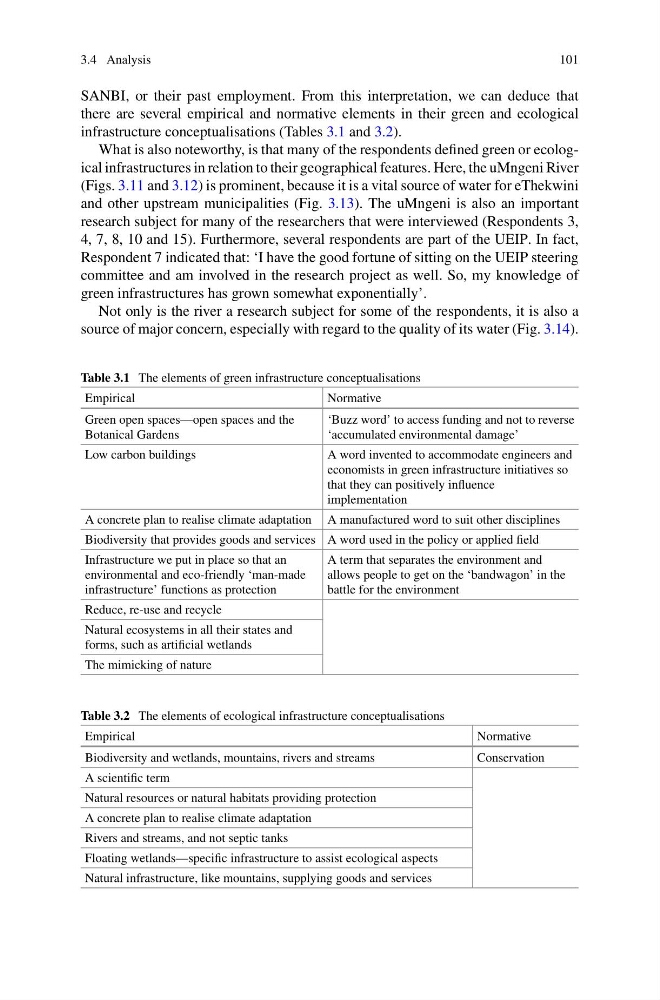
infrastructure conceptualisations (Tables 3.1 and 3.2).
What is also noteworthy, is that many of the respondents defined green or ecological infrastructures in relation to their geographical features. Here, the uMngeni River
(Figs. 3.11 and 3.12) is prominent, because it is a vital source of water for eThekwini
and other upstream municipalities (Fig. 3.13). The uMngeni is also an important
research subject for many of the researchers that were interviewed (Respondents 3,
4, 7, 8, 10 and 15). Furthermore, several respondents are part of the UEIP. In fact,
Respondent 7 indicated that: ‘I have the good fortune of sitting on the UEIP steering
committee and am involved in the research project as well. So, my knowledge of
green infrastructures has grown somewhat exponentially’.
Not only is the river a research subject for some of the respondents, it is also a
source of major concern, especially with regard to the quality of its water (Fig. 3.14).
Table 3.1 The elements of green infrastructure conceptualisations
Empirical
Normative
Green open spaces—open spaces and the
Botanical Gardens
‘Buzz word’ to access funding and not to reverse
‘accumulated environmental damage’
Low carbon buildings
A word invented to accommodate engineers and
economists in green infrastructure initiatives so
that they can positively influence
implementation
A concrete plan to realise climate adaptation A manufactured word to suit other disciplines
Biodiversity that provides goods and services A word used in the policy or applied field
Infrastructure we put in place so that an
environmental and eco-friendly ‘man-made
infrastructure’ functions as protection
A term that separates the environment and
allows people to get on the ‘bandwagon’ in the
battle for the environment
Reduce, re-use and recycle
Natural ecosystems in all their states and
forms, such as artificial wetlands
The mimicking of nature
Table 3.2 The elements of ecological infrastructure conceptualisations
Empirical
Normative
Biodiversity and wetlands, mountains, rivers and streams
Conservation
A scientific term
Natural resources or natural habitats providing protection
A concrete plan to realise climate adaptation
Rivers and streams, and not septic tanks
Floating wetlands—specific infrastructure to assist ecological aspects
Natural infrastructure, like mountains, supplying goods and services
101
SANBI, or their past employment. From this interpretation, we can deduce that
there are several empirical and normative elements in their green and ecological
infrastructure conceptualisations (Tables 3.1 and 3.2).
What is also noteworthy, is that many of the respondents defined green or ecological infrastructures in relation to their geographical features. Here, the uMngeni River
(Figs. 3.11 and 3.12) is prominent, because it is a vital source of water for eThekwini
and other upstream municipalities (Fig. 3.13). The uMngeni is also an important
research subject for many of the researchers that were interviewed (Respondents 3,
4, 7, 8, 10 and 15). Furthermore, several respondents are part of the UEIP. In fact,
Respondent 7 indicated that: ‘I have the good fortune of sitting on the UEIP steering
committee and am involved in the research project as well. So, my knowledge of
green infrastructures has grown somewhat exponentially’.
Not only is the river a research subject for some of the respondents, it is also a
source of major concern, especially with regard to the quality of its water (Fig. 3.14).
Table 3.1 The elements of green infrastructure conceptualisations
Empirical
Normative
Green open spaces—open spaces and the
Botanical Gardens
‘Buzz word’ to access funding and not to reverse
‘accumulated environmental damage’
Low carbon buildings
A word invented to accommodate engineers and
economists in green infrastructure initiatives so
that they can positively influence
implementation
A concrete plan to realise climate adaptation A manufactured word to suit other disciplines
Biodiversity that provides goods and services A word used in the policy or applied field
Infrastructure we put in place so that an
environmental and eco-friendly ‘man-made
infrastructure’ functions as protection
A term that separates the environment and
allows people to get on the ‘bandwagon’ in the
battle for the environment
Reduce, re-use and recycle
Natural ecosystems in all their states and
forms, such as artificial wetlands
The mimicking of nature
Table 3.2 The elements of ecological infrastructure conceptualisations
Empirical
Normative
Biodiversity and wetlands, mountains, rivers and streams
Conservation
A scientific term
Natural resources or natural habitats providing protection
A concrete plan to realise climate adaptation
Rivers and streams, and not septic tanks
Floating wetlands—specific infrastructure to assist ecological aspects
Natural infrastructure, like mountains, supplying goods and services