

as the synthetic ability to combine multiple amphiphilic moieties, are the most
important reasons for their popularity. Lipid-based nanoparticle platforms allow
the inclusion of a variety of imaging agents, ranging from fluorescent molecules to
chelated metals and nanocrystals.
Liposomes are lipid bilayers encapsulating an aqueous core. Due to their ease of
preparation in a size-controlled manner and their biocompatibility, they are widely
used as lipid-based nanoparticles for drug delivery. Incorporation of PEGcontaining lipid reduces opsonization and renders the liposomes long-circulating
in the blood stream. After intravenous administration, long-circulating liposomes
passively accumulate in the tumor tissues due to an enhanced permeation and
retention effect. For active targeting, antibodies, peptides, and small molecules
have been conjugated to the surface of the liposomes. The side effects of anticancer
drugs are considerably reduced by encapsulating them in the liposomes. Numerous
clinical trials are currently in progress using liposome-encapsulated anticancer
drugs. Table 12 shows the efficient preparation methods for functional lyposomes.
Bionanotechnology involves the use of biomolecules to control both the structure
and properties of nanomaterials. One of the most studied examples is DNA-directed
assembly of inorganic nanoparticles such as gold nanoparticles (GNPs). However,
systematic studies on DNA-linked soft nanoparticles, such as liposomes, are still
lacking.
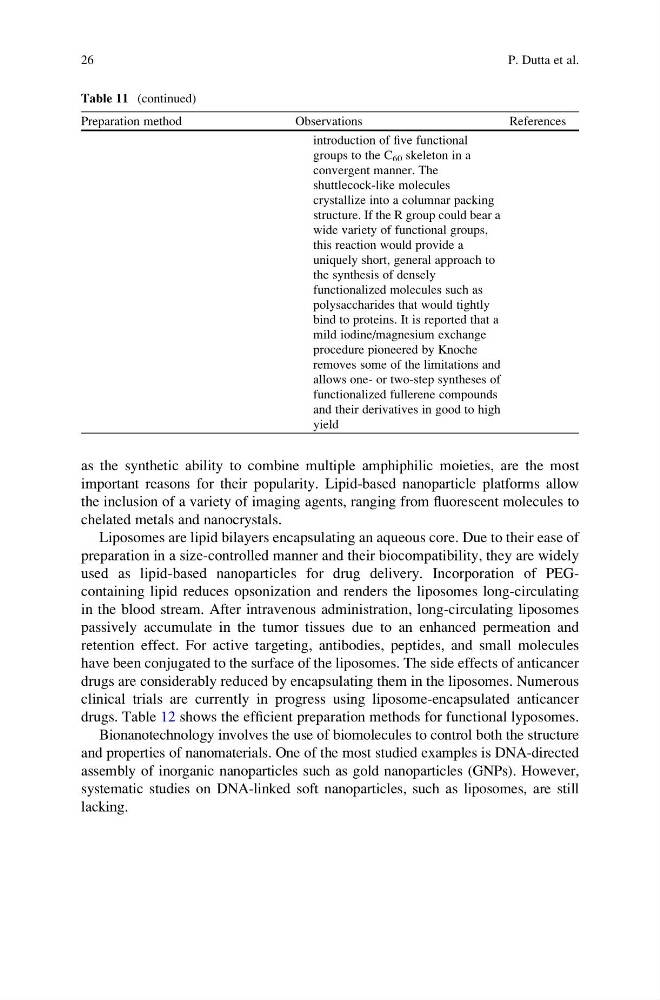
Table 11 (continued)
Preparation method
Observations
References
introduction of five functional
groups to the C 60 skeleton in a
convergent manner. The
shuttlecock-like molecules
crystallize into a columnar packing
structure. If the R group could bear a
wide variety of functional groups,
this reaction would provide a
uniquely short, general approach to
the synthesis of densely
functionalized molecules such as
polysaccharides that would tightly
bind to proteins. It is reported that a
mild iodine/magnesium exchange
procedure pioneered by Knoche
removes some of the limitations and
allows one- or two-step syntheses of
functionalized fullerene compounds
and their derivatives in good to high
yield
26
P. Dutta et al.
important reasons for their popularity. Lipid-based nanoparticle platforms allow
the inclusion of a variety of imaging agents, ranging from fluorescent molecules to
chelated metals and nanocrystals.
Liposomes are lipid bilayers encapsulating an aqueous core. Due to their ease of
preparation in a size-controlled manner and their biocompatibility, they are widely
used as lipid-based nanoparticles for drug delivery. Incorporation of PEGcontaining lipid reduces opsonization and renders the liposomes long-circulating
in the blood stream. After intravenous administration, long-circulating liposomes
passively accumulate in the tumor tissues due to an enhanced permeation and
retention effect. For active targeting, antibodies, peptides, and small molecules
have been conjugated to the surface of the liposomes. The side effects of anticancer
drugs are considerably reduced by encapsulating them in the liposomes. Numerous
clinical trials are currently in progress using liposome-encapsulated anticancer
drugs. Table 12 shows the efficient preparation methods for functional lyposomes.
Bionanotechnology involves the use of biomolecules to control both the structure
and properties of nanomaterials. One of the most studied examples is DNA-directed
assembly of inorganic nanoparticles such as gold nanoparticles (GNPs). However,
systematic studies on DNA-linked soft nanoparticles, such as liposomes, are still
lacking.
Table 11 (continued)
Preparation method
Observations
References
introduction of five functional
groups to the C 60 skeleton in a
convergent manner. The
shuttlecock-like molecules
crystallize into a columnar packing
structure. If the R group could bear a
wide variety of functional groups,
this reaction would provide a
uniquely short, general approach to
the synthesis of densely
functionalized molecules such as
polysaccharides that would tightly
bind to proteins. It is reported that a
mild iodine/magnesium exchange
procedure pioneered by Knoche
removes some of the limitations and
allows one- or two-step syntheses of
functionalized fullerene compounds
and their derivatives in good to high
yield
26
P. Dutta et al.