

diameter were generated. The activity of the polymeric auronafin micelles against
tumor cells was assessed by measuring the proliferation of human ovarian carcinoma cells OVCAR-3. In the studies, it was found that the micelles of 114 showed
better efficiency (IC 50 0.94 μM) than the drug auronafin alone (IC 50 1.51 μM),
which was known to be most the potent form. The high efficiency of the micelles
was thought to be due to the route of entry via endocytosis rather than via diffusion,
as used by the smaller molecule auronafin.
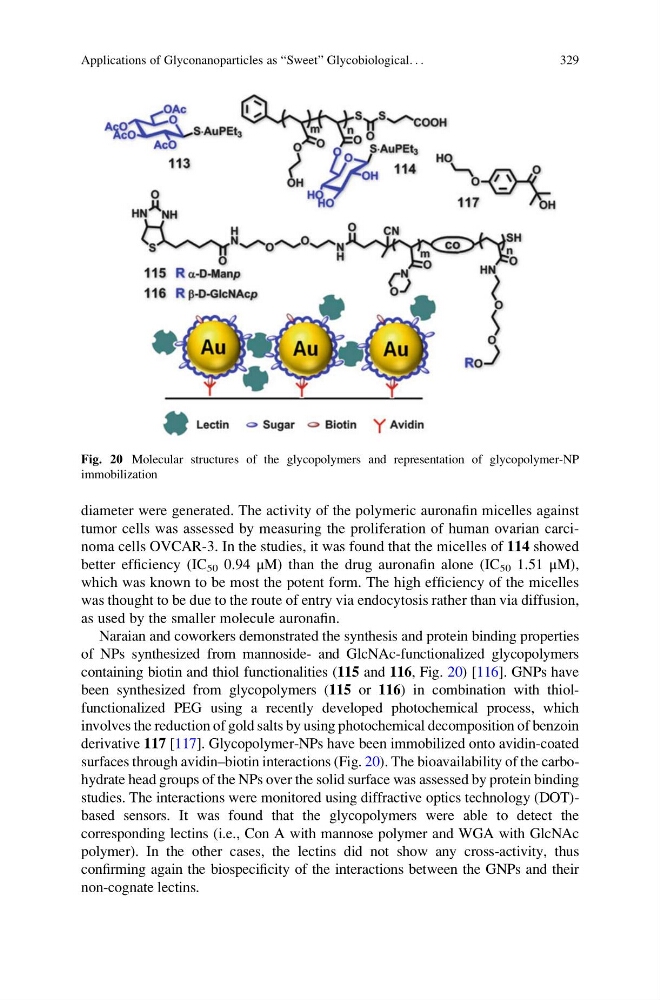
Naraian and coworkers demonstrated the synthesis and protein binding properties
of NPs synthesized from mannoside- and GlcNAc-functionalized glycopolymers
containing biotin and thiol functionalities (115 and 116, Fig. 20) [116]. GNPs have
been synthesized from glycopolymers (115 or 116) in combination with thiolfunctionalized PEG using a recently developed photochemical process, which
involves the reduction of gold salts by using photochemical decomposition of benzoin
derivative 117 [117]. Glycopolymer-NPs have been immobilized onto avidin-coated
surfaces through avidin–biotin interactions (Fig. 20). The bioavailability of the carbohydrate head groups of the NPs over the solid surface was assessed by protein binding
studies. The interactions were monitored using diffractive optics technology (DOT)based sensors. It was found that the glycopolymers were able to detect the
corresponding lectins (i.e., Con A with mannose polymer and WGA with GlcNAc
polymer). In the other cases, the lectins did not show any cross-activity, thus
confirming again the biospecificity of the interactions between the GNPs and their
non-cognate lectins.
Fig. 20 Molecular structures of the glycopolymers and representation of glycopolymer-NP
immobilization
Applications of Glyconanoparticles as “Sweet” Glycobiological. . .
329
tumor cells was assessed by measuring the proliferation of human ovarian carcinoma cells OVCAR-3. In the studies, it was found that the micelles of 114 showed
better efficiency (IC 50 0.94 μM) than the drug auronafin alone (IC 50 1.51 μM),
which was known to be most the potent form. The high efficiency of the micelles
was thought to be due to the route of entry via endocytosis rather than via diffusion,
as used by the smaller molecule auronafin.
Naraian and coworkers demonstrated the synthesis and protein binding properties
of NPs synthesized from mannoside- and GlcNAc-functionalized glycopolymers
containing biotin and thiol functionalities (115 and 116, Fig. 20) [116]. GNPs have
been synthesized from glycopolymers (115 or 116) in combination with thiolfunctionalized PEG using a recently developed photochemical process, which
involves the reduction of gold salts by using photochemical decomposition of benzoin
derivative 117 [117]. Glycopolymer-NPs have been immobilized onto avidin-coated
surfaces through avidin–biotin interactions (Fig. 20). The bioavailability of the carbohydrate head groups of the NPs over the solid surface was assessed by protein binding
studies. The interactions were monitored using diffractive optics technology (DOT)based sensors. It was found that the glycopolymers were able to detect the
corresponding lectins (i.e., Con A with mannose polymer and WGA with GlcNAc
polymer). In the other cases, the lectins did not show any cross-activity, thus
confirming again the biospecificity of the interactions between the GNPs and their
non-cognate lectins.
Fig. 20 Molecular structures of the glycopolymers and representation of glycopolymer-NP
immobilization
Applications of Glyconanoparticles as “Sweet” Glycobiological. . .
329