

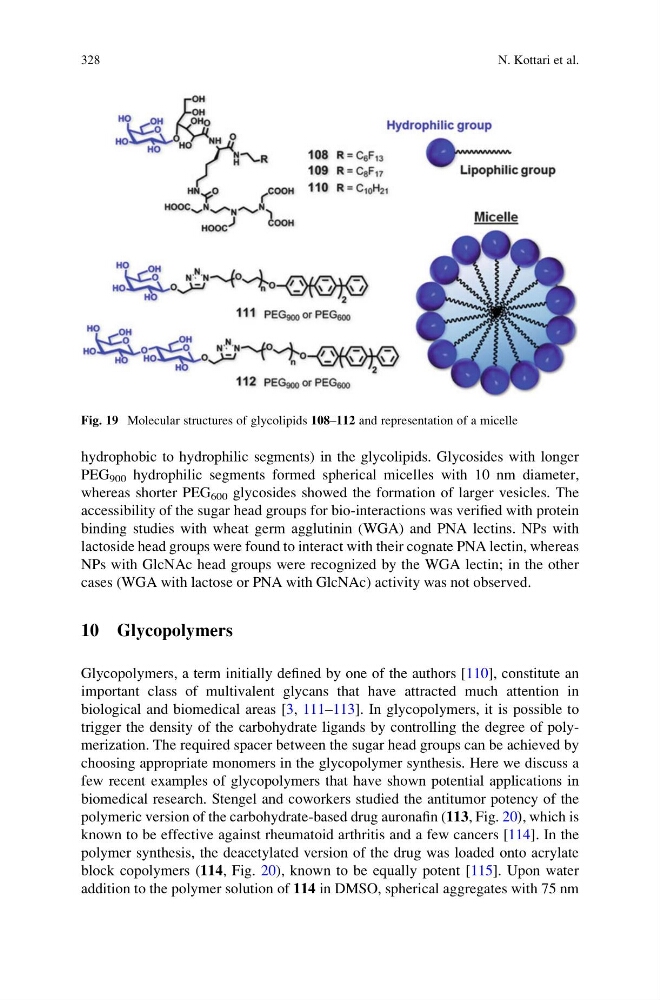
hydrophobic to hydrophilic segments) in the glycolipids. Glycosides with longer
PEG 900 hydrophilic segments formed spherical micelles with 10 nm diameter,
whereas shorter PEG 600 glycosides showed the formation of larger vesicles. The
accessibility of the sugar head groups for bio-interactions was verified with protein
binding studies with wheat germ agglutinin (WGA) and PNA lectins. NPs with
lactoside head groups were found to interact with their cognate PNA lectin, whereas
NPs with GlcNAc head groups were recognized by the WGA lectin; in the other
cases (WGA with lactose or PNA with GlcNAc) activity was not observed.
10 Glycopolymers
Glycopolymers, a term initially defined by one of the authors [110], constitute an
important class of multivalent glycans that have attracted much attention in
biological and biomedical areas [3, 111–113]. In glycopolymers, it is possible to
trigger the density of the carbohydrate ligands by controlling the degree of polymerization. The required spacer between the sugar head groups can be achieved by
choosing appropriate monomers in the glycopolymer synthesis. Here we discuss a
few recent examples of glycopolymers that have shown potential applications in
biomedical research. Stengel and coworkers studied the antitumor potency of the
polymeric version of the carbohydrate-based drug auronafin (113, Fig. 20), which is
known to be effective against rheumatoid arthritis and a few cancers [114]. In the
polymer synthesis, the deacetylated version of the drug was loaded onto acrylate
block copolymers (114, Fig. 20), known to be equally potent [115]. Upon water
addition to the polymer solution of 114 in DMSO, spherical aggregates with 75 nm
Fig. 19 Molecular structures of glycolipids 108–112 and representation of a micelle
328
N. Kottari et al.
PEG 900 hydrophilic segments formed spherical micelles with 10 nm diameter,
whereas shorter PEG 600 glycosides showed the formation of larger vesicles. The
accessibility of the sugar head groups for bio-interactions was verified with protein
binding studies with wheat germ agglutinin (WGA) and PNA lectins. NPs with
lactoside head groups were found to interact with their cognate PNA lectin, whereas
NPs with GlcNAc head groups were recognized by the WGA lectin; in the other
cases (WGA with lactose or PNA with GlcNAc) activity was not observed.
10 Glycopolymers
Glycopolymers, a term initially defined by one of the authors [110], constitute an
important class of multivalent glycans that have attracted much attention in
biological and biomedical areas [3, 111–113]. In glycopolymers, it is possible to
trigger the density of the carbohydrate ligands by controlling the degree of polymerization. The required spacer between the sugar head groups can be achieved by
choosing appropriate monomers in the glycopolymer synthesis. Here we discuss a
few recent examples of glycopolymers that have shown potential applications in
biomedical research. Stengel and coworkers studied the antitumor potency of the
polymeric version of the carbohydrate-based drug auronafin (113, Fig. 20), which is
known to be effective against rheumatoid arthritis and a few cancers [114]. In the
polymer synthesis, the deacetylated version of the drug was loaded onto acrylate
block copolymers (114, Fig. 20), known to be equally potent [115]. Upon water
addition to the polymer solution of 114 in DMSO, spherical aggregates with 75 nm
Fig. 19 Molecular structures of glycolipids 108–112 and representation of a micelle
328
N. Kottari et al.