

for the detection of CT. Upon binding with CT, due to the multiple binding events
between the CT lectin and the gold GNPs, the monodispersed GNPs formed
aggregates, which resulted in visible color changes from red to deep purple. Upon
aggregation, the UV–vis absorption spectra were shifted from 524 to 620 nm and
the amount of bound protein could be quantified by measuring the absorbance at
620 nm. To mimic the biological samples, the efficiency of the assay was also
assessed in the presence of other ions present in the human stool samples. The
developed assay was found to be robust and the added ions had no effect on the
aggregation of NPs upon binding to CT lectin. Using the colorimetric assay, it was
possible to detect and quantify the very low concentration (110 nM) of the CT lectin
within 10 min. The stability of the NPs was assessed with the freeze-drying process,
which did not have any effect on the CT detection abilities of gold GNPs.
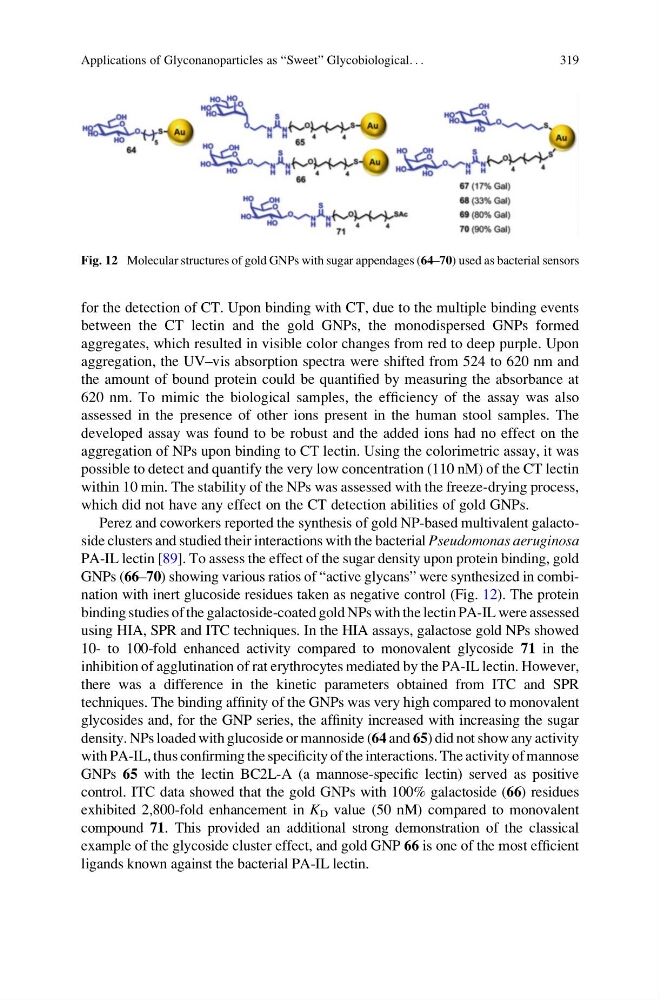
Perez and coworkers reported the synthesis of gold NP-based multivalent galactoside clusters and studied their interactions with the bacterial Pseudomonas aeruginosa
PA-IL lectin [89]. To assess the effect of the sugar density upon protein binding, gold
GNPs (66–70) showing various ratios of “active glycans” were synthesized in combination with inert glucoside residues taken as negative control (Fig. 12). The protein
binding studies of the galactoside-coated gold NPs with the lectin PA-IL were assessed
using HIA, SPR and ITC techniques. In the HIA assays, galactose gold NPs showed
10- to 100-fold enhanced activity compared to monovalent glycoside 71 in the
inhibition of agglutination of rat erythrocytes mediated by the PA-IL lectin. However,
there was a difference in the kinetic parameters obtained from ITC and SPR
techniques. The binding affinity of the GNPs was very high compared to monovalent
glycosides and, for the GNP series, the affinity increased with increasing the sugar
density. NPs loaded with glucoside or mannoside (64 and 65) did not show any activity
with PA-IL, thus confirming the specificity of the interactions. The activity of mannose
GNPs 65 with the lectin BC2L-A (a mannose-specific lectin) served as positive
control. ITC data showed that the gold GNPs with 100% galactoside (66) residues
exhibited 2,800-fold enhancement in K D value (50 nM) compared to monovalent
compound 71. This provided an additional strong demonstration of the classical
example of the glycoside cluster effect, and gold GNP 66 is one of the most efficient
ligands known against the bacterial PA-IL lectin.
Fig. 12 Molecular structures of gold GNPs with sugar appendages (64–70) used as bacterial sensors
Applications of Glyconanoparticles as “Sweet” Glycobiological. . .
319
between the CT lectin and the gold GNPs, the monodispersed GNPs formed
aggregates, which resulted in visible color changes from red to deep purple. Upon
aggregation, the UV–vis absorption spectra were shifted from 524 to 620 nm and
the amount of bound protein could be quantified by measuring the absorbance at
620 nm. To mimic the biological samples, the efficiency of the assay was also
assessed in the presence of other ions present in the human stool samples. The
developed assay was found to be robust and the added ions had no effect on the
aggregation of NPs upon binding to CT lectin. Using the colorimetric assay, it was
possible to detect and quantify the very low concentration (110 nM) of the CT lectin
within 10 min. The stability of the NPs was assessed with the freeze-drying process,
which did not have any effect on the CT detection abilities of gold GNPs.
Perez and coworkers reported the synthesis of gold NP-based multivalent galactoside clusters and studied their interactions with the bacterial Pseudomonas aeruginosa
PA-IL lectin [89]. To assess the effect of the sugar density upon protein binding, gold
GNPs (66–70) showing various ratios of “active glycans” were synthesized in combination with inert glucoside residues taken as negative control (Fig. 12). The protein
binding studies of the galactoside-coated gold NPs with the lectin PA-IL were assessed
using HIA, SPR and ITC techniques. In the HIA assays, galactose gold NPs showed
10- to 100-fold enhanced activity compared to monovalent glycoside 71 in the
inhibition of agglutination of rat erythrocytes mediated by the PA-IL lectin. However,
there was a difference in the kinetic parameters obtained from ITC and SPR
techniques. The binding affinity of the GNPs was very high compared to monovalent
glycosides and, for the GNP series, the affinity increased with increasing the sugar
density. NPs loaded with glucoside or mannoside (64 and 65) did not show any activity
with PA-IL, thus confirming the specificity of the interactions. The activity of mannose
GNPs 65 with the lectin BC2L-A (a mannose-specific lectin) served as positive
control. ITC data showed that the gold GNPs with 100% galactoside (66) residues
exhibited 2,800-fold enhancement in K D value (50 nM) compared to monovalent
compound 71. This provided an additional strong demonstration of the classical
example of the glycoside cluster effect, and gold GNP 66 is one of the most efficient
ligands known against the bacterial PA-IL lectin.
Fig. 12 Molecular structures of gold GNPs with sugar appendages (64–70) used as bacterial sensors
Applications of Glyconanoparticles as “Sweet” Glycobiological. . .
319