

Paramagnetic gold NPs functionalized with sugar conjugates and Gd complexes
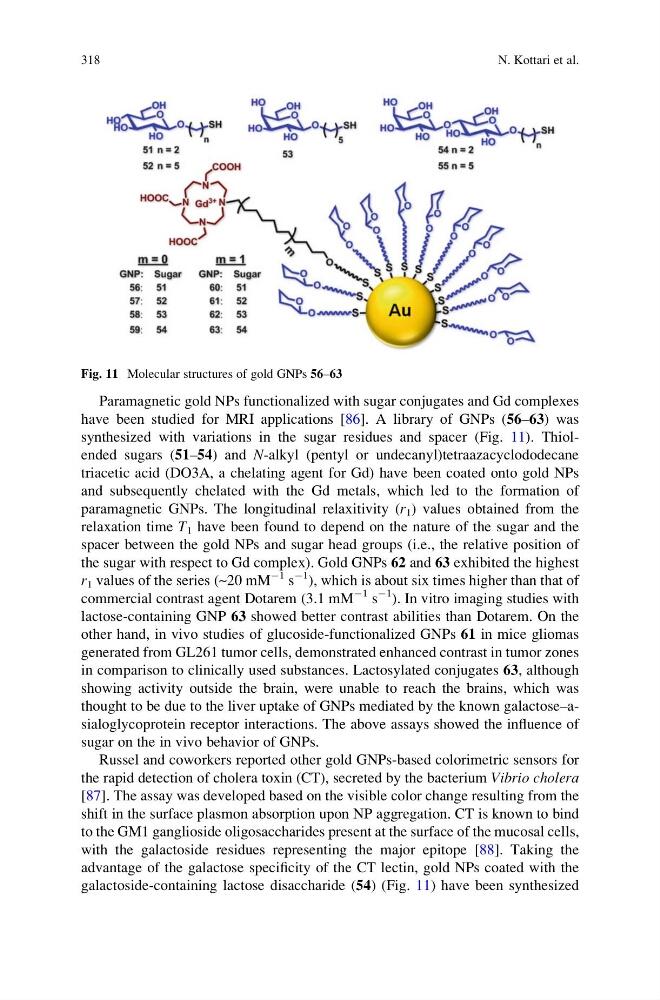
have been studied for MRI applications [86]. A library of GNPs (56–63) was
synthesized with variations in the sugar residues and spacer (Fig. 11). Thiolended sugars (51–54) and N-alkyl (pentyl or undecanyl)tetraazacyclododecane
triacetic acid (DO3A, a chelating agent for Gd) have been coated onto gold NPs
and subsequently chelated with the Gd metals, which led to the formation of
paramagnetic GNPs. The longitudinal relaxitivity (r 1 ) values obtained from the
relaxation time T 1 have been found to depend on the nature of the sugar and the
spacer between the gold NPs and sugar head groups (i.e., the relative position of
the sugar with respect to Gd complex). Gold GNPs 62 and 63 exhibited the highest
r 1 values of the series (~20 mM
À1 s
À1 ), which is about six times higher than that of
commercial contrast agent Dotarem (3.1 mM
À1 s
À1
). In vitro imaging studies with
lactose-containing GNP 63 showed better contrast abilities than Dotarem. On the
other hand, in vivo studies of glucoside-functionalized GNPs 61 in mice gliomas
generated from GL261 tumor cells, demonstrated enhanced contrast in tumor zones
in comparison to clinically used substances. Lactosylated conjugates 63, although
showing activity outside the brain, were unable to reach the brains, which was
thought to be due to the liver uptake of GNPs mediated by the known galactose–asialoglycoprotein receptor interactions. The above assays showed the influence of
sugar on the in vivo behavior of GNPs.
Russel and coworkers reported other gold GNPs-based colorimetric sensors for
the rapid detection of cholera toxin (CT), secreted by the bacterium Vibrio cholera
[87]. The assay was developed based on the visible color change resulting from the
shift in the surface plasmon absorption upon NP aggregation. CT is known to bind
to the GM1 ganglioside oligosaccharides present at the surface of the mucosal cells,
with the galactoside residues representing the major epitope [88]. Taking the
advantage of the galactose specificity of the CT lectin, gold NPs coated with the
galactoside-containing lactose disaccharide (54) (Fig. 11) have been synthesized
Fig. 11 Molecular structures of gold GNPs 56–63
318
N. Kottari et al.
have been studied for MRI applications [86]. A library of GNPs (56–63) was
synthesized with variations in the sugar residues and spacer (Fig. 11). Thiolended sugars (51–54) and N-alkyl (pentyl or undecanyl)tetraazacyclododecane
triacetic acid (DO3A, a chelating agent for Gd) have been coated onto gold NPs
and subsequently chelated with the Gd metals, which led to the formation of
paramagnetic GNPs. The longitudinal relaxitivity (r 1 ) values obtained from the
relaxation time T 1 have been found to depend on the nature of the sugar and the
spacer between the gold NPs and sugar head groups (i.e., the relative position of
the sugar with respect to Gd complex). Gold GNPs 62 and 63 exhibited the highest
r 1 values of the series (~20 mM
À1 s
À1 ), which is about six times higher than that of
commercial contrast agent Dotarem (3.1 mM
À1 s
À1
). In vitro imaging studies with
lactose-containing GNP 63 showed better contrast abilities than Dotarem. On the
other hand, in vivo studies of glucoside-functionalized GNPs 61 in mice gliomas
generated from GL261 tumor cells, demonstrated enhanced contrast in tumor zones
in comparison to clinically used substances. Lactosylated conjugates 63, although
showing activity outside the brain, were unable to reach the brains, which was
thought to be due to the liver uptake of GNPs mediated by the known galactose–asialoglycoprotein receptor interactions. The above assays showed the influence of
sugar on the in vivo behavior of GNPs.
Russel and coworkers reported other gold GNPs-based colorimetric sensors for
the rapid detection of cholera toxin (CT), secreted by the bacterium Vibrio cholera
[87]. The assay was developed based on the visible color change resulting from the
shift in the surface plasmon absorption upon NP aggregation. CT is known to bind
to the GM1 ganglioside oligosaccharides present at the surface of the mucosal cells,
with the galactoside residues representing the major epitope [88]. Taking the
advantage of the galactose specificity of the CT lectin, gold NPs coated with the
galactoside-containing lactose disaccharide (54) (Fig. 11) have been synthesized
Fig. 11 Molecular structures of gold GNPs 56–63
318
N. Kottari et al.