

glyconanoparticle-based chemotherapeutic drug delivery agents will also be
addressed, together with their molecular imaging properties for magnetic resonance
imaging (MRI) or as X-ray contrast agents, as platforms for selective immunolabeling
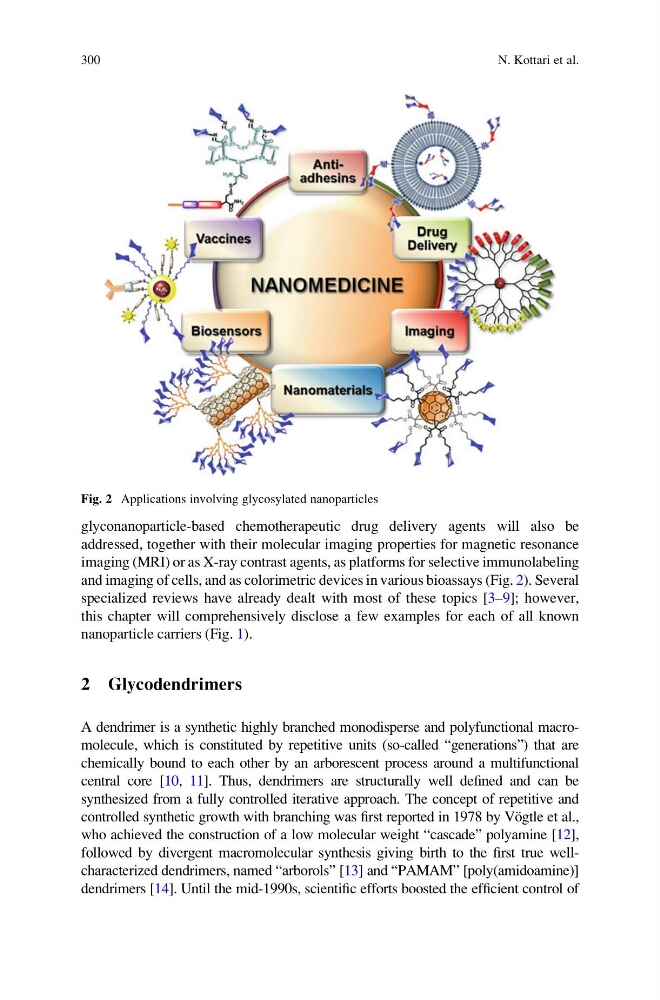
and imaging of cells, and as colorimetric devices in various bioassays (Fig. 2). Several
specialized reviews have already dealt with most of these topics [3–9]; however,
this chapter will comprehensively disclose a few examples for each of all known
nanoparticle carriers (Fig. 1).
2 Glycodendrimers
A dendrimer is a synthetic highly branched monodisperse and polyfunctional macromolecule, which is constituted by repetitive units (so-called “generations”) that are
chemically bound to each other by an arborescent process around a multifunctional
central core [10, 11]. Thus, dendrimers are structurally well defined and can be
synthesized from a fully controlled iterative approach. The concept of repetitive and
controlled synthetic growth with branching was first reported in 1978 by Vo ¨gtle et al.,
who achieved the construction of a low molecular weight “cascade” polyamine [12],
followed by divergent macromolecular synthesis giving birth to the first true wellcharacterized dendrimers, named “arborols” [13] and “PAMAM” [poly(amidoamine)]
dendrimers [14]. Until the mid-1990s, scientific efforts boosted the efficient control of
Fig. 2 Applications involving glycosylated nanoparticles
300
N. Kottari et al.
addressed, together with their molecular imaging properties for magnetic resonance
imaging (MRI) or as X-ray contrast agents, as platforms for selective immunolabeling
and imaging of cells, and as colorimetric devices in various bioassays (Fig. 2). Several
specialized reviews have already dealt with most of these topics [3–9]; however,
this chapter will comprehensively disclose a few examples for each of all known
nanoparticle carriers (Fig. 1).
2 Glycodendrimers
A dendrimer is a synthetic highly branched monodisperse and polyfunctional macromolecule, which is constituted by repetitive units (so-called “generations”) that are
chemically bound to each other by an arborescent process around a multifunctional
central core [10, 11]. Thus, dendrimers are structurally well defined and can be
synthesized from a fully controlled iterative approach. The concept of repetitive and
controlled synthetic growth with branching was first reported in 1978 by Vo ¨gtle et al.,
who achieved the construction of a low molecular weight “cascade” polyamine [12],
followed by divergent macromolecular synthesis giving birth to the first true wellcharacterized dendrimers, named “arborols” [13] and “PAMAM” [poly(amidoamine)]
dendrimers [14]. Until the mid-1990s, scientific efforts boosted the efficient control of
Fig. 2 Applications involving glycosylated nanoparticles
300
N. Kottari et al.