

For chemotherapy, NP-based drugs have the additional advantage of being more
readily accumulated in tumor tissues than in normal tissues due to the enhanced
permeability and retention (EPR) effect of the tumor vasculature. The increased vascular
permeability of tumor blood vessels to NPs and ineffective lymphatic drainage due to
the poor development of lymphatic vessels in tumor tissue can lead to accumulation of
NPs in the tumor surroundings. As such, NP-based drugs conjugated with cellular
targeting carbohydrate agents could be effective chemotherapeutic agents for different
types of cancers. This subject will be extensively examined throughout the chapter.
Combining nanotechnology with glycobiology has triggered an exponential growth
of research activities in the design of novel functional bionanomaterials (glyconanotechnology). More specifically, recent synthetic advances towards the tailored and
versatile architectural assembly of glycosylated nanoparticles (glyconanoparticles),
considered as synthetic mimetics of natural glycoconjugates, have paved the way
towards diverse biomedical applications. The accessibility of a wide variety of these
structured nanosystems, in terms of shape, size, and organization around stable
nanoparticles, have readily contributed to their development and application in
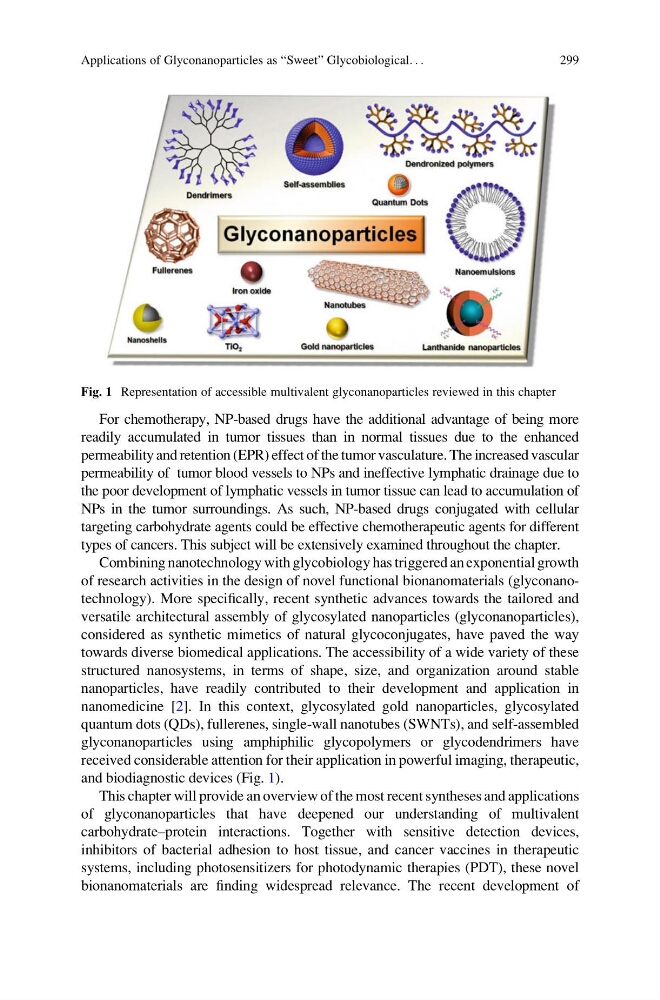
nanomedicine [2]. In this context, glycosylated gold nanoparticles, glycosylated
quantum dots (QDs), fullerenes, single-wall nanotubes (SWNTs), and self-assembled
glyconanoparticles using amphiphilic glycopolymers or glycodendrimers have
received considerable attention for their application in powerful imaging, therapeutic,
and biodiagnostic devices (Fig. 1).
This chapter will provide an overview of the most recent syntheses and applications
of glyconanoparticles that have deepened our understanding of multivalent
carbohydrate–protein interactions. Together with sensitive detection devices,
inhibitors of bacterial adhesion to host tissue, and cancer vaccines in therapeutic
systems, including photosensitizers for photodynamic therapies (PDT), these novel
bionanomaterials are finding widespread relevance. The recent development of
Fig. 1 Representation of accessible multivalent glyconanoparticles reviewed in this chapter
Applications of Glyconanoparticles as “Sweet” Glycobiological. . .
299
readily accumulated in tumor tissues than in normal tissues due to the enhanced
permeability and retention (EPR) effect of the tumor vasculature. The increased vascular
permeability of tumor blood vessels to NPs and ineffective lymphatic drainage due to
the poor development of lymphatic vessels in tumor tissue can lead to accumulation of
NPs in the tumor surroundings. As such, NP-based drugs conjugated with cellular
targeting carbohydrate agents could be effective chemotherapeutic agents for different
types of cancers. This subject will be extensively examined throughout the chapter.
Combining nanotechnology with glycobiology has triggered an exponential growth
of research activities in the design of novel functional bionanomaterials (glyconanotechnology). More specifically, recent synthetic advances towards the tailored and
versatile architectural assembly of glycosylated nanoparticles (glyconanoparticles),
considered as synthetic mimetics of natural glycoconjugates, have paved the way
towards diverse biomedical applications. The accessibility of a wide variety of these
structured nanosystems, in terms of shape, size, and organization around stable
nanoparticles, have readily contributed to their development and application in
nanomedicine [2]. In this context, glycosylated gold nanoparticles, glycosylated
quantum dots (QDs), fullerenes, single-wall nanotubes (SWNTs), and self-assembled
glyconanoparticles using amphiphilic glycopolymers or glycodendrimers have
received considerable attention for their application in powerful imaging, therapeutic,
and biodiagnostic devices (Fig. 1).
This chapter will provide an overview of the most recent syntheses and applications
of glyconanoparticles that have deepened our understanding of multivalent
carbohydrate–protein interactions. Together with sensitive detection devices,
inhibitors of bacterial adhesion to host tissue, and cancer vaccines in therapeutic
systems, including photosensitizers for photodynamic therapies (PDT), these novel
bionanomaterials are finding widespread relevance. The recent development of
Fig. 1 Representation of accessible multivalent glyconanoparticles reviewed in this chapter
Applications of Glyconanoparticles as “Sweet” Glycobiological. . .
299