

developed as pH sensitive carriers for specifically targeting tumors, providing an
optimum drug release at pH 6.8 and decreased release either below pH 6.5 or above
pH 6.9 at 37
C [90].
When sustained drug release using simple dissolution mechanisms such as
diffusion, erosion, membrane control, or osmotic systems becomes difficult, retardation mediated by ionic interactions could provide an ideal alternative for
attaining controlled release. This can be facilitated by the use of oppositely charged
drug and polymeric excipients. For cationic drugs, polymers such as starch,
polyacrylates, sodium carboxymethylcellulose, or alginate can be used as the
matrix, with chitosan being the best option for anionic drugs. Development of
high density complexes using both cationic and anionic polymeric excipients
could also slow down the release [91, 92]. Instead of anionic polymers, multivalent
inorganic anions such as tripolyphosphate or sulfate can also be used to achieve
similar effects [17, 36, 37].
2.2.2 Drug Release from Proteins
In a study that investigates the factors affecting the release of several antimicrobials from albumin microspheres, it was concluded that the denaturation
temperature, time, concentration of crosslinking agents, agitation of the release
medium, and presence of proteolytic enzymes impact the release profile considerably, with drug leaching from the granular matrix as the key method of drug
release [93]. Similar conclusions were drawn in another study investigating the
influence of physiochemical parameters on the release of hydrocortisone acetate
from albumin microspheres. They observed that the release from the microspheres is initially Fickian, then becomes zero order, and finally is exponentially
correlated with time [94].
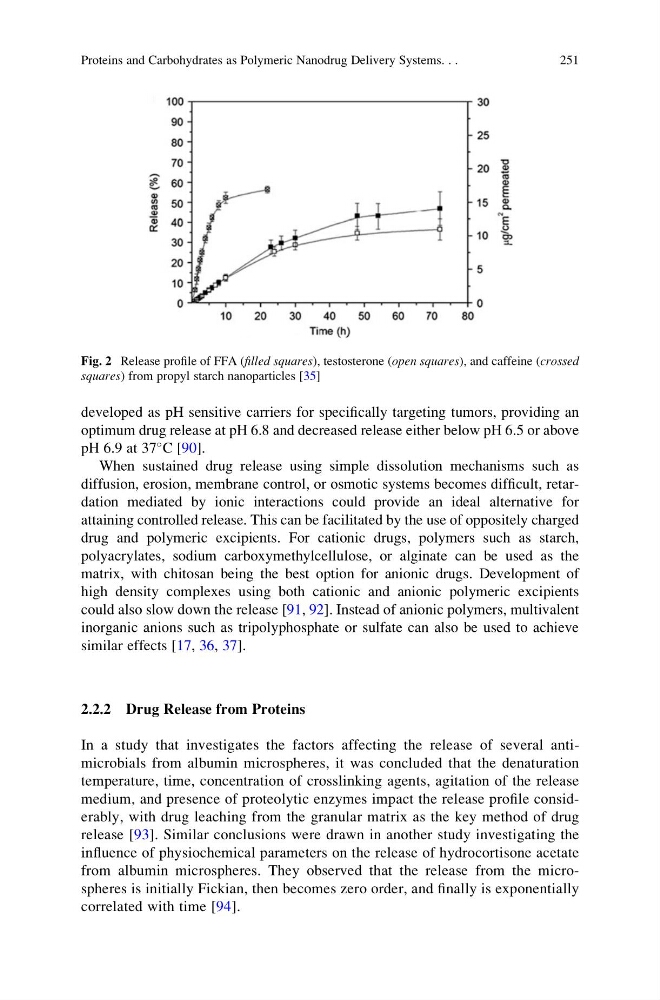
Fig. 2 Release profile of FFA (filled squares), testosterone (open squares), and caffeine (crossed
squares) from propyl starch nanoparticles [35]
Proteins and Carbohydrates as Polymeric Nanodrug Delivery Systems. . .
251
optimum drug release at pH 6.8 and decreased release either below pH 6.5 or above
pH 6.9 at 37
C [90].
When sustained drug release using simple dissolution mechanisms such as
diffusion, erosion, membrane control, or osmotic systems becomes difficult, retardation mediated by ionic interactions could provide an ideal alternative for
attaining controlled release. This can be facilitated by the use of oppositely charged
drug and polymeric excipients. For cationic drugs, polymers such as starch,
polyacrylates, sodium carboxymethylcellulose, or alginate can be used as the
matrix, with chitosan being the best option for anionic drugs. Development of
high density complexes using both cationic and anionic polymeric excipients
could also slow down the release [91, 92]. Instead of anionic polymers, multivalent
inorganic anions such as tripolyphosphate or sulfate can also be used to achieve
similar effects [17, 36, 37].
2.2.2 Drug Release from Proteins
In a study that investigates the factors affecting the release of several antimicrobials from albumin microspheres, it was concluded that the denaturation
temperature, time, concentration of crosslinking agents, agitation of the release
medium, and presence of proteolytic enzymes impact the release profile considerably, with drug leaching from the granular matrix as the key method of drug
release [93]. Similar conclusions were drawn in another study investigating the
influence of physiochemical parameters on the release of hydrocortisone acetate
from albumin microspheres. They observed that the release from the microspheres is initially Fickian, then becomes zero order, and finally is exponentially
correlated with time [94].
Fig. 2 Release profile of FFA (filled squares), testosterone (open squares), and caffeine (crossed
squares) from propyl starch nanoparticles [35]
Proteins and Carbohydrates as Polymeric Nanodrug Delivery Systems. . .
251