

ROS formation as well as formation of lipid peroxides. Ethanol-containing vesicles
based on SPC were able to promote trans-resveratrol permeation through the porcine
skin. The nanosystem could be potentially exploited for the transdermal delivery of
nutraceuticals with anticancer potential specifically for skin cancer [169]. Guo et al.
investigated the antitumor effects and functional mechanism of resveratrol-BSA
nanoparticles on human primary ovarian carcinoma cells (SKOV) in nude mice. The
administration of resveratrol-BSA NPs significantly retarded the growth of
carcinomas in nude mice from the third week onwards, and the inhibition rate was
markedly higher than in mice treated with free resveratrol (52.43% vs. 46.34%,
P < 0.05), without causing weight loss (P > 0.05). Apoptotic and necrotic morphological characteristics were observed with electron microscopy in the tumor
tissues of treated mice and also revealed that part of the mechanism might be
mediated by triggering the release of cytochrome c from the intermembrane space
and upregulating the expression of caspase-9 and caspase-3, suggesting that the
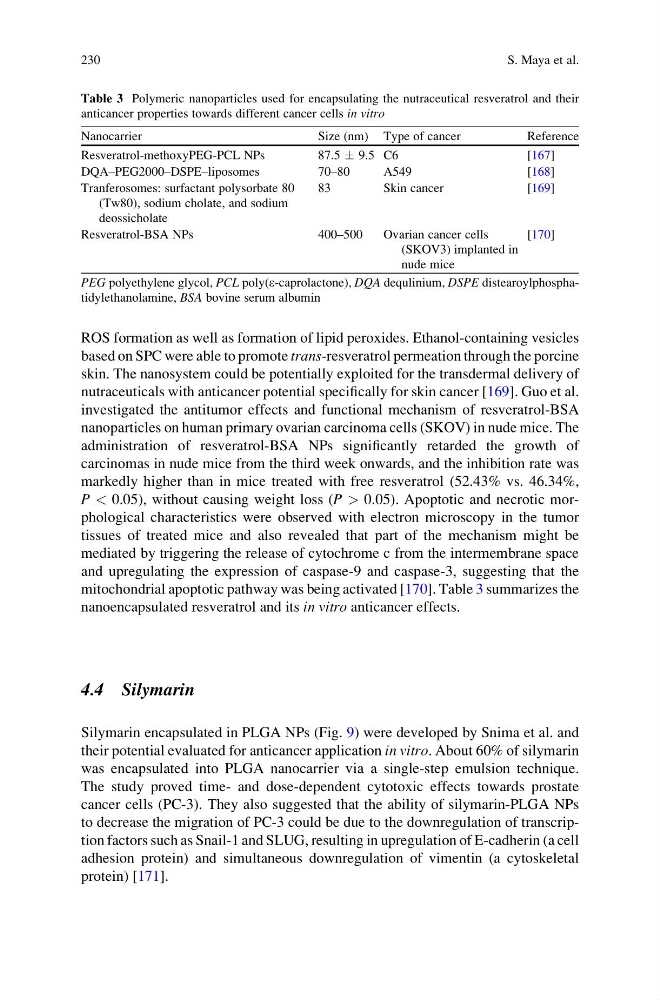
mitochondrial apoptotic pathway was being activated [170]. Table 3 summarizes the
nanoencapsulated resveratrol and its in vitro anticancer effects.
4.4 Silymarin
Silymarin encapsulated in PLGA NPs (Fig. 9) were developed by Snima et al. and
their potential evaluated for anticancer application in vitro. About 60% of silymarin
was encapsulated into PLGA nanocarrier via a single-step emulsion technique.
The study proved time- and dose-dependent cytotoxic effects towards prostate
cancer cells (PC-3). They also suggested that the ability of silymarin-PLGA NPs
to decrease the migration of PC-3 could be due to the downregulation of transcription factors such as Snail-1 and SLUG, resulting in upregulation of E-cadherin (a cell
adhesion protein) and simultaneous downregulation of vimentin (a cytoskeletal
protein) [171].
Table 3 Polymeric nanoparticles used for encapsulating the nutraceutical resveratrol and their
anticancer properties towards different cancer cells in vitro
Nanocarrier
Size (nm) Type of cancer
Reference
Resveratrol-methoxyPEG-PCL NPs
87.5 Æ 9.5 C6
[167]
DQA–PEG2000–DSPE–liposomes
70–80
A549
[168]
Tranferosomes: surfactant polysorbate 80
(Tw80), sodium cholate, and sodium
deossicholate
83
Skin cancer
[169]
Resveratrol-BSA NPs
400–500
Ovarian cancer cells
(SKOV3) implanted in
nude mice
[170]
PEG polyethylene glycol, PCL poly(e-caprolactone), DQA dequlinium, DSPE distearoylphosphatidylethanolamine, BSA bovine serum albumin
230
S. Maya et al.
based on SPC were able to promote trans-resveratrol permeation through the porcine
skin. The nanosystem could be potentially exploited for the transdermal delivery of
nutraceuticals with anticancer potential specifically for skin cancer [169]. Guo et al.
investigated the antitumor effects and functional mechanism of resveratrol-BSA
nanoparticles on human primary ovarian carcinoma cells (SKOV) in nude mice. The
administration of resveratrol-BSA NPs significantly retarded the growth of
carcinomas in nude mice from the third week onwards, and the inhibition rate was
markedly higher than in mice treated with free resveratrol (52.43% vs. 46.34%,
P < 0.05), without causing weight loss (P > 0.05). Apoptotic and necrotic morphological characteristics were observed with electron microscopy in the tumor
tissues of treated mice and also revealed that part of the mechanism might be
mediated by triggering the release of cytochrome c from the intermembrane space
and upregulating the expression of caspase-9 and caspase-3, suggesting that the
mitochondrial apoptotic pathway was being activated [170]. Table 3 summarizes the
nanoencapsulated resveratrol and its in vitro anticancer effects.
4.4 Silymarin
Silymarin encapsulated in PLGA NPs (Fig. 9) were developed by Snima et al. and
their potential evaluated for anticancer application in vitro. About 60% of silymarin
was encapsulated into PLGA nanocarrier via a single-step emulsion technique.
The study proved time- and dose-dependent cytotoxic effects towards prostate
cancer cells (PC-3). They also suggested that the ability of silymarin-PLGA NPs
to decrease the migration of PC-3 could be due to the downregulation of transcription factors such as Snail-1 and SLUG, resulting in upregulation of E-cadherin (a cell
adhesion protein) and simultaneous downregulation of vimentin (a cytoskeletal
protein) [171].
Table 3 Polymeric nanoparticles used for encapsulating the nutraceutical resveratrol and their
anticancer properties towards different cancer cells in vitro
Nanocarrier
Size (nm) Type of cancer
Reference
Resveratrol-methoxyPEG-PCL NPs
87.5 Æ 9.5 C6
[167]
DQA–PEG2000–DSPE–liposomes
70–80
A549
[168]
Tranferosomes: surfactant polysorbate 80
(Tw80), sodium cholate, and sodium
deossicholate
83
Skin cancer
[169]
Resveratrol-BSA NPs
400–500
Ovarian cancer cells
(SKOV3) implanted in
nude mice
[170]
PEG polyethylene glycol, PCL poly(e-caprolactone), DQA dequlinium, DSPE distearoylphosphatidylethanolamine, BSA bovine serum albumin
230
S. Maya et al.