

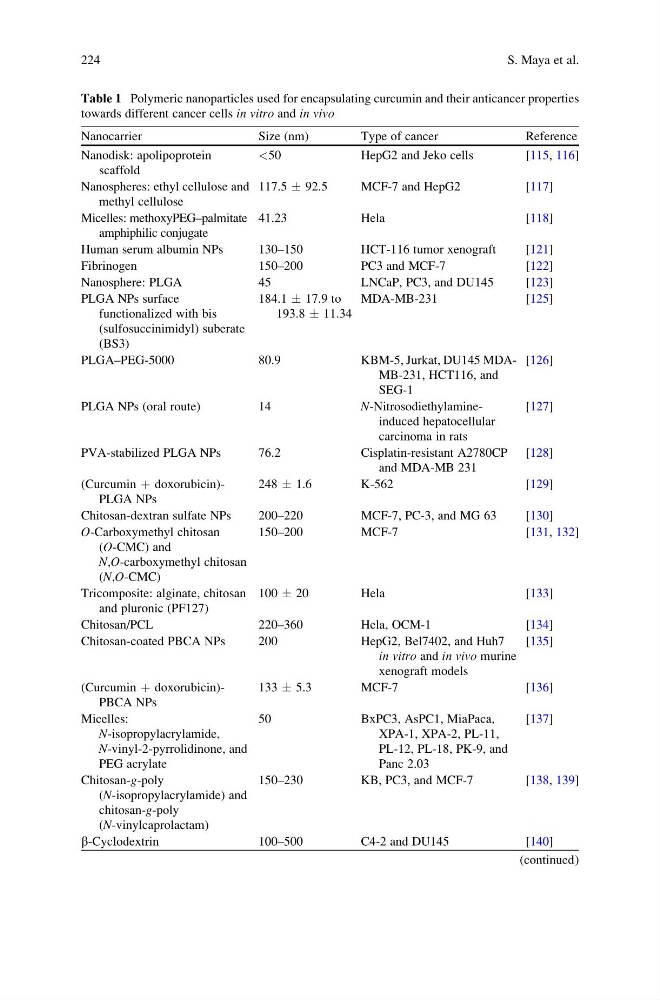
Table 1 Polymeric nanoparticles used for encapsulating curcumin and their anticancer properties
towards different cancer cells in vitro and in vivo
Nanocarrier
Size (nm)
Type of cancer
Reference
Nanodisk: apolipoprotein
scaffold
<50
HepG2 and Jeko cells
[115, 116]
Nanospheres: ethyl cellulose and
methyl cellulose
117.5 Æ 92.5
MCF-7 and HepG2
[117]
Micelles: methoxyPEG–palmitate
amphiphilic conjugate
41.23
Hela
[118]
Human serum albumin NPs
130–150
HCT-116 tumor xenograft
[121]
Fibrinogen
150–200
PC3 and MCF-7
[122]
Nanosphere: PLGA
45
LNCaP, PC3, and DU145
[123]
PLGA NPs surface
functionalized with bis
(sulfosuccinimidyl) suberate
(BS3)
184.1 Æ 17.9 to
193.8 Æ 11.34
MDA-MB-231
[125]
PLGA–PEG-5000
80.9
KBM-5, Jurkat, DU145 MDAMB-231, HCT116, and
SEG-1
[126]
PLGA NPs (oral route)
14
N-Nitrosodiethylamineinduced hepatocellular
carcinoma in rats
[127]
PVA-stabilized PLGA NPs
76.2
Cisplatin-resistant A2780CP
and MDA-MB 231
[128]
(Curcumin þ doxorubicin)PLGA NPs
248 Æ 1.6
K-562
[129]
Chitosan-dextran sulfate NPs
200–220
MCF-7, PC-3, and MG 63
[130]
O-Carboxymethyl chitosan
(O-CMC) and
N,O-carboxymethyl chitosan
(N,O-CMC)
150–200
MCF-7
[131, 132]
Tricomposite: alginate, chitosan
and pluronic (PF127)
100 Æ 20
Hela
[133]
Chitosan/PCL
220–360
Hela, OCM-1
[134]
Chitosan-coated PBCA NPs
200
HepG2, Bel7402, and Huh7
in vitro and in vivo murine
xenograft models
[135]
(Curcumin þ doxorubicin)PBCA NPs
133 Æ 5.3
MCF-7
[136]
Micelles:
N-isopropylacrylamide,
N-vinyl-2-pyrrolidinone, and
PEG acrylate
50
BxPC3, AsPC1, MiaPaca,
XPA-1, XPA-2, PL-11,
PL-12, PL-18, PK-9, and
Panc 2.03
[137]
Chitosan-g-poly
(N-isopropylacrylamide) and
chitosan-g-poly
(N-vinylcaprolactam)
150–230
KB, PC3, and MCF-7
[138, 139]
b-Cyclodextrin
100–500
C4-2 and DU145
[140]
(continued)
224
S. Maya et al.
towards different cancer cells in vitro and in vivo
Nanocarrier
Size (nm)
Type of cancer
Reference
Nanodisk: apolipoprotein
scaffold
<50
HepG2 and Jeko cells
[115, 116]
Nanospheres: ethyl cellulose and
methyl cellulose
117.5 Æ 92.5
MCF-7 and HepG2
[117]
Micelles: methoxyPEG–palmitate
amphiphilic conjugate
41.23
Hela
[118]
Human serum albumin NPs
130–150
HCT-116 tumor xenograft
[121]
Fibrinogen
150–200
PC3 and MCF-7
[122]
Nanosphere: PLGA
45
LNCaP, PC3, and DU145
[123]
PLGA NPs surface
functionalized with bis
(sulfosuccinimidyl) suberate
(BS3)
184.1 Æ 17.9 to
193.8 Æ 11.34
MDA-MB-231
[125]
PLGA–PEG-5000
80.9
KBM-5, Jurkat, DU145 MDAMB-231, HCT116, and
SEG-1
[126]
PLGA NPs (oral route)
14
N-Nitrosodiethylamineinduced hepatocellular
carcinoma in rats
[127]
PVA-stabilized PLGA NPs
76.2
Cisplatin-resistant A2780CP
and MDA-MB 231
[128]
(Curcumin þ doxorubicin)PLGA NPs
248 Æ 1.6
K-562
[129]
Chitosan-dextran sulfate NPs
200–220
MCF-7, PC-3, and MG 63
[130]
O-Carboxymethyl chitosan
(O-CMC) and
N,O-carboxymethyl chitosan
(N,O-CMC)
150–200
MCF-7
[131, 132]
Tricomposite: alginate, chitosan
and pluronic (PF127)
100 Æ 20
Hela
[133]
Chitosan/PCL
220–360
Hela, OCM-1
[134]
Chitosan-coated PBCA NPs
200
HepG2, Bel7402, and Huh7
in vitro and in vivo murine
xenograft models
[135]
(Curcumin þ doxorubicin)PBCA NPs
133 Æ 5.3
MCF-7
[136]
Micelles:
N-isopropylacrylamide,
N-vinyl-2-pyrrolidinone, and
PEG acrylate
50
BxPC3, AsPC1, MiaPaca,
XPA-1, XPA-2, PL-11,
PL-12, PL-18, PK-9, and
Panc 2.03
[137]
Chitosan-g-poly
(N-isopropylacrylamide) and
chitosan-g-poly
(N-vinylcaprolactam)
150–230
KB, PC3, and MCF-7
[138, 139]
b-Cyclodextrin
100–500
C4-2 and DU145
[140]
(continued)
224
S. Maya et al.