

in cationic nanoparticles of curcumin with chitosan and poly(e-caprolactone) (PCL),
which were found to enhance the cellular uptake by Hela cells and human choroidal
melanoma (OCM-1). The study suggested that the blending of PCL nanoparticles
with the bio-adhesive polymer chitosan resulted in favorable drug loading and
release profiles as well as good cellular interaction and in vitro anticancer efficacy,
thereby retaining the activity of curcumin towards the cancer cells [134].
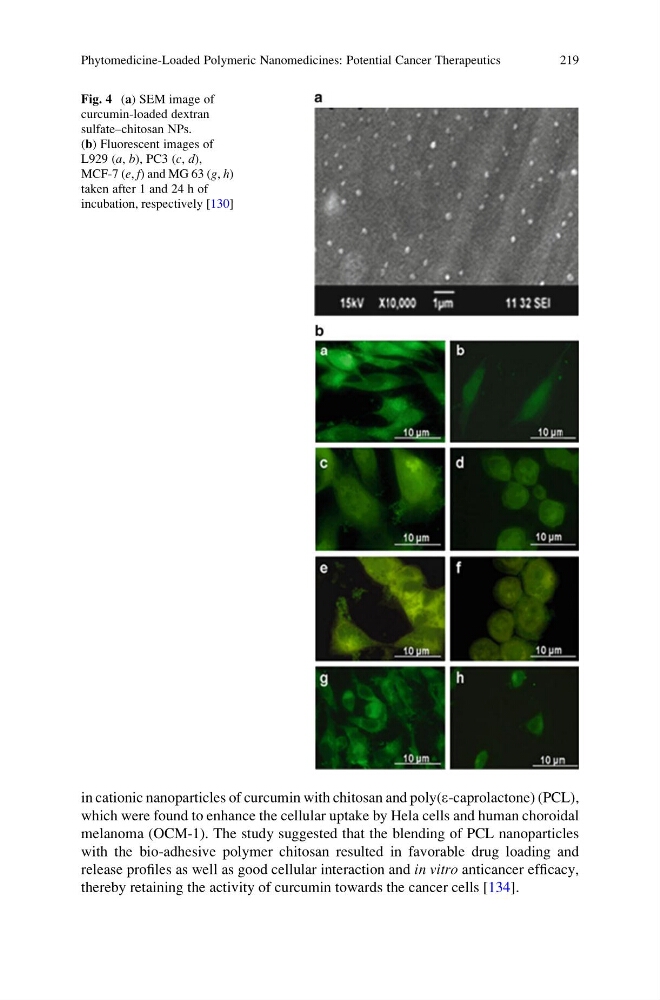
Fig. 4 (a) SEM image of
curcumin-loaded dextran
sulfate–chitosan NPs.
(b) Fluorescent images of
L929 (a, b), PC3 (c, d),
MCF-7 (e, f) and MG 63 (g, h)
taken after 1 and 24 h of
incubation, respectively [130]
Phytomedicine-Loaded Polymeric Nanomedicines: Potential Cancer Therapeutics
219
which were found to enhance the cellular uptake by Hela cells and human choroidal
melanoma (OCM-1). The study suggested that the blending of PCL nanoparticles
with the bio-adhesive polymer chitosan resulted in favorable drug loading and
release profiles as well as good cellular interaction and in vitro anticancer efficacy,
thereby retaining the activity of curcumin towards the cancer cells [134].
Fig. 4 (a) SEM image of
curcumin-loaded dextran
sulfate–chitosan NPs.
(b) Fluorescent images of
L929 (a, b), PC3 (c, d),
MCF-7 (e, f) and MG 63 (g, h)
taken after 1 and 24 h of
incubation, respectively [130]
Phytomedicine-Loaded Polymeric Nanomedicines: Potential Cancer Therapeutics
219