

6.2 Poly(lactic acid)
PLA is linear aliphatic thermoplastic polyester (T g ~55
C, T m ~175
C), which is
being extensively considered for biomedical applications due to its biocompatibility, biodegradation, excellent thermal and mechanical properties, and easy processability [122, 123]. PLA is easily metabolized into lactic acid, a natural
component in the body. Lactic acid is a chiral molecule and exists in two
stereoisomeric forms (D- and L-lactide) [2]. L-PLA exists in semicrystalline form
due to high regioregularity, whereas D,L-PLA is an amorphous polymer with
varying D-content because of irregularities in the polymer chain structure [4].
Therefore, the use of D,L-PLA is preferred over L-PLA for homogeneous dispersion of drug in the polymer matrix [124]. Savoxepine is a psychotic drug that has
been loaded into PLA nanoparticles with high encapsulation efficiency (95%),
which extended its delivery to more than 1 week [125]. However, the semicrystalline L-PLA is preferred for biomaterial devices and controlled delivery systems
to help cure various health dysfunctions. Progesterone-loaded PLA nanoparticles
have been prepared, with entrapment efficiencies of around 70% and particle size
around 260–320 nm, for embryogenesis and gestation in females [93]. Oridoninloaded PLA nanoparticles have been prepared by a modified spontaneous emulsion/solvent diffusion method [97], with entrapment efficiency of around 92%, for
the treatment of esophageal and hepatic carcinoma. Quercitrin-embedded poly
(D, L-lactide) nanoparticles have been prepared by a solvent evaporation method,
with encapsulation efficiency of 40% and nanoparticles size around 195 nm, for
antimalarial and anti-inflammatory activities [126]. The breast cancer drug tamoxifen was loaded into magnetite/poly(L-lactic acid) composite nanoparticles of
200 nm with encapsulation efficiency of 81% using a solvent evaporation method
[127]. On the other hand, PLA is preferred for applications related to orthopedic
surgery due to its high mechanical strength and toughness [128, 129]. PLA
scaffolds satisfy several requirements for use as a suitable material for bone tissue
engineering [130].
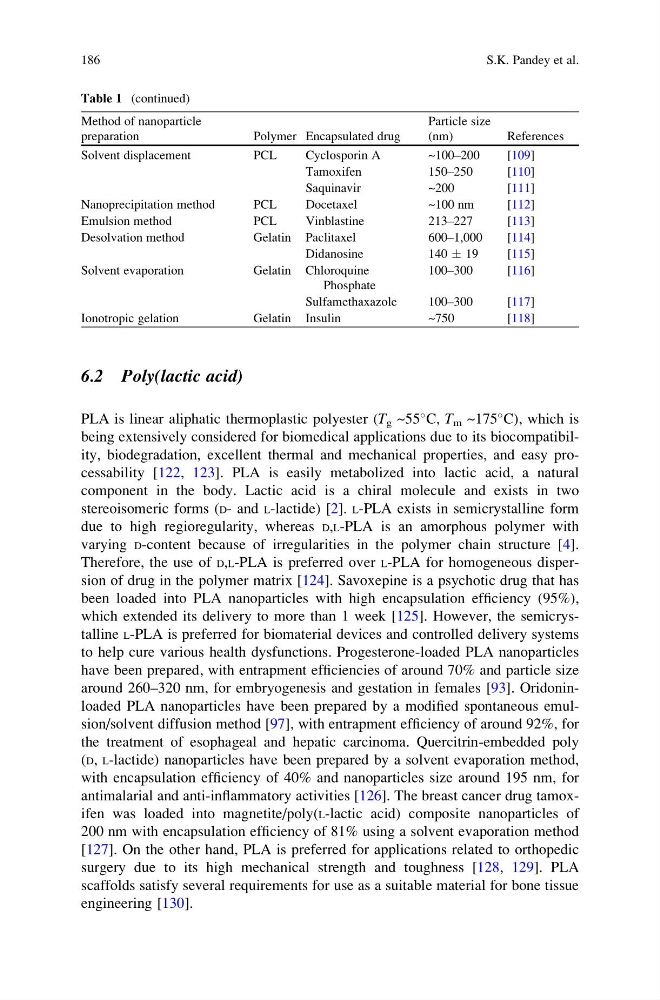
Table 1 (continued)
Method of nanoparticle
preparation
Polymer Encapsulated drug
Particle size
(nm)
References
Solvent displacement
PCL
Cyclosporin A
~100–200
[109]
Tamoxifen
150–250
[110]
Saquinavir
~200
[111]
Nanoprecipitation method
PCL
Docetaxel
~100 nm
[112]
Emulsion method
PCL
Vinblastine
213–227
[113]
Desolvation method
Gelatin Paclitaxel
600–1,000
[114]
Didanosine
140 Æ 19
[115]
Solvent evaporation
Gelatin Chloroquine
Phosphate
100–300
[116]
Sulfamethaxazole
100–300
[117]
Ionotropic gelation
Gelatin Insulin
~750
[118]
186
S.K. Pandey et al.
PLA is linear aliphatic thermoplastic polyester (T g ~55
C, T m ~175
C), which is
being extensively considered for biomedical applications due to its biocompatibility, biodegradation, excellent thermal and mechanical properties, and easy processability [122, 123]. PLA is easily metabolized into lactic acid, a natural
component in the body. Lactic acid is a chiral molecule and exists in two
stereoisomeric forms (D- and L-lactide) [2]. L-PLA exists in semicrystalline form
due to high regioregularity, whereas D,L-PLA is an amorphous polymer with
varying D-content because of irregularities in the polymer chain structure [4].
Therefore, the use of D,L-PLA is preferred over L-PLA for homogeneous dispersion of drug in the polymer matrix [124]. Savoxepine is a psychotic drug that has
been loaded into PLA nanoparticles with high encapsulation efficiency (95%),
which extended its delivery to more than 1 week [125]. However, the semicrystalline L-PLA is preferred for biomaterial devices and controlled delivery systems
to help cure various health dysfunctions. Progesterone-loaded PLA nanoparticles
have been prepared, with entrapment efficiencies of around 70% and particle size
around 260–320 nm, for embryogenesis and gestation in females [93]. Oridoninloaded PLA nanoparticles have been prepared by a modified spontaneous emulsion/solvent diffusion method [97], with entrapment efficiency of around 92%, for
the treatment of esophageal and hepatic carcinoma. Quercitrin-embedded poly
(D, L-lactide) nanoparticles have been prepared by a solvent evaporation method,
with encapsulation efficiency of 40% and nanoparticles size around 195 nm, for
antimalarial and anti-inflammatory activities [126]. The breast cancer drug tamoxifen was loaded into magnetite/poly(L-lactic acid) composite nanoparticles of
200 nm with encapsulation efficiency of 81% using a solvent evaporation method
[127]. On the other hand, PLA is preferred for applications related to orthopedic
surgery due to its high mechanical strength and toughness [128, 129]. PLA
scaffolds satisfy several requirements for use as a suitable material for bone tissue
engineering [130].
Table 1 (continued)
Method of nanoparticle
preparation
Polymer Encapsulated drug
Particle size
(nm)
References
Solvent displacement
PCL
Cyclosporin A
~100–200
[109]
Tamoxifen
150–250
[110]
Saquinavir
~200
[111]
Nanoprecipitation method
PCL
Docetaxel
~100 nm
[112]
Emulsion method
PCL
Vinblastine
213–227
[113]
Desolvation method
Gelatin Paclitaxel
600–1,000
[114]
Didanosine
140 Æ 19
[115]
Solvent evaporation
Gelatin Chloroquine
Phosphate
100–300
[116]
Sulfamethaxazole
100–300
[117]
Ionotropic gelation
Gelatin Insulin
~750
[118]
186
S.K. Pandey et al.