

5.1 Emulsification/Solvent Evaporation Method
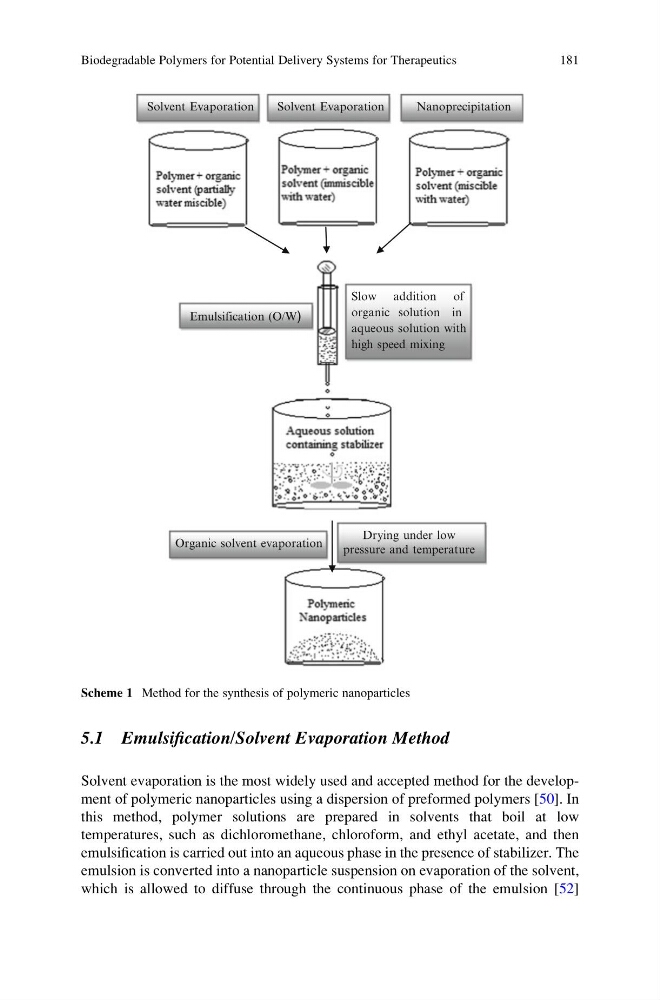
Solvent evaporation is the most widely used and accepted method for the development of polymeric nanoparticles using a dispersion of preformed polymers [50]. In
this method, polymer solutions are prepared in solvents that boil at low
temperatures, such as dichloromethane, chloroform, and ethyl acetate, and then
emulsification is carried out into an aqueous phase in the presence of stabilizer. The
emulsion is converted into a nanoparticle suspension on evaporation of the solvent,
which is allowed to diffuse through the continuous phase of the emulsion [52]
Emulsification (O/W)
Slow addition of
organic solution in
aqueous solution with
high speed mixing
Drying under low
pressure and temperature
Organic solvent evaporation
Solvent Evaporation
Solvent Evaporation
Nanoprecipitation
Scheme 1 Method for the synthesis of polymeric nanoparticles
Biodegradable Polymers for Potential Delivery Systems for Therapeutics
181
Solvent evaporation is the most widely used and accepted method for the development of polymeric nanoparticles using a dispersion of preformed polymers [50]. In
this method, polymer solutions are prepared in solvents that boil at low
temperatures, such as dichloromethane, chloroform, and ethyl acetate, and then
emulsification is carried out into an aqueous phase in the presence of stabilizer. The
emulsion is converted into a nanoparticle suspension on evaporation of the solvent,
which is allowed to diffuse through the continuous phase of the emulsion [52]
Emulsification (O/W)
Slow addition of
organic solution in
aqueous solution with
high speed mixing
Drying under low
pressure and temperature
Organic solvent evaporation
Solvent Evaporation
Solvent Evaporation
Nanoprecipitation
Scheme 1 Method for the synthesis of polymeric nanoparticles
Biodegradable Polymers for Potential Delivery Systems for Therapeutics
181