

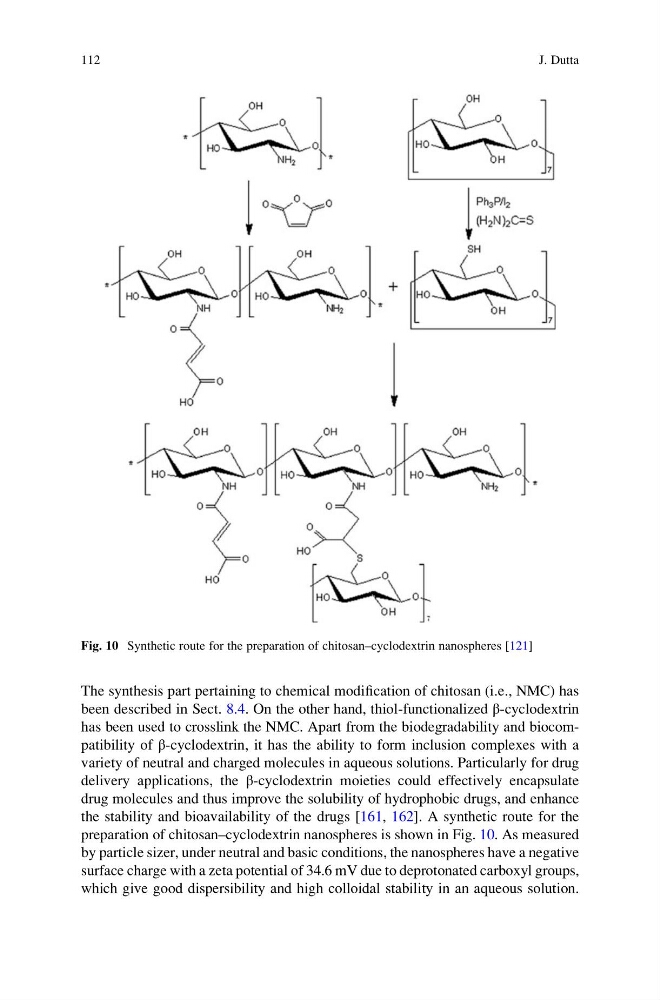
The synthesis part pertaining to chemical modification of chitosan (i.e., NMC) has
been described in Sect. 8.4. On the other hand, thiol-functionalized β-cyclodextrin
has been used to crosslink the NMC. Apart from the biodegradability and biocompatibility of β-cyclodextrin, it has the ability to form inclusion complexes with a
variety of neutral and charged molecules in aqueous solutions. Particularly for drug
delivery applications, the β-cyclodextrin moieties could effectively encapsulate
drug molecules and thus improve the solubility of hydrophobic drugs, and enhance
the stability and bioavailability of the drugs [161, 162]. A synthetic route for the
preparation of chitosan–cyclodextrin nanospheres is shown in Fig. 10. As measured
by particle sizer, under neutral and basic conditions, the nanospheres have a negative
surface charge with a zeta potential of 34.6 mV due to deprotonated carboxyl groups,
which give good dispersibility and high colloidal stability in an aqueous solution.
Fig. 10 Synthetic route for the preparation of chitosan–cyclodextrin nanospheres [121]
112
J. Dutta
been described in Sect. 8.4. On the other hand, thiol-functionalized β-cyclodextrin
has been used to crosslink the NMC. Apart from the biodegradability and biocompatibility of β-cyclodextrin, it has the ability to form inclusion complexes with a
variety of neutral and charged molecules in aqueous solutions. Particularly for drug
delivery applications, the β-cyclodextrin moieties could effectively encapsulate
drug molecules and thus improve the solubility of hydrophobic drugs, and enhance
the stability and bioavailability of the drugs [161, 162]. A synthetic route for the
preparation of chitosan–cyclodextrin nanospheres is shown in Fig. 10. As measured
by particle sizer, under neutral and basic conditions, the nanospheres have a negative
surface charge with a zeta potential of 34.6 mV due to deprotonated carboxyl groups,
which give good dispersibility and high colloidal stability in an aqueous solution.
Fig. 10 Synthetic route for the preparation of chitosan–cyclodextrin nanospheres [121]
112
J. Dutta