

46
M. Svrˇ cek
Hence, in addition to the well-known particle-wave dualism, we discern here a new
type of property-object dualism. Equations (2.11), (2.12) thus become the proper
opening from the original mechanical formulation of the system of electrons and
nuclei to the new field theoretic formulation of electrons, phonons, rotons and
translons. There is here no reduction of the system into a subsystem with 3N − 5(6)
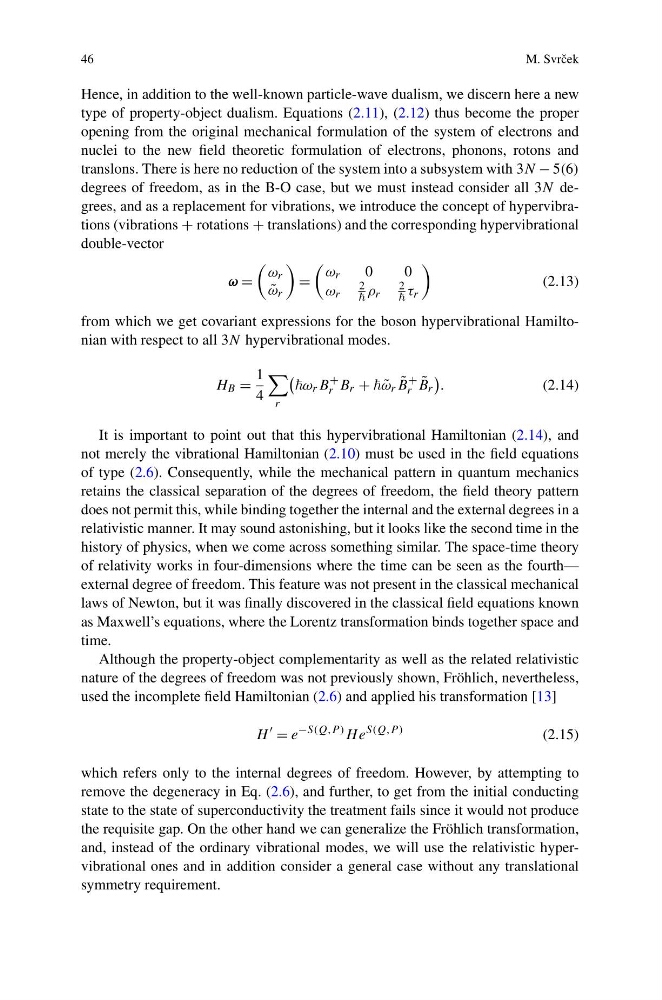
degrees of freedom, as in the B-O case, but we must instead consider all 3N degrees, and as a replacement for vibrations, we introduce the concept of hypervibrations (vibrations + rotations + translations) and the corresponding hypervibrational
double-vector
ω =
ω r
˜
ω r
=
ω r
0
0
ω r
2
ρ r
2
τ r
(2.13)
from which we get covariant expressions for the boson hypervibrational Hamiltonian with respect to all 3N hypervibrational modes.
H B =
1
4
r
ω r B
+
r B r + ˜
ω r ˜
B
+
r
˜
B r
.
(2.14)
It is important to point out that this hypervibrational Hamiltonian (2.14), and
not merely the vibrational Hamiltonian (2.10) must be used in the field equations
of type (2.6). Consequently, while the mechanical pattern in quantum mechanics
retains the classical separation of the degrees of freedom, the field theory pattern
does not permit this, while binding together the internal and the external degrees in a
relativistic manner. It may sound astonishing, but it looks like the second time in the
history of physics, when we come across something similar. The space-time theory
of relativity works in four-dimensions where the time can be seen as the fourth—
external degree of freedom. This feature was not present in the classical mechanical
laws of Newton, but it was finally discovered in the classical field equations known
as Maxwell’s equations, where the Lorentz transformation binds together space and
time.
Although the property-object complementarity as well as the related relativistic
nature of the degrees of freedom was not previously shown, Fröhlich, nevertheless,
used the incomplete field Hamiltonian (2.6) and applied his transformation [13]
H
= e
−S(Q,P ) H e
S(Q,P )
(2.15)
which refers only to the internal degrees of freedom. However, by attempting to
remove the degeneracy in Eq. (2.6), and further, to get from the initial conducting
state to the state of superconductivity the treatment fails since it would not produce
the requisite gap. On the other hand we can generalize the Fröhlich transformation,
and, instead of the ordinary vibrational modes, we will use the relativistic hypervibrational ones and in addition consider a general case without any translational
symmetry requirement.
M. Svrˇ cek
Hence, in addition to the well-known particle-wave dualism, we discern here a new
type of property-object dualism. Equations (2.11), (2.12) thus become the proper
opening from the original mechanical formulation of the system of electrons and
nuclei to the new field theoretic formulation of electrons, phonons, rotons and
translons. There is here no reduction of the system into a subsystem with 3N − 5(6)
degrees of freedom, as in the B-O case, but we must instead consider all 3N degrees, and as a replacement for vibrations, we introduce the concept of hypervibrations (vibrations + rotations + translations) and the corresponding hypervibrational
double-vector
ω =
ω r
˜
ω r
=
ω r
0
0
ω r
2
ρ r
2
τ r
(2.13)
from which we get covariant expressions for the boson hypervibrational Hamiltonian with respect to all 3N hypervibrational modes.
H B =
1
4
r
ω r B
+
r B r + ˜
ω r ˜
B
+
r
˜
B r
.
(2.14)
It is important to point out that this hypervibrational Hamiltonian (2.14), and
not merely the vibrational Hamiltonian (2.10) must be used in the field equations
of type (2.6). Consequently, while the mechanical pattern in quantum mechanics
retains the classical separation of the degrees of freedom, the field theory pattern
does not permit this, while binding together the internal and the external degrees in a
relativistic manner. It may sound astonishing, but it looks like the second time in the
history of physics, when we come across something similar. The space-time theory
of relativity works in four-dimensions where the time can be seen as the fourth—
external degree of freedom. This feature was not present in the classical mechanical
laws of Newton, but it was finally discovered in the classical field equations known
as Maxwell’s equations, where the Lorentz transformation binds together space and
time.
Although the property-object complementarity as well as the related relativistic
nature of the degrees of freedom was not previously shown, Fröhlich, nevertheless,
used the incomplete field Hamiltonian (2.6) and applied his transformation [13]
H
= e
−S(Q,P ) H e
S(Q,P )
(2.15)
which refers only to the internal degrees of freedom. However, by attempting to
remove the degeneracy in Eq. (2.6), and further, to get from the initial conducting
state to the state of superconductivity the treatment fails since it would not produce
the requisite gap. On the other hand we can generalize the Fröhlich transformation,
and, instead of the ordinary vibrational modes, we will use the relativistic hypervibrational ones and in addition consider a general case without any translational
symmetry requirement.