

2 A Comment on the Question of Degeneracies in Quantum Mechanics
45
modes r, r ∈ V , and the external degrees are reflected in the translational degrees of
freedom corresponding to the de Broglie wave of COM, and the rotational degrees
of freedom corresponding to the quantized states of angular momentum, with eigenvalues of L 2 and L 3 . An error in the determination of the centre of gravity is then
entirely compensated by the Born-Handy ansatz, but only on the adiabatic level, as
Kutzelnigg did prove [11].
The field theoretical approach, unfortunately, involves Eq. (2.10) as an ingredient
in the total Hamiltonian (2.6) without any possibility to compensate for the COM
factual error. Where is, however, the mistake? Is the error to be found in Eq. (2.10)?
In considering this question, we get back to one of the fundamental problems of
quantum mechanics, which for inexplicable reasons were never brought up for consideration. As is well-known, in quantum mechanics the mechanical and the field
attributes are brought together, and this gives rise to recognized microscopic peculiarities, viz. the complementarity between the coordinate and the momentum representations, the alleged dualism of the considered entities, e.g., the appearance as
particles or as waves, the non-commutativity between different classes of operators. Even if this has been correctly formulated for single-particle states, the general
role of complementarity in quantum mechanics is not completely unraveled in this
way. There is yet another manifestation of complementarity, which shows up at the
many-body level, i.e. the degenerate states in the B-O many-body approximation
just emerge as the reappearance through the backdoor of the fundamental principle
of complementarity, however on a much more subtle level.
Equations (2.8) and (2.9) represent the standard quantum mechanical picture of
vibrations as the properties of the system of electrons and nuclei. However, if we
want to further include Eq. (2.10) in the ensuing field Hamiltonian (2.6), the vibrations must not be interpreted as properties only, but instead they are quantum
mechanical objects themselves, ontologically equivalent with electrons. Hence, the
external degrees of freedom cannot be separated from the internal ones, rather they
are materialized in the form of quasiparticles, i.e. rotons and translons, cf. the internal degrees of freedom that are materialized e.g. in the form of phonons. This
leads to a surprising deduction: Eqs. (2.8) and (2.9) have two mutually exclusive
interpretations: firstly, they are the determining equations for the properties of electrons and nuclei, e.g. vibrations with a clear separation from the external degrees
of freedom; or secondly, they are the generic equations for new quasiparticles, e.g.
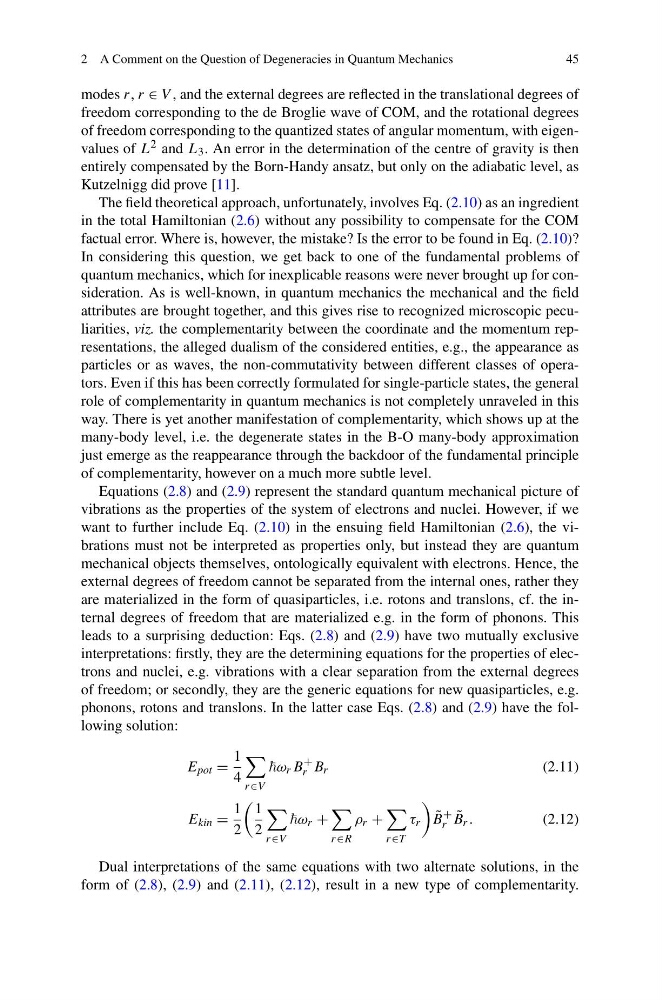
phonons, rotons and translons. In the latter case Eqs. (2.8) and (2.9) have the following solution:
E pot =
1
4
r∈V
ω r B
+
r B r
(2.11)
E kin =
1
2
1
2
r∈V
ω r +
r∈R
ρ r +
r∈T
τ r
˜
B
+
r
˜
B r .
(2.12)
Dual interpretations of the same equations with two alternate solutions, in the
form of (2.8), (2.9) and (2.11), (2.12), result in a new type of complementarity.
45
modes r, r ∈ V , and the external degrees are reflected in the translational degrees of
freedom corresponding to the de Broglie wave of COM, and the rotational degrees
of freedom corresponding to the quantized states of angular momentum, with eigenvalues of L 2 and L 3 . An error in the determination of the centre of gravity is then
entirely compensated by the Born-Handy ansatz, but only on the adiabatic level, as
Kutzelnigg did prove [11].
The field theoretical approach, unfortunately, involves Eq. (2.10) as an ingredient
in the total Hamiltonian (2.6) without any possibility to compensate for the COM
factual error. Where is, however, the mistake? Is the error to be found in Eq. (2.10)?
In considering this question, we get back to one of the fundamental problems of
quantum mechanics, which for inexplicable reasons were never brought up for consideration. As is well-known, in quantum mechanics the mechanical and the field
attributes are brought together, and this gives rise to recognized microscopic peculiarities, viz. the complementarity between the coordinate and the momentum representations, the alleged dualism of the considered entities, e.g., the appearance as
particles or as waves, the non-commutativity between different classes of operators. Even if this has been correctly formulated for single-particle states, the general
role of complementarity in quantum mechanics is not completely unraveled in this
way. There is yet another manifestation of complementarity, which shows up at the
many-body level, i.e. the degenerate states in the B-O many-body approximation
just emerge as the reappearance through the backdoor of the fundamental principle
of complementarity, however on a much more subtle level.
Equations (2.8) and (2.9) represent the standard quantum mechanical picture of
vibrations as the properties of the system of electrons and nuclei. However, if we
want to further include Eq. (2.10) in the ensuing field Hamiltonian (2.6), the vibrations must not be interpreted as properties only, but instead they are quantum
mechanical objects themselves, ontologically equivalent with electrons. Hence, the
external degrees of freedom cannot be separated from the internal ones, rather they
are materialized in the form of quasiparticles, i.e. rotons and translons, cf. the internal degrees of freedom that are materialized e.g. in the form of phonons. This
leads to a surprising deduction: Eqs. (2.8) and (2.9) have two mutually exclusive
interpretations: firstly, they are the determining equations for the properties of electrons and nuclei, e.g. vibrations with a clear separation from the external degrees
of freedom; or secondly, they are the generic equations for new quasiparticles, e.g.
phonons, rotons and translons. In the latter case Eqs. (2.8) and (2.9) have the following solution:
E pot =
1
4
r∈V
ω r B
+
r B r
(2.11)
E kin =
1
2
1
2
r∈V
ω r +
r∈R
ρ r +
r∈T
τ r
˜
B
+
r
˜
B r .
(2.12)
Dual interpretations of the same equations with two alternate solutions, in the
form of (2.8), (2.9) and (2.11), (2.12), result in a new type of complementarity.