

1 The Potential Energy Surface in Molecular Quantum Mechanics
23
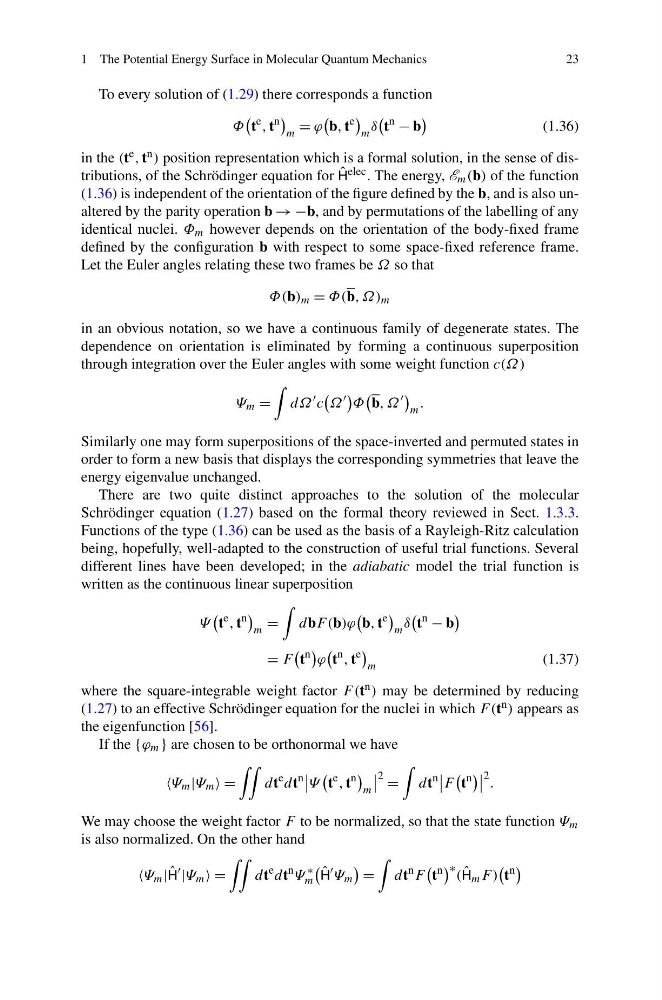
To every solution of (1.29) there corresponds a function
Φ
t
e , t
n
m
= ϕ
b, t
e
m
δ
t
n
− b
(1.36)
in the (t e , t n ) position representation which is a formal solution, in the sense of distributions, of the Schrödinger equation for ˆ
H elec . The energy, E m (b) of the function
(1.36) is independent of the orientation of the figure defined by the b, and is also unaltered by the parity operation b → −b, and by permutations of the labelling of any
identical nuclei. Φ m however depends on the orientation of the body-fixed frame
defined by the configuration b with respect to some space-fixed reference frame.
Let the Euler angles relating these two frames be Ω so that
Φ(b) m = Φ(b, Ω) m
in an obvious notation, so we have a continuous family of degenerate states. The
dependence on orientation is eliminated by forming a continuous superposition
through integration over the Euler angles with some weight function c(Ω)
Ψ m =
dΩ
c
Ω
Φ
b, Ω
m
.
Similarly one may form superpositions of the space-inverted and permuted states in
order to form a new basis that displays the corresponding symmetries that leave the
energy eigenvalue unchanged.
There are two quite distinct approaches to the solution of the molecular
Schrödinger equation (1.27) based on the formal theory reviewed in Sect. 1.3.3.
Functions of the type (1.36) can be used as the basis of a Rayleigh-Ritz calculation
being, hopefully, well-adapted to the construction of useful trial functions. Several
different lines have been developed; in the adiabatic model the trial function is
written as the continuous linear superposition
Ψ
t
e , t
n
m
=
dbF (b)ϕ
b, t
e
m
δ
t
n
− b
= F
t
n
ϕ
t
n , t
e
m
(1.37)
where the square-integrable weight factor F (t n ) may be determined by reducing
(1.27) to an effective Schrödinger equation for the nuclei in which F (t n ) appears as
the eigenfunction [56].
If the {ϕ m } are chosen to be orthonormal we have
Ψ m |Ψ m =
dt
e dt
n
Ψ
t
e , t
n
m
2 =
dt
n
F
t
n
2 .
We may choose the weight factor F to be normalized, so that the state function Ψ m
is also normalized. On the other hand
Ψ m | ˆ
H
|Ψ m =
dt
e dt
n Ψ
∗
m
ˆ
H
Ψ m
=
dt
n F
t
n
∗ ( ˆ
H m F )
t
n
23
To every solution of (1.29) there corresponds a function
Φ
t
e , t
n
m
= ϕ
b, t
e
m
δ
t
n
− b
(1.36)
in the (t e , t n ) position representation which is a formal solution, in the sense of distributions, of the Schrödinger equation for ˆ
H elec . The energy, E m (b) of the function
(1.36) is independent of the orientation of the figure defined by the b, and is also unaltered by the parity operation b → −b, and by permutations of the labelling of any
identical nuclei. Φ m however depends on the orientation of the body-fixed frame
defined by the configuration b with respect to some space-fixed reference frame.
Let the Euler angles relating these two frames be Ω so that
Φ(b) m = Φ(b, Ω) m
in an obvious notation, so we have a continuous family of degenerate states. The
dependence on orientation is eliminated by forming a continuous superposition
through integration over the Euler angles with some weight function c(Ω)
Ψ m =
dΩ
c
Ω
Φ
b, Ω
m
.
Similarly one may form superpositions of the space-inverted and permuted states in
order to form a new basis that displays the corresponding symmetries that leave the
energy eigenvalue unchanged.
There are two quite distinct approaches to the solution of the molecular
Schrödinger equation (1.27) based on the formal theory reviewed in Sect. 1.3.3.
Functions of the type (1.36) can be used as the basis of a Rayleigh-Ritz calculation
being, hopefully, well-adapted to the construction of useful trial functions. Several
different lines have been developed; in the adiabatic model the trial function is
written as the continuous linear superposition
Ψ
t
e , t
n
m
=
dbF (b)ϕ
b, t
e
m
δ
t
n
− b
= F
t
n
ϕ
t
n , t
e
m
(1.37)
where the square-integrable weight factor F (t n ) may be determined by reducing
(1.27) to an effective Schrödinger equation for the nuclei in which F (t n ) appears as
the eigenfunction [56].
If the {ϕ m } are chosen to be orthonormal we have
Ψ m |Ψ m =
dt
e dt
n
Ψ
t
e , t
n
m
2 =
dt
n
F
t
n
2 .
We may choose the weight factor F to be normalized, so that the state function Ψ m
is also normalized. On the other hand
Ψ m | ˆ
H
|Ψ m =
dt
e dt
n Ψ
∗
m
ˆ
H
Ψ m
=
dt
n F
t
n
∗ ( ˆ
H m F )
t
n