

346
M. Springborg et al.
Table 18.1 The relative
change in the optimized
lattice constant, i.e., the
strain δ, for the device of
Fig. 18.5 and the two systems
of Sect. 18.3.2
˜
n
Sm
Gd
−2
0 .075
−0.257
−1
−0.032
−0.030
0
−0.057
−0.056
1
−0.069
−0.069
2
−0.076
−0.077
inclusion of an electrostatic field. As a further approximation, we shall assume that
this second order expansion is sufficiently accurate to describe the structural changes
due to short-circuiting even if these are far from being infinitesimally small.
The relative change in the optimized lattice constant with respect to the isolated
chain value a 0 , i.e., the strain
δ =
a − a 0
a 0
,
(18.41)
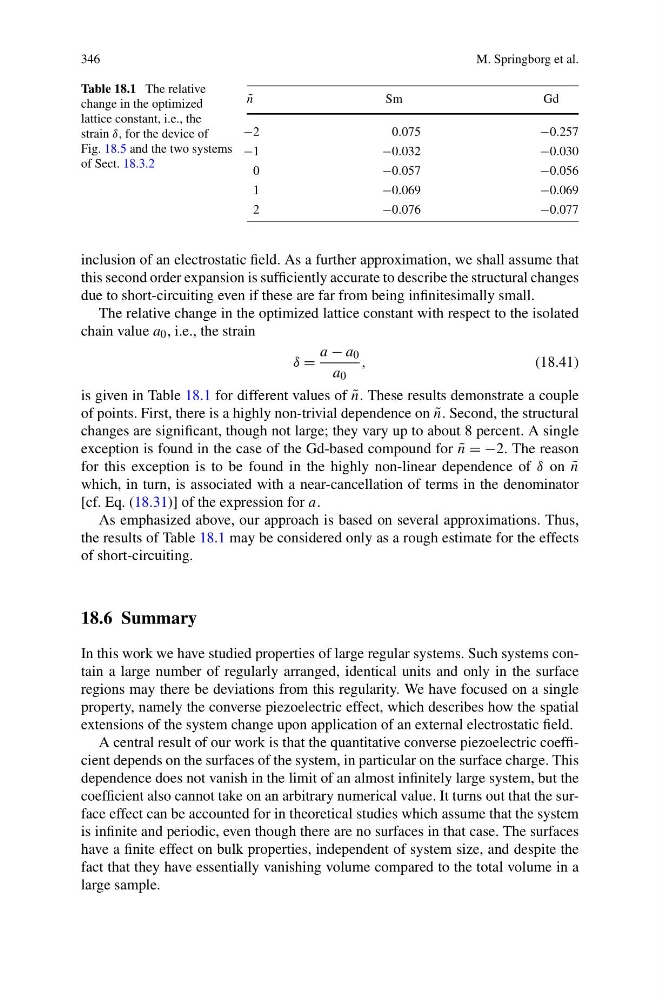
is given in Table 18.1 for different values of ˜
n. These results demonstrate a couple
of points. First, there is a highly non-trivial dependence on ˜
n. Second, the structural
changes are significant, though not large; they vary up to about 8 percent. A single
exception is found in the case of the Gd-based compound for ˜
n = −2. The reason
for this exception is to be found in the highly non-linear dependence of δ on ˜
n
which, in turn, is associated with a near-cancellation of terms in the denominator
[cf. Eq. (18.31)] of the expression for a.
As emphasized above, our approach is based on several approximations. Thus,
the results of Table 18.1 may be considered only as a rough estimate for the effects
of short-circuiting.
18.6 Summary
In this work we have studied properties of large regular systems. Such systems contain a large number of regularly arranged, identical units and only in the surface
regions may there be deviations from this regularity. We have focused on a single
property, namely the converse piezoelectric effect, which describes how the spatial
extensions of the system change upon application of an external electrostatic field.
A central result of our work is that the quantitative converse piezoelectric coefficient depends on the surfaces of the system, in particular on the surface charge. This
dependence does not vanish in the limit of an almost infinitely large system, but the
coefficient also cannot take on an arbitrary numerical value. It turns out that the surface effect can be accounted for in theoretical studies which assume that the system
is infinite and periodic, even though there are no surfaces in that case. The surfaces
have a finite effect on bulk properties, independent of system size, and despite the
fact that they have essentially vanishing volume compared to the total volume in a
large sample.
M. Springborg et al.
Table 18.1 The relative
change in the optimized
lattice constant, i.e., the
strain δ, for the device of
Fig. 18.5 and the two systems
of Sect. 18.3.2
˜
n
Sm
Gd
−2
0 .075
−0.257
−1
−0.032
−0.030
0
−0.057
−0.056
1
−0.069
−0.069
2
−0.076
−0.077
inclusion of an electrostatic field. As a further approximation, we shall assume that
this second order expansion is sufficiently accurate to describe the structural changes
due to short-circuiting even if these are far from being infinitesimally small.
The relative change in the optimized lattice constant with respect to the isolated
chain value a 0 , i.e., the strain
δ =
a − a 0
a 0
,
(18.41)
is given in Table 18.1 for different values of ˜
n. These results demonstrate a couple
of points. First, there is a highly non-trivial dependence on ˜
n. Second, the structural
changes are significant, though not large; they vary up to about 8 percent. A single
exception is found in the case of the Gd-based compound for ˜
n = −2. The reason
for this exception is to be found in the highly non-linear dependence of δ on ˜
n
which, in turn, is associated with a near-cancellation of terms in the denominator
[cf. Eq. (18.31)] of the expression for a.
As emphasized above, our approach is based on several approximations. Thus,
the results of Table 18.1 may be considered only as a rough estimate for the effects
of short-circuiting.
18.6 Summary
In this work we have studied properties of large regular systems. Such systems contain a large number of regularly arranged, identical units and only in the surface
regions may there be deviations from this regularity. We have focused on a single
property, namely the converse piezoelectric effect, which describes how the spatial
extensions of the system change upon application of an external electrostatic field.
A central result of our work is that the quantitative converse piezoelectric coefficient depends on the surfaces of the system, in particular on the surface charge. This
dependence does not vanish in the limit of an almost infinitely large system, but the
coefficient also cannot take on an arbitrary numerical value. It turns out that the surface effect can be accounted for in theoretical studies which assume that the system
is infinite and periodic, even though there are no surfaces in that case. The surfaces
have a finite effect on bulk properties, independent of system size, and despite the
fact that they have essentially vanishing volume compared to the total volume in a
large sample.