

18 On Converse Piezoelectricity
345
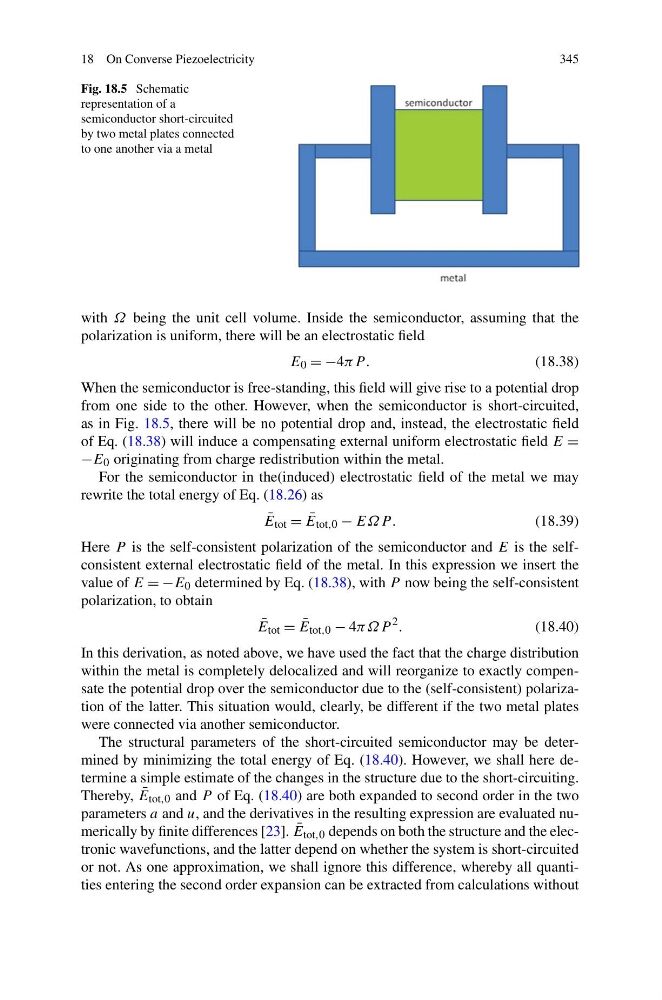
Fig. 18.5 Schematic
representation of a
semiconductor short-circuited
by two metal plates connected
to one another via a metal
with Ω being the unit cell volume. Inside the semiconductor, assuming that the
polarization is uniform, there will be an electrostatic field
E 0 = −4πP .
(18.38)
When the semiconductor is free-standing, this field will give rise to a potential drop
from one side to the other. However, when the semiconductor is short-circuited,
as in Fig. 18.5, there will be no potential drop and, instead, the electrostatic field
of Eq. (18.38) will induce a compensating external uniform electrostatic field E =
−E 0 originating from charge redistribution within the metal.
For the semiconductor in the(induced) electrostatic field of the metal we may
rewrite the total energy of Eq. (18.26) as
¯
E tot = ¯
E tot,0 − EΩP .
(18.39)
Here P is the self-consistent polarization of the semiconductor and E is the selfconsistent external electrostatic field of the metal. In this expression we insert the
value of E = −E 0 determined by Eq. (18.38), with P now being the self-consistent
polarization, to obtain
¯
E tot = ¯
E tot,0 − 4πΩP
2 .
(18.40)
In this derivation, as noted above, we have used the fact that the charge distribution
within the metal is completely delocalized and will reorganize to exactly compensate the potential drop over the semiconductor due to the (self-consistent) polarization of the latter. This situation would, clearly, be different if the two metal plates
were connected via another semiconductor.
The structural parameters of the short-circuited semiconductor may be determined by minimizing the total energy of Eq. (18.40). However, we shall here determine a simple estimate of the changes in the structure due to the short-circuiting.
Thereby, ¯
E tot,0 and P of Eq. (18.40) are both expanded to second order in the two
parameters a and u, and the derivatives in the resulting expression are evaluated numerically by finite differences [23]. ¯
E tot,0 depends on both the structure and the electronic wavefunctions, and the latter depend on whether the system is short-circuited
or not. As one approximation, we shall ignore this difference, whereby all quantities entering the second order expansion can be extracted from calculations without
345
Fig. 18.5 Schematic
representation of a
semiconductor short-circuited
by two metal plates connected
to one another via a metal
with Ω being the unit cell volume. Inside the semiconductor, assuming that the
polarization is uniform, there will be an electrostatic field
E 0 = −4πP .
(18.38)
When the semiconductor is free-standing, this field will give rise to a potential drop
from one side to the other. However, when the semiconductor is short-circuited,
as in Fig. 18.5, there will be no potential drop and, instead, the electrostatic field
of Eq. (18.38) will induce a compensating external uniform electrostatic field E =
−E 0 originating from charge redistribution within the metal.
For the semiconductor in the(induced) electrostatic field of the metal we may
rewrite the total energy of Eq. (18.26) as
¯
E tot = ¯
E tot,0 − EΩP .
(18.39)
Here P is the self-consistent polarization of the semiconductor and E is the selfconsistent external electrostatic field of the metal. In this expression we insert the
value of E = −E 0 determined by Eq. (18.38), with P now being the self-consistent
polarization, to obtain
¯
E tot = ¯
E tot,0 − 4πΩP
2 .
(18.40)
In this derivation, as noted above, we have used the fact that the charge distribution
within the metal is completely delocalized and will reorganize to exactly compensate the potential drop over the semiconductor due to the (self-consistent) polarization of the latter. This situation would, clearly, be different if the two metal plates
were connected via another semiconductor.
The structural parameters of the short-circuited semiconductor may be determined by minimizing the total energy of Eq. (18.40). However, we shall here determine a simple estimate of the changes in the structure due to the short-circuiting.
Thereby, ¯
E tot,0 and P of Eq. (18.40) are both expanded to second order in the two
parameters a and u, and the derivatives in the resulting expression are evaluated numerically by finite differences [23]. ¯
E tot,0 depends on both the structure and the electronic wavefunctions, and the latter depend on whether the system is short-circuited
or not. As one approximation, we shall ignore this difference, whereby all quantities entering the second order expansion can be extracted from calculations without