

340
M. Springborg et al.
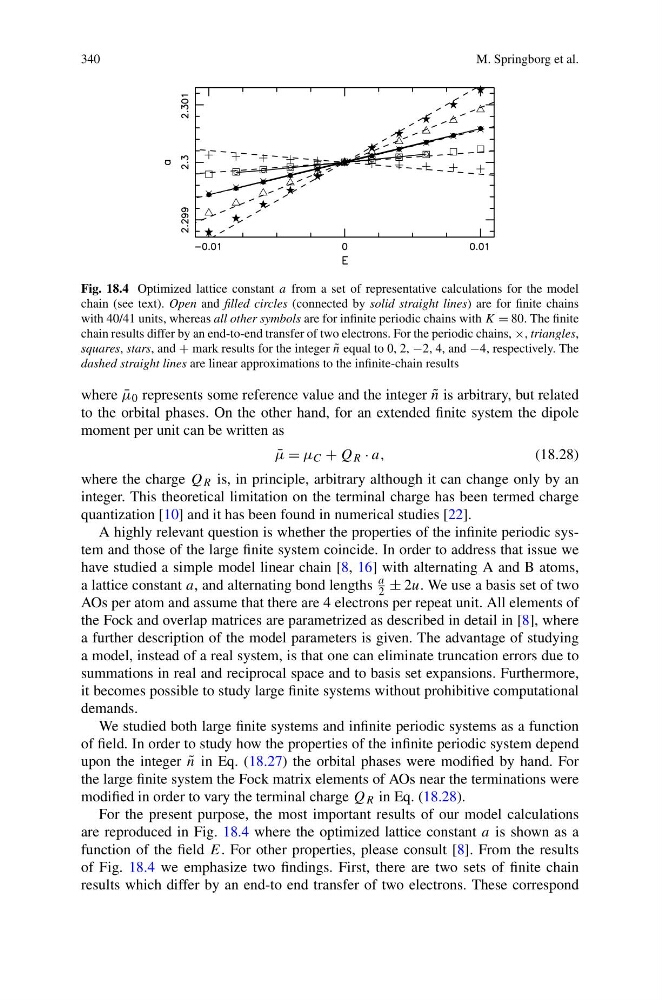
Fig. 18.4 Optimized lattice constant a from a set of representative calculations for the model
chain (see text). Open and filled circles (connected by solid straight lines) are for finite chains
with 40/41 units, whereas all other symbols are for infinite periodic chains with K = 80. The finite
chain results differ by an end-to-end transfer of two electrons. For the periodic chains, ×, triangles,
squares, stars, and + mark results for the integer ˜
n equal to 0, 2, −2, 4, and −4, respectively. The
dashed straight lines are linear approximations to the infinite-chain results
where ¯
μ 0 represents some reference value and the integer ˜
n is arbitrary, but related
to the orbital phases. On the other hand, for an extended finite system the dipole
moment per unit can be written as
¯
μ = μ C + Q R · a,
(18.28)
where the charge Q R is, in principle, arbitrary although it can change only by an
integer. This theoretical limitation on the terminal charge has been termed charge
quantization [10] and it has been found in numerical studies [22].
A highly relevant question is whether the properties of the infinite periodic system and those of the large finite system coincide. In order to address that issue we
have studied a simple model linear chain [8, 16] with alternating A and B atoms,
a lattice constant a, and alternating bond lengths
a
2 ± 2u. We use a basis set of two
AOs per atom and assume that there are 4 electrons per repeat unit. All elements of
the Fock and overlap matrices are parametrized as described in detail in [8], where
a further description of the model parameters is given. The advantage of studying
a model, instead of a real system, is that one can eliminate truncation errors due to
summations in real and reciprocal space and to basis set expansions. Furthermore,
it becomes possible to study large finite systems without prohibitive computational
demands.
We studied both large finite systems and infinite periodic systems as a function
of field. In order to study how the properties of the infinite periodic system depend
upon the integer ˜
n in Eq. (18.27) the orbital phases were modified by hand. For
the large finite system the Fock matrix elements of AOs near the terminations were
modified in order to vary the terminal charge Q R in Eq. (18.28).
For the present purpose, the most important results of our model calculations
are reproduced in Fig. 18.4 where the optimized lattice constant a is shown as a
function of the field E. For other properties, please consult [8]. From the results
of Fig. 18.4 we emphasize two findings. First, there are two sets of finite chain
results which differ by an end-to end transfer of two electrons. These correspond
M. Springborg et al.
Fig. 18.4 Optimized lattice constant a from a set of representative calculations for the model
chain (see text). Open and filled circles (connected by solid straight lines) are for finite chains
with 40/41 units, whereas all other symbols are for infinite periodic chains with K = 80. The finite
chain results differ by an end-to-end transfer of two electrons. For the periodic chains, ×, triangles,
squares, stars, and + mark results for the integer ˜
n equal to 0, 2, −2, 4, and −4, respectively. The
dashed straight lines are linear approximations to the infinite-chain results
where ¯
μ 0 represents some reference value and the integer ˜
n is arbitrary, but related
to the orbital phases. On the other hand, for an extended finite system the dipole
moment per unit can be written as
¯
μ = μ C + Q R · a,
(18.28)
where the charge Q R is, in principle, arbitrary although it can change only by an
integer. This theoretical limitation on the terminal charge has been termed charge
quantization [10] and it has been found in numerical studies [22].
A highly relevant question is whether the properties of the infinite periodic system and those of the large finite system coincide. In order to address that issue we
have studied a simple model linear chain [8, 16] with alternating A and B atoms,
a lattice constant a, and alternating bond lengths
a
2 ± 2u. We use a basis set of two
AOs per atom and assume that there are 4 electrons per repeat unit. All elements of
the Fock and overlap matrices are parametrized as described in detail in [8], where
a further description of the model parameters is given. The advantage of studying
a model, instead of a real system, is that one can eliminate truncation errors due to
summations in real and reciprocal space and to basis set expansions. Furthermore,
it becomes possible to study large finite systems without prohibitive computational
demands.
We studied both large finite systems and infinite periodic systems as a function
of field. In order to study how the properties of the infinite periodic system depend
upon the integer ˜
n in Eq. (18.27) the orbital phases were modified by hand. For
the large finite system the Fock matrix elements of AOs near the terminations were
modified in order to vary the terminal charge Q R in Eq. (18.28).
For the present purpose, the most important results of our model calculations
are reproduced in Fig. 18.4 where the optimized lattice constant a is shown as a
function of the field E. For other properties, please consult [8]. From the results
of Fig. 18.4 we emphasize two findings. First, there are two sets of finite chain
results which differ by an end-to end transfer of two electrons. These correspond