

326
T. Ishimoto and M. Tachikawa
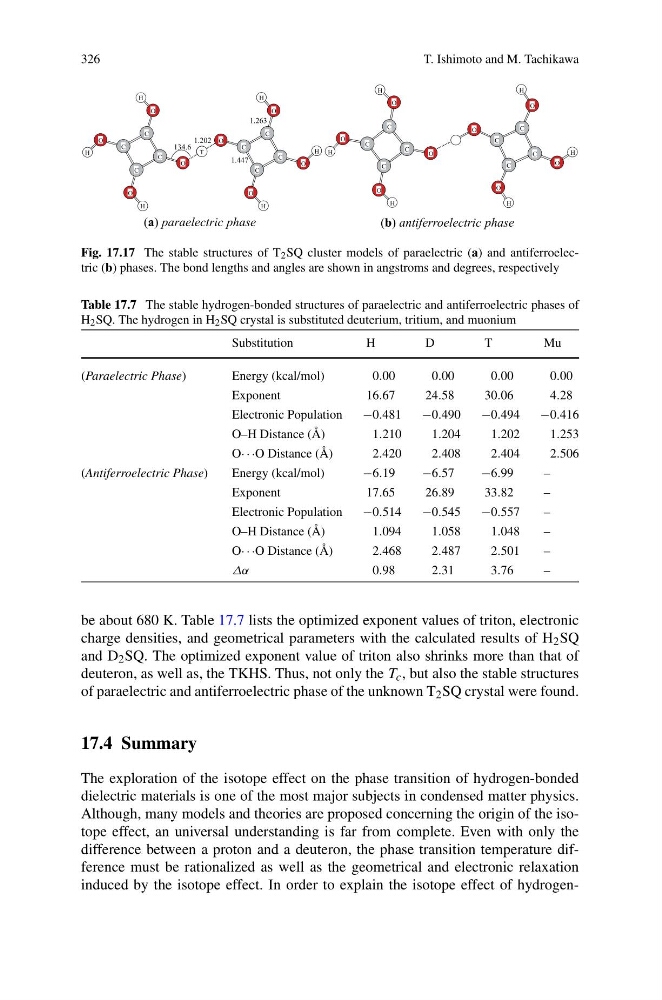
Fig. 17.17 The stable structures of T 2 SQ cluster models of paraelectric (a) and antiferroelectric (b) phases. The bond lengths and angles are shown in angstroms and degrees, respectively
Table 17.7 The stable hydrogen-bonded structures of paraelectric and antiferroelectric phases of
H 2 SQ. The hydrogen in H 2 SQ crystal is substituted deuterium, tritium, and muonium
Substitution
H
D
T
Mu
(Paraelectric Phase)
Energy (kcal/mol)
0.00
0.00
0.00
0.00
Exponent
16.67
24.58
30.06
4.28
Electronic Population
−0.481
−0.490
−0.494
−0.416
O–H Distance (Å)
1.210
1.204
1.202
1.253
O· · ·O Distance (Å)
2.420
2.408
2.404
2.506
(Antiferroelectric Phase)
Energy (kcal/mol)
−6.19
−6.57
−6.99
–
Exponent
17.65
26.89
33.82
–
Electronic Population
−0.514
−0.545
−0.557
–
O–H Distance (Å)
1.094
1.058
1.048
–
O· · ·O Distance (Å)
2.468
2.487
2.501
–
Δα
0.98
2.31
3.76
–
be about 680 K. Table 17.7 lists the optimized exponent values of triton, electronic
charge densities, and geometrical parameters with the calculated results of H 2 SQ
and D 2 SQ. The optimized exponent value of triton also shrinks more than that of
deuteron, as well as, the TKHS. Thus, not only the T c , but also the stable structures
of paraelectric and antiferroelectric phase of the unknown T 2 SQ crystal were found.
17.4 Summary
The exploration of the isotope effect on the phase transition of hydrogen-bonded
dielectric materials is one of the most major subjects in condensed matter physics.
Although, many models and theories are proposed concerning the origin of the isotope effect, an universal understanding is far from complete. Even with only the
difference between a proton and a deuteron, the phase transition temperature difference must be rationalized as well as the geometrical and electronic relaxation
induced by the isotope effect. In order to explain the isotope effect of hydrogen-
T. Ishimoto and M. Tachikawa
Fig. 17.17 The stable structures of T 2 SQ cluster models of paraelectric (a) and antiferroelectric (b) phases. The bond lengths and angles are shown in angstroms and degrees, respectively
Table 17.7 The stable hydrogen-bonded structures of paraelectric and antiferroelectric phases of
H 2 SQ. The hydrogen in H 2 SQ crystal is substituted deuterium, tritium, and muonium
Substitution
H
D
T
Mu
(Paraelectric Phase)
Energy (kcal/mol)
0.00
0.00
0.00
0.00
Exponent
16.67
24.58
30.06
4.28
Electronic Population
−0.481
−0.490
−0.494
−0.416
O–H Distance (Å)
1.210
1.204
1.202
1.253
O· · ·O Distance (Å)
2.420
2.408
2.404
2.506
(Antiferroelectric Phase)
Energy (kcal/mol)
−6.19
−6.57
−6.99
–
Exponent
17.65
26.89
33.82
–
Electronic Population
−0.514
−0.545
−0.557
–
O–H Distance (Å)
1.094
1.058
1.048
–
O· · ·O Distance (Å)
2.468
2.487
2.501
–
Δα
0.98
2.31
3.76
–
be about 680 K. Table 17.7 lists the optimized exponent values of triton, electronic
charge densities, and geometrical parameters with the calculated results of H 2 SQ
and D 2 SQ. The optimized exponent value of triton also shrinks more than that of
deuteron, as well as, the TKHS. Thus, not only the T c , but also the stable structures
of paraelectric and antiferroelectric phase of the unknown T 2 SQ crystal were found.
17.4 Summary
The exploration of the isotope effect on the phase transition of hydrogen-bonded
dielectric materials is one of the most major subjects in condensed matter physics.
Although, many models and theories are proposed concerning the origin of the isotope effect, an universal understanding is far from complete. Even with only the
difference between a proton and a deuteron, the phase transition temperature difference must be rationalized as well as the geometrical and electronic relaxation
induced by the isotope effect. In order to explain the isotope effect of hydrogen-