

316
T. Ishimoto and M. Tachikawa
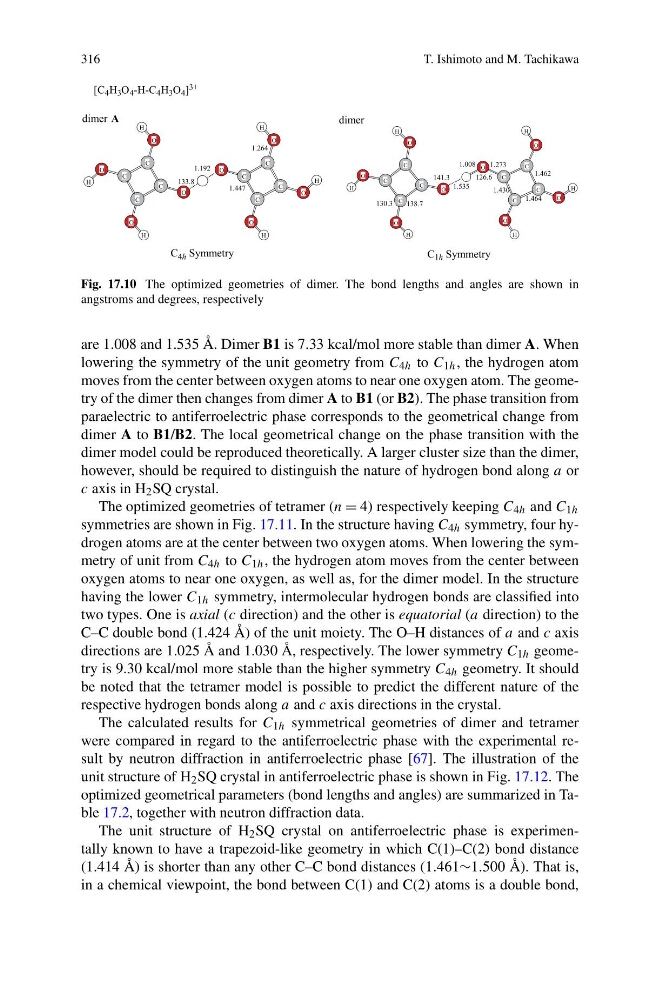
Fig. 17.10 The optimized geometries of dimer. The bond lengths and angles are shown in
angstroms and degrees, respectively
are 1.008 and 1.535 Å. Dimer B1 is 7.33 kcal/mol more stable than dimer A. When
lowering the symmetry of the unit geometry from C 4h to C 1h , the hydrogen atom
moves from the center between oxygen atoms to near one oxygen atom. The geometry of the dimer then changes from dimer A to B1 (or B2). The phase transition from
paraelectric to antiferroelectric phase corresponds to the geometrical change from
dimer A to B1/B2. The local geometrical change on the phase transition with the
dimer model could be reproduced theoretically. A larger cluster size than the dimer,
however, should be required to distinguish the nature of hydrogen bond along a or
c axis in H 2 SQ crystal.
The optimized geometries of tetramer (n = 4) respectively keeping C 4h and C 1h
symmetries are shown in Fig. 17.11. In the structure having C 4h symmetry, four hydrogen atoms are at the center between two oxygen atoms. When lowering the symmetry of unit from C 4h to C 1h , the hydrogen atom moves from the center between
oxygen atoms to near one oxygen, as well as, for the dimer model. In the structure
having the lower C 1h symmetry, intermolecular hydrogen bonds are classified into
two types. One is axial (c direction) and the other is equatorial (a direction) to the
C–C double bond (1.424 Å) of the unit moiety. The O–H distances of a and c axis
directions are 1.025 Å and 1.030 Å, respectively. The lower symmetry C 1h geometry is 9.30 kcal/mol more stable than the higher symmetry C 4h geometry. It should
be noted that the tetramer model is possible to predict the different nature of the
respective hydrogen bonds along a and c axis directions in the crystal.
The calculated results for C 1h symmetrical geometries of dimer and tetramer
were compared in regard to the antiferroelectric phase with the experimental result by neutron diffraction in antiferroelectric phase [67]. The illustration of the
unit structure of H 2 SQ crystal in antiferroelectric phase is shown in Fig. 17.12. The
optimized geometrical parameters (bond lengths and angles) are summarized in Table 17.2, together with neutron diffraction data.
The unit structure of H 2 SQ crystal on antiferroelectric phase is experimentally known to have a trapezoid-like geometry in which C(1)–C(2) bond distance
(1.414 Å) is shorter than any other C–C bond distances (1.461∼1.500 Å). That is,
in a chemical viewpoint, the bond between C(1) and C(2) atoms is a double bond,
T. Ishimoto and M. Tachikawa
Fig. 17.10 The optimized geometries of dimer. The bond lengths and angles are shown in
angstroms and degrees, respectively
are 1.008 and 1.535 Å. Dimer B1 is 7.33 kcal/mol more stable than dimer A. When
lowering the symmetry of the unit geometry from C 4h to C 1h , the hydrogen atom
moves from the center between oxygen atoms to near one oxygen atom. The geometry of the dimer then changes from dimer A to B1 (or B2). The phase transition from
paraelectric to antiferroelectric phase corresponds to the geometrical change from
dimer A to B1/B2. The local geometrical change on the phase transition with the
dimer model could be reproduced theoretically. A larger cluster size than the dimer,
however, should be required to distinguish the nature of hydrogen bond along a or
c axis in H 2 SQ crystal.
The optimized geometries of tetramer (n = 4) respectively keeping C 4h and C 1h
symmetries are shown in Fig. 17.11. In the structure having C 4h symmetry, four hydrogen atoms are at the center between two oxygen atoms. When lowering the symmetry of unit from C 4h to C 1h , the hydrogen atom moves from the center between
oxygen atoms to near one oxygen, as well as, for the dimer model. In the structure
having the lower C 1h symmetry, intermolecular hydrogen bonds are classified into
two types. One is axial (c direction) and the other is equatorial (a direction) to the
C–C double bond (1.424 Å) of the unit moiety. The O–H distances of a and c axis
directions are 1.025 Å and 1.030 Å, respectively. The lower symmetry C 1h geometry is 9.30 kcal/mol more stable than the higher symmetry C 4h geometry. It should
be noted that the tetramer model is possible to predict the different nature of the
respective hydrogen bonds along a and c axis directions in the crystal.
The calculated results for C 1h symmetrical geometries of dimer and tetramer
were compared in regard to the antiferroelectric phase with the experimental result by neutron diffraction in antiferroelectric phase [67]. The illustration of the
unit structure of H 2 SQ crystal in antiferroelectric phase is shown in Fig. 17.12. The
optimized geometrical parameters (bond lengths and angles) are summarized in Table 17.2, together with neutron diffraction data.
The unit structure of H 2 SQ crystal on antiferroelectric phase is experimentally known to have a trapezoid-like geometry in which C(1)–C(2) bond distance
(1.414 Å) is shorter than any other C–C bond distances (1.461∼1.500 Å). That is,
in a chemical viewpoint, the bond between C(1) and C(2) atoms is a double bond,