

16 Topological Mechanochemistry of Graphene
289
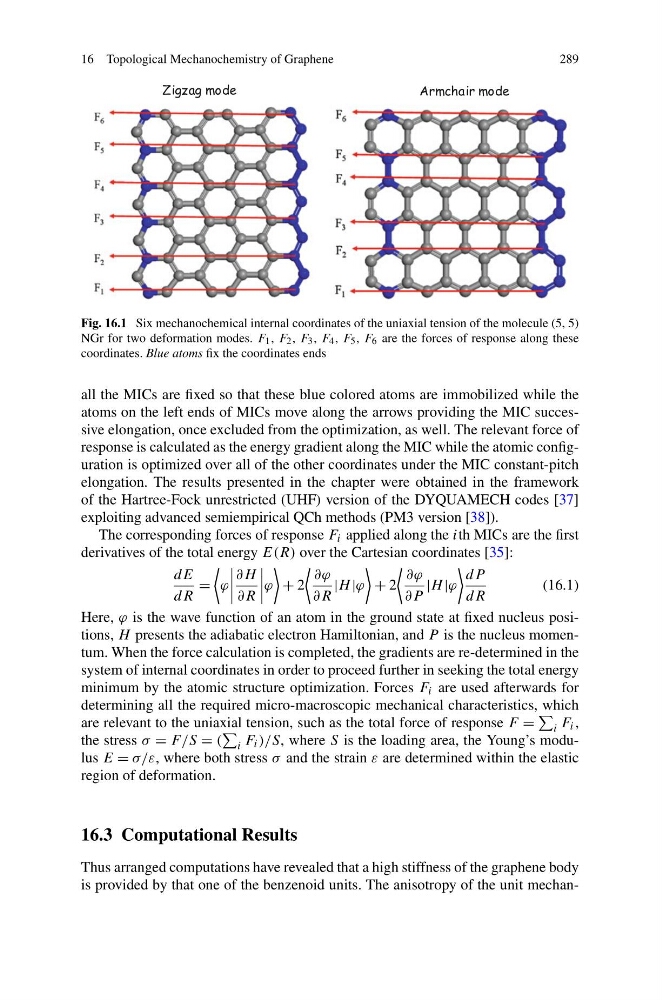
Fig. 16.1 Six mechanochemical internal coordinates of the uniaxial tension of the molecule (5, 5)
NGr for two deformation modes. F 1 , F 2 , F 3 , F 4 , F 5 , F 6 are the forces of response along these
coordinates. Blue atoms fix the coordinates ends
all the MICs are fixed so that these blue colored atoms are immobilized while the
atoms on the left ends of MICs move along the arrows providing the MIC successive elongation, once excluded from the optimization, as well. The relevant force of
response is calculated as the energy gradient along the MIC while the atomic configuration is optimized over all of the other coordinates under the MIC constant-pitch
elongation. The results presented in the chapter were obtained in the framework
of the Hartree-Fock unrestricted (UHF) version of the DYQUAMECH codes [37]
exploiting advanced semiempirical QCh methods (PM3 version [38]).
The corresponding forces of response F i applied along the ith MICs are the first
derivatives of the total energy E(R) over the Cartesian coordinates [35]:
dE
dR
=
ϕ
∂H
∂R
ϕ
+ 2
∂ϕ
∂R
|H |ϕ
+ 2
∂ϕ
∂P
|H |ϕ
dP
dR
(16.1)
Here, ϕ is the wave function of an atom in the ground state at fixed nucleus positions, H presents the adiabatic electron Hamiltonian, and P is the nucleus momentum. When the force calculation is completed, the gradients are re-determined in the
system of internal coordinates in order to proceed further in seeking the total energy
minimum by the atomic structure optimization. Forces F i are used afterwards for
determining all the required micro-macroscopic mechanical characteristics, which
are relevant to the uniaxial tension, such as the total force of response F =
i F i ,
the stress σ = F /S = (
i F i )/S, where S is the loading area, the Young’s modulus E = σ/ε, where both stress σ and the strain ε are determined within the elastic
region of deformation.
16.3 Computational Results
Thus arranged computations have revealed that a high stiffness of the graphene body
is provided by that one of the benzenoid units. The anisotropy of the unit mechan-
289
Fig. 16.1 Six mechanochemical internal coordinates of the uniaxial tension of the molecule (5, 5)
NGr for two deformation modes. F 1 , F 2 , F 3 , F 4 , F 5 , F 6 are the forces of response along these
coordinates. Blue atoms fix the coordinates ends
all the MICs are fixed so that these blue colored atoms are immobilized while the
atoms on the left ends of MICs move along the arrows providing the MIC successive elongation, once excluded from the optimization, as well. The relevant force of
response is calculated as the energy gradient along the MIC while the atomic configuration is optimized over all of the other coordinates under the MIC constant-pitch
elongation. The results presented in the chapter were obtained in the framework
of the Hartree-Fock unrestricted (UHF) version of the DYQUAMECH codes [37]
exploiting advanced semiempirical QCh methods (PM3 version [38]).
The corresponding forces of response F i applied along the ith MICs are the first
derivatives of the total energy E(R) over the Cartesian coordinates [35]:
dE
dR
=
ϕ
∂H
∂R
ϕ
+ 2
∂ϕ
∂R
|H |ϕ
+ 2
∂ϕ
∂P
|H |ϕ
dP
dR
(16.1)
Here, ϕ is the wave function of an atom in the ground state at fixed nucleus positions, H presents the adiabatic electron Hamiltonian, and P is the nucleus momentum. When the force calculation is completed, the gradients are re-determined in the
system of internal coordinates in order to proceed further in seeking the total energy
minimum by the atomic structure optimization. Forces F i are used afterwards for
determining all the required micro-macroscopic mechanical characteristics, which
are relevant to the uniaxial tension, such as the total force of response F =
i F i ,
the stress σ = F /S = (
i F i )/S, where S is the loading area, the Young’s modulus E = σ/ε, where both stress σ and the strain ε are determined within the elastic
region of deformation.
16.3 Computational Results
Thus arranged computations have revealed that a high stiffness of the graphene body
is provided by that one of the benzenoid units. The anisotropy of the unit mechan-