

274
E.F. Sheka
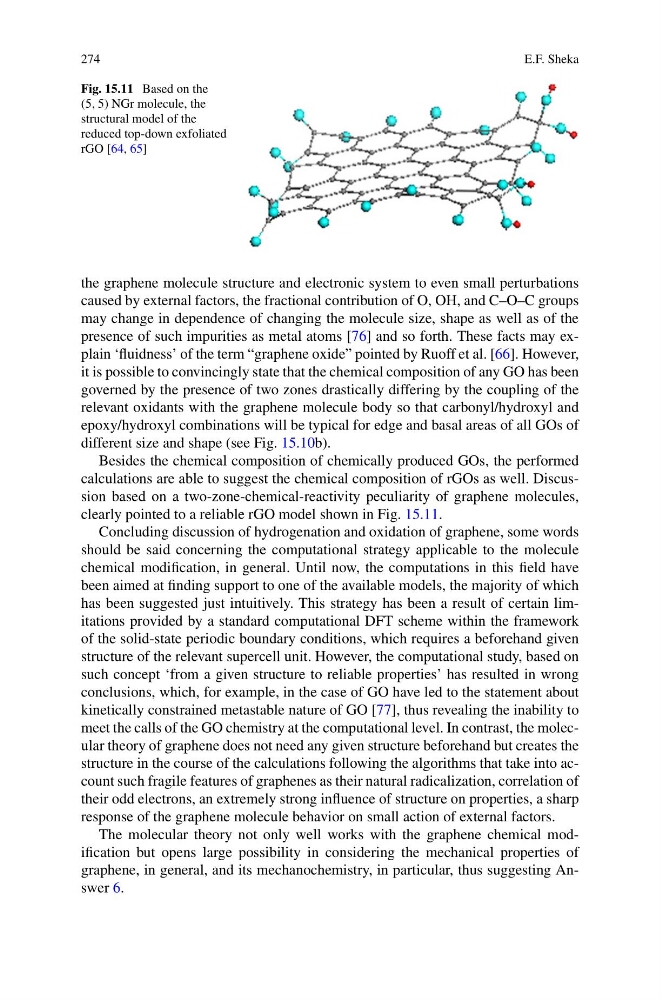
Fig. 15.11 Based on the
(5, 5) NGr molecule, the
structural model of the
reduced top-down exfoliated
rGO [64, 65]
the graphene molecule structure and electronic system to even small perturbations
caused by external factors, the fractional contribution of O, OH, and C–O–C groups
may change in dependence of changing the molecule size, shape as well as of the
presence of such impurities as metal atoms [76] and so forth. These facts may explain ‘fluidness’ of the term “graphene oxide” pointed by Ruoff et al. [66]. However,
it is possible to convincingly state that the chemical composition of any GO has been
governed by the presence of two zones drastically differing by the coupling of the
relevant oxidants with the graphene molecule body so that carbonyl/hydroxyl and
epoxy/hydroxyl combinations will be typical for edge and basal areas of all GOs of
different size and shape (see Fig. 15.10b).
Besides the chemical composition of chemically produced GOs, the performed
calculations are able to suggest the chemical composition of rGOs as well. Discussion based on a two-zone-chemical-reactivity peculiarity of graphene molecules,
clearly pointed to a reliable rGO model shown in Fig. 15.11.
Concluding discussion of hydrogenation and oxidation of graphene, some words
should be said concerning the computational strategy applicable to the molecule
chemical modification, in general. Until now, the computations in this field have
been aimed at finding support to one of the available models, the majority of which
has been suggested just intuitively. This strategy has been a result of certain limitations provided by a standard computational DFT scheme within the framework
of the solid-state periodic boundary conditions, which requires a beforehand given
structure of the relevant supercell unit. However, the computational study, based on
such concept ‘from a given structure to reliable properties’ has resulted in wrong
conclusions, which, for example, in the case of GO have led to the statement about
kinetically constrained metastable nature of GO [77], thus revealing the inability to
meet the calls of the GO chemistry at the computational level. In contrast, the molecular theory of graphene does not need any given structure beforehand but creates the
structure in the course of the calculations following the algorithms that take into account such fragile features of graphenes as their natural radicalization, correlation of
their odd electrons, an extremely strong influence of structure on properties, a sharp
response of the graphene molecule behavior on small action of external factors.
The molecular theory not only well works with the graphene chemical modification but opens large possibility in considering the mechanical properties of
graphene, in general, and its mechanochemistry, in particular, thus suggesting Answer 6.
E.F. Sheka
Fig. 15.11 Based on the
(5, 5) NGr molecule, the
structural model of the
reduced top-down exfoliated
rGO [64, 65]
the graphene molecule structure and electronic system to even small perturbations
caused by external factors, the fractional contribution of O, OH, and C–O–C groups
may change in dependence of changing the molecule size, shape as well as of the
presence of such impurities as metal atoms [76] and so forth. These facts may explain ‘fluidness’ of the term “graphene oxide” pointed by Ruoff et al. [66]. However,
it is possible to convincingly state that the chemical composition of any GO has been
governed by the presence of two zones drastically differing by the coupling of the
relevant oxidants with the graphene molecule body so that carbonyl/hydroxyl and
epoxy/hydroxyl combinations will be typical for edge and basal areas of all GOs of
different size and shape (see Fig. 15.10b).
Besides the chemical composition of chemically produced GOs, the performed
calculations are able to suggest the chemical composition of rGOs as well. Discussion based on a two-zone-chemical-reactivity peculiarity of graphene molecules,
clearly pointed to a reliable rGO model shown in Fig. 15.11.
Concluding discussion of hydrogenation and oxidation of graphene, some words
should be said concerning the computational strategy applicable to the molecule
chemical modification, in general. Until now, the computations in this field have
been aimed at finding support to one of the available models, the majority of which
has been suggested just intuitively. This strategy has been a result of certain limitations provided by a standard computational DFT scheme within the framework
of the solid-state periodic boundary conditions, which requires a beforehand given
structure of the relevant supercell unit. However, the computational study, based on
such concept ‘from a given structure to reliable properties’ has resulted in wrong
conclusions, which, for example, in the case of GO have led to the statement about
kinetically constrained metastable nature of GO [77], thus revealing the inability to
meet the calls of the GO chemistry at the computational level. In contrast, the molecular theory of graphene does not need any given structure beforehand but creates the
structure in the course of the calculations following the algorithms that take into account such fragile features of graphenes as their natural radicalization, correlation of
their odd electrons, an extremely strong influence of structure on properties, a sharp
response of the graphene molecule behavior on small action of external factors.
The molecular theory not only well works with the graphene chemical modification but opens large possibility in considering the mechanical properties of
graphene, in general, and its mechanochemistry, in particular, thus suggesting Answer 6.