

15 Molecular Theory of Graphene
273
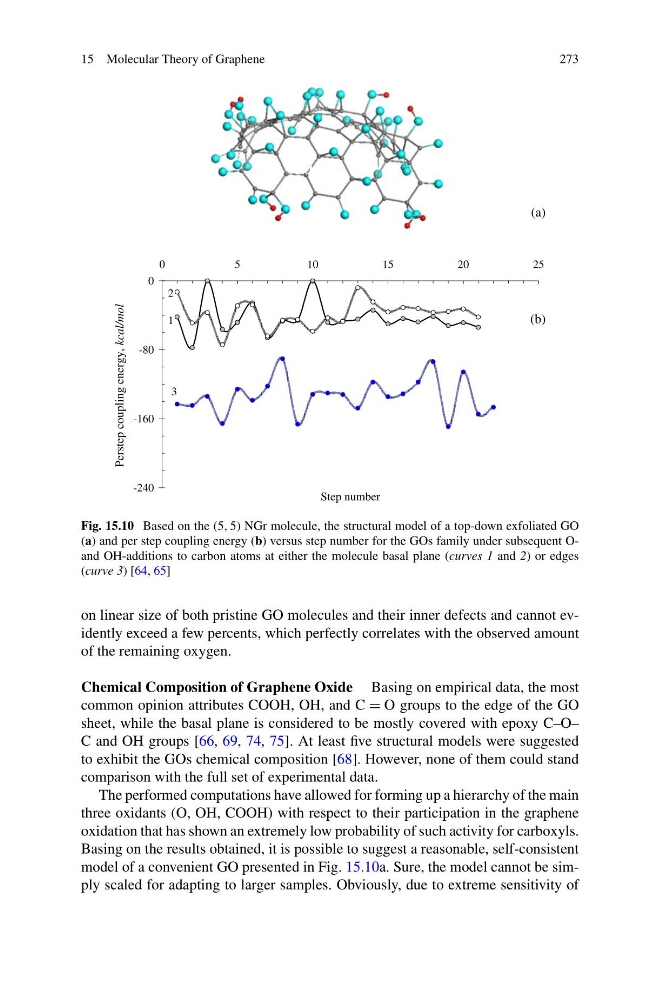
Fig. 15.10 Based on the (5, 5) NGr molecule, the structural model of a top-down exfoliated GO
(a) and per step coupling energy (b) versus step number for the GOs family under subsequent Oand OH-additions to carbon atoms at either the molecule basal plane (curves 1 and 2) or edges
(curve 3) [64, 65]
on linear size of both pristine GO molecules and their inner defects and cannot evidently exceed a few percents, which perfectly correlates with the observed amount
of the remaining oxygen.
Chemical Composition of Graphene Oxide Basing on empirical data, the most
common opinion attributes COOH, OH, and C = O groups to the edge of the GO
sheet, while the basal plane is considered to be mostly covered with epoxy C–O–
C and OH groups [66, 69, 74, 75]. At least five structural models were suggested
to exhibit the GOs chemical composition [68]. However, none of them could stand
comparison with the full set of experimental data.
The performed computations have allowed for forming up a hierarchy of the main
three oxidants (O, OH, COOH) with respect to their participation in the graphene
oxidation that has shown an extremely low probability of such activity for carboxyls.
Basing on the results obtained, it is possible to suggest a reasonable, self-consistent
model of a convenient GO presented in Fig. 15.10a. Sure, the model cannot be simply scaled for adapting to larger samples. Obviously, due to extreme sensitivity of
273
Fig. 15.10 Based on the (5, 5) NGr molecule, the structural model of a top-down exfoliated GO
(a) and per step coupling energy (b) versus step number for the GOs family under subsequent Oand OH-additions to carbon atoms at either the molecule basal plane (curves 1 and 2) or edges
(curve 3) [64, 65]
on linear size of both pristine GO molecules and their inner defects and cannot evidently exceed a few percents, which perfectly correlates with the observed amount
of the remaining oxygen.
Chemical Composition of Graphene Oxide Basing on empirical data, the most
common opinion attributes COOH, OH, and C = O groups to the edge of the GO
sheet, while the basal plane is considered to be mostly covered with epoxy C–O–
C and OH groups [66, 69, 74, 75]. At least five structural models were suggested
to exhibit the GOs chemical composition [68]. However, none of them could stand
comparison with the full set of experimental data.
The performed computations have allowed for forming up a hierarchy of the main
three oxidants (O, OH, COOH) with respect to their participation in the graphene
oxidation that has shown an extremely low probability of such activity for carboxyls.
Basing on the results obtained, it is possible to suggest a reasonable, self-consistent
model of a convenient GO presented in Fig. 15.10a. Sure, the model cannot be simply scaled for adapting to larger samples. Obviously, due to extreme sensitivity of