

270
E.F. Sheka
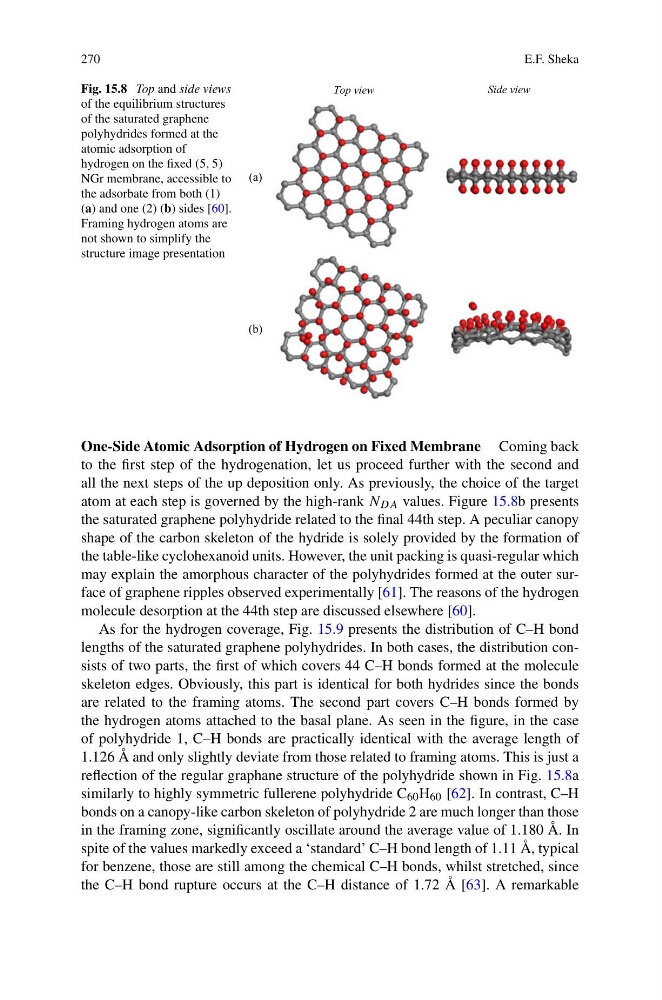
Fig. 15.8 Top and side views
of the equilibrium structures
of the saturated graphene
polyhydrides formed at the
atomic adsorption of
hydrogen on the fixed (5, 5)
NGr membrane, accessible to
the adsorbate from both (1)
(a) and one (2) (b) sides [60].
Framing hydrogen atoms are
not shown to simplify the
structure image presentation
One-Side Atomic Adsorption of Hydrogen on Fixed Membrane Coming back
to the first step of the hydrogenation, let us proceed further with the second and
all the next steps of the up deposition only. As previously, the choice of the target
atom at each step is governed by the high-rank N DA values. Figure 15.8b presents
the saturated graphene polyhydride related to the final 44th step. A peculiar canopy
shape of the carbon skeleton of the hydride is solely provided by the formation of
the table-like cyclohexanoid units. However, the unit packing is quasi-regular which
may explain the amorphous character of the polyhydrides formed at the outer surface of graphene ripples observed experimentally [61]. The reasons of the hydrogen
molecule desorption at the 44th step are discussed elsewhere [60].
As for the hydrogen coverage, Fig. 15.9 presents the distribution of C–H bond
lengths of the saturated graphene polyhydrides. In both cases, the distribution consists of two parts, the first of which covers 44 C–H bonds formed at the molecule
skeleton edges. Obviously, this part is identical for both hydrides since the bonds
are related to the framing atoms. The second part covers C–H bonds formed by
the hydrogen atoms attached to the basal plane. As seen in the figure, in the case
of polyhydride 1, C–H bonds are practically identical with the average length of
1.126 Å and only slightly deviate from those related to framing atoms. This is just a
reflection of the regular graphane structure of the polyhydride shown in Fig. 15.8a
similarly to highly symmetric fullerene polyhydride C 60 H 60 [62]. In contrast, C–H
bonds on a canopy-like carbon skeleton of polyhydride 2 are much longer than those
in the framing zone, significantly oscillate around the average value of 1.180 Å. In
spite of the values markedly exceed a ‘standard’ C–H bond length of 1.11 Å, typical
for benzene, those are still among the chemical C–H bonds, whilst stretched, since
the C–H bond rupture occurs at the C–H distance of 1.72 Å [63]. A remarkable
E.F. Sheka
Fig. 15.8 Top and side views
of the equilibrium structures
of the saturated graphene
polyhydrides formed at the
atomic adsorption of
hydrogen on the fixed (5, 5)
NGr membrane, accessible to
the adsorbate from both (1)
(a) and one (2) (b) sides [60].
Framing hydrogen atoms are
not shown to simplify the
structure image presentation
One-Side Atomic Adsorption of Hydrogen on Fixed Membrane Coming back
to the first step of the hydrogenation, let us proceed further with the second and
all the next steps of the up deposition only. As previously, the choice of the target
atom at each step is governed by the high-rank N DA values. Figure 15.8b presents
the saturated graphene polyhydride related to the final 44th step. A peculiar canopy
shape of the carbon skeleton of the hydride is solely provided by the formation of
the table-like cyclohexanoid units. However, the unit packing is quasi-regular which
may explain the amorphous character of the polyhydrides formed at the outer surface of graphene ripples observed experimentally [61]. The reasons of the hydrogen
molecule desorption at the 44th step are discussed elsewhere [60].
As for the hydrogen coverage, Fig. 15.9 presents the distribution of C–H bond
lengths of the saturated graphene polyhydrides. In both cases, the distribution consists of two parts, the first of which covers 44 C–H bonds formed at the molecule
skeleton edges. Obviously, this part is identical for both hydrides since the bonds
are related to the framing atoms. The second part covers C–H bonds formed by
the hydrogen atoms attached to the basal plane. As seen in the figure, in the case
of polyhydride 1, C–H bonds are practically identical with the average length of
1.126 Å and only slightly deviate from those related to framing atoms. This is just a
reflection of the regular graphane structure of the polyhydride shown in Fig. 15.8a
similarly to highly symmetric fullerene polyhydride C 60 H 60 [62]. In contrast, C–H
bonds on a canopy-like carbon skeleton of polyhydride 2 are much longer than those
in the framing zone, significantly oscillate around the average value of 1.180 Å. In
spite of the values markedly exceed a ‘standard’ C–H bond length of 1.11 Å, typical
for benzene, those are still among the chemical C–H bonds, whilst stretched, since
the C–H bond rupture occurs at the C–H distance of 1.72 Å [63]. A remarkable