

15 Molecular Theory of Graphene
255
Table 15.2 Energies of singlet ground state and exchange integral of the rectangular graphene
fragments, a kcal/mole [17]
Fragment (n a , n z ) E R (0) E U (0) E P S (0) )E RP S δE RP S b % E UP S δE UP S b % J
(5, 5)
1902 1495 1432
470
24.70
63
4.39
−1.429
(7, 7)
2599 2223 2156
443
17.03
67
3.09
−0.888
(9, 9)
3419 2778 2710
709
20.75
68
2.53
−0.600
(11, 10)
4072 3312 3241
831
20.42
71
2.20
−0.483
(11, 12)
4577 3676 3606
971
21.22
70
1.95
−0.406
(15, 12)
5451 4413 4339
1112
20.40
74
1.70
−0.324
a AM1 version of UHF codes of CLUSTER-Z1. Presented energy values are rounded off to an
integer
b The percentage values are related to δE RP S = E RP S /E R (0) and δE UP S = E UP S /E U (0),
respectively
where, E U (0) is the energy of the singlet state of the USB solution while S max is the
highest spin of the studied odd electron system and J presents the exchange integral
J =
E U (0) − E U (S max )
S 2
max
.
(15.5)
Here, E U (S max ) is the energy of the highest-spin-multiplicity state and corresponds
to the S max -pure-spin state.
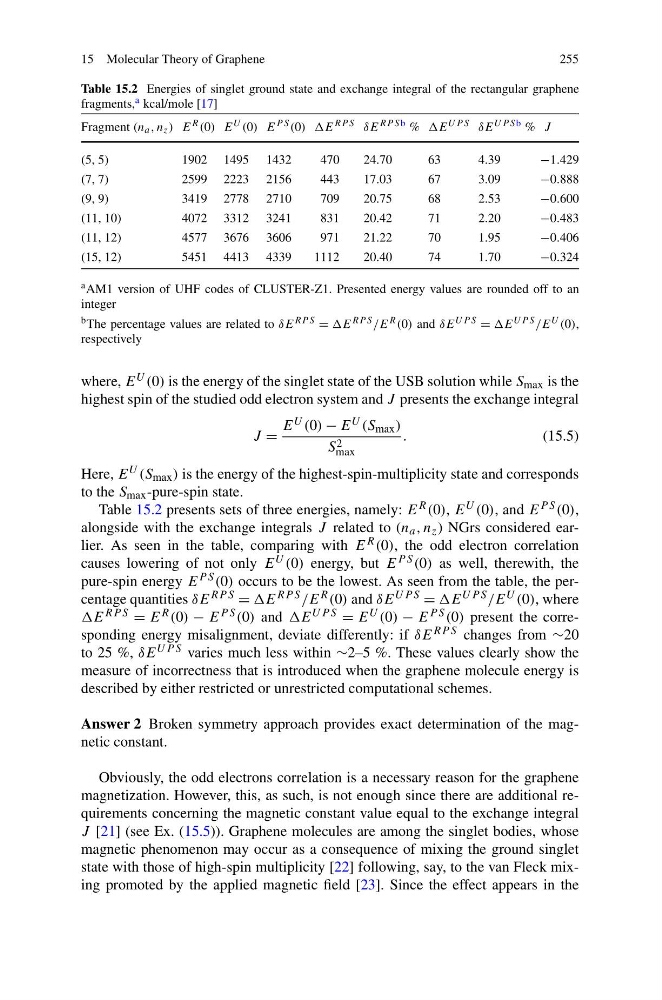
Table 15.2 presents sets of three energies, namely: E R (0), E U (0), and E P S (0),
alongside with the exchange integrals J related to (n a , n z ) NGrs considered earlier. As seen in the table, comparing with E R (0), the odd electron correlation
causes lowering of not only E U (0) energy, but E P S (0) as well, therewith, the
pure-spin energy E P S (0) occurs to be the lowest. As seen from the table, the percentage quantities δE RP S = E RP S /E R (0) and δE UP S = E UP S /E U (0), where
E RP S = E R (0) − E P S (0) and E UP S = E U (0) − E P S (0) present the corresponding energy misalignment, deviate differently: if δE RP S changes from ∼20
to 25 %, δE UP S varies much less within ∼2–5 %. These values clearly show the
measure of incorrectness that is introduced when the graphene molecule energy is
described by either restricted or unrestricted computational schemes.
Answer 2 Broken symmetry approach provides exact determination of the magnetic constant.
Obviously, the odd electrons correlation is a necessary reason for the graphene
magnetization. However, this, as such, is not enough since there are additional requirements concerning the magnetic constant value equal to the exchange integral
J [21] (see Ex. (15.5)). Graphene molecules are among the singlet bodies, whose
magnetic phenomenon may occur as a consequence of mixing the ground singlet
state with those of high-spin multiplicity [22] following, say, to the van Fleck mixing promoted by the applied magnetic field [23]. Since the effect appears in the
255
Table 15.2 Energies of singlet ground state and exchange integral of the rectangular graphene
fragments, a kcal/mole [17]
Fragment (n a , n z ) E R (0) E U (0) E P S (0) )E RP S δE RP S b % E UP S δE UP S b % J
(5, 5)
1902 1495 1432
470
24.70
63
4.39
−1.429
(7, 7)
2599 2223 2156
443
17.03
67
3.09
−0.888
(9, 9)
3419 2778 2710
709
20.75
68
2.53
−0.600
(11, 10)
4072 3312 3241
831
20.42
71
2.20
−0.483
(11, 12)
4577 3676 3606
971
21.22
70
1.95
−0.406
(15, 12)
5451 4413 4339
1112
20.40
74
1.70
−0.324
a AM1 version of UHF codes of CLUSTER-Z1. Presented energy values are rounded off to an
integer
b The percentage values are related to δE RP S = E RP S /E R (0) and δE UP S = E UP S /E U (0),
respectively
where, E U (0) is the energy of the singlet state of the USB solution while S max is the
highest spin of the studied odd electron system and J presents the exchange integral
J =
E U (0) − E U (S max )
S 2
max
.
(15.5)
Here, E U (S max ) is the energy of the highest-spin-multiplicity state and corresponds
to the S max -pure-spin state.
Table 15.2 presents sets of three energies, namely: E R (0), E U (0), and E P S (0),
alongside with the exchange integrals J related to (n a , n z ) NGrs considered earlier. As seen in the table, comparing with E R (0), the odd electron correlation
causes lowering of not only E U (0) energy, but E P S (0) as well, therewith, the
pure-spin energy E P S (0) occurs to be the lowest. As seen from the table, the percentage quantities δE RP S = E RP S /E R (0) and δE UP S = E UP S /E U (0), where
E RP S = E R (0) − E P S (0) and E UP S = E U (0) − E P S (0) present the corresponding energy misalignment, deviate differently: if δE RP S changes from ∼20
to 25 %, δE UP S varies much less within ∼2–5 %. These values clearly show the
measure of incorrectness that is introduced when the graphene molecule energy is
described by either restricted or unrestricted computational schemes.
Answer 2 Broken symmetry approach provides exact determination of the magnetic constant.
Obviously, the odd electrons correlation is a necessary reason for the graphene
magnetization. However, this, as such, is not enough since there are additional requirements concerning the magnetic constant value equal to the exchange integral
J [21] (see Ex. (15.5)). Graphene molecules are among the singlet bodies, whose
magnetic phenomenon may occur as a consequence of mixing the ground singlet
state with those of high-spin multiplicity [22] following, say, to the van Fleck mixing promoted by the applied magnetic field [23]. Since the effect appears in the