

254
E.F. Sheka
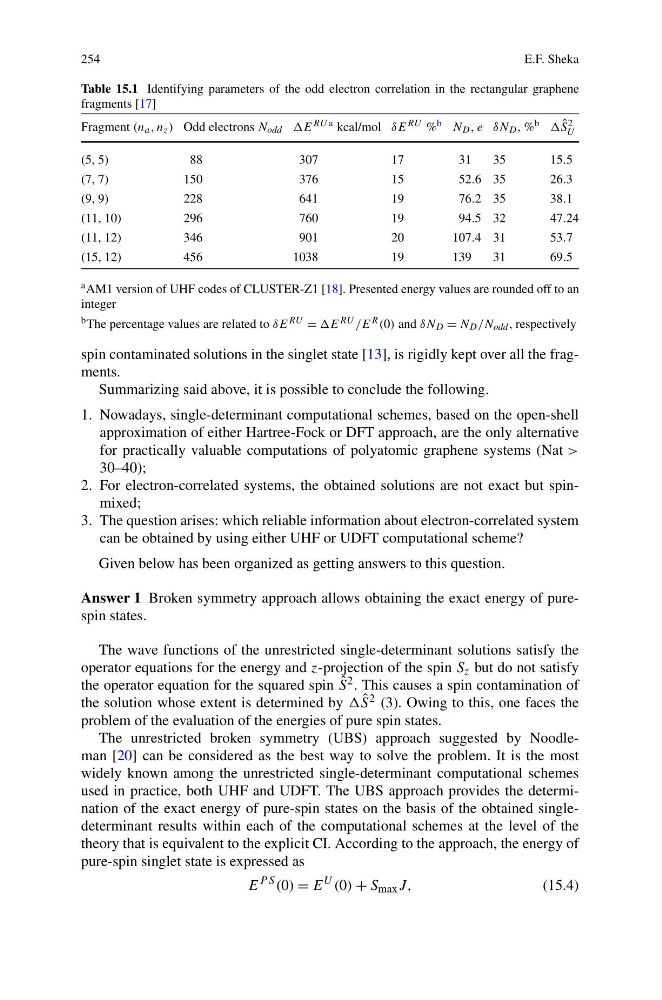
Table 15.1 Identifying parameters of the odd electron correlation in the rectangular graphene
fragments [17]
Fragment (n a , n z ) Odd electrons N odd E RU a kcal/mol δE RU % b N D , e δN D , % b ˆ
S 2
U
(5, 5)
88
307
17
31
35
15.5
(7, 7)
150
376
15
52.6 35
26.3
(9, 9)
228
641
19
76.2 35
38.1
(11, 10)
296
760
19
94.5 32
47.24
(11, 12)
346
901
20
107.4 31
53.7
(15, 12)
456
1038
19
139
31
69.5
a AM1 version of UHF codes of CLUSTER-Z1 [18]. Presented energy values are rounded off to an
integer
b The percentage values are related to δE RU = E RU /E R (0) and δN D = N D /N odd , respectively
spin contaminated solutions in the singlet state [13], is rigidly kept over all the fragments.
Summarizing said above, it is possible to conclude the following.
1. Nowadays, single-determinant computational schemes, based on the open-shell
approximation of either Hartree-Fock or DFT approach, are the only alternative
for practically valuable computations of polyatomic graphene systems (Nat >
30–40);
2. For electron-correlated systems, the obtained solutions are not exact but spinmixed;
3. The question arises: which reliable information about electron-correlated system
can be obtained by using either UHF or UDFT computational scheme?
Given below has been organized as getting answers to this question.
Answer 1 Broken symmetry approach allows obtaining the exact energy of purespin states.
The wave functions of the unrestricted single-determinant solutions satisfy the
operator equations for the energy and z-projection of the spin S z but do not satisfy
the operator equation for the squared spin ˆ
S 2 . This causes a spin contamination of
the solution whose extent is determined by ˆ
S 2 (3). Owing to this, one faces the
problem of the evaluation of the energies of pure spin states.
The unrestricted broken symmetry (UBS) approach suggested by Noodleman [20] can be considered as the best way to solve the problem. It is the most
widely known among the unrestricted single-determinant computational schemes
used in practice, both UHF and UDFT. The UBS approach provides the determination of the exact energy of pure-spin states on the basis of the obtained singledeterminant results within each of the computational schemes at the level of the
theory that is equivalent to the explicit CI. According to the approach, the energy of
pure-spin singlet state is expressed as
E
P S (0) = E
U (0) + S max J,
(15.4)
E.F. Sheka
Table 15.1 Identifying parameters of the odd electron correlation in the rectangular graphene
fragments [17]
Fragment (n a , n z ) Odd electrons N odd E RU a kcal/mol δE RU % b N D , e δN D , % b ˆ
S 2
U
(5, 5)
88
307
17
31
35
15.5
(7, 7)
150
376
15
52.6 35
26.3
(9, 9)
228
641
19
76.2 35
38.1
(11, 10)
296
760
19
94.5 32
47.24
(11, 12)
346
901
20
107.4 31
53.7
(15, 12)
456
1038
19
139
31
69.5
a AM1 version of UHF codes of CLUSTER-Z1 [18]. Presented energy values are rounded off to an
integer
b The percentage values are related to δE RU = E RU /E R (0) and δN D = N D /N odd , respectively
spin contaminated solutions in the singlet state [13], is rigidly kept over all the fragments.
Summarizing said above, it is possible to conclude the following.
1. Nowadays, single-determinant computational schemes, based on the open-shell
approximation of either Hartree-Fock or DFT approach, are the only alternative
for practically valuable computations of polyatomic graphene systems (Nat >
30–40);
2. For electron-correlated systems, the obtained solutions are not exact but spinmixed;
3. The question arises: which reliable information about electron-correlated system
can be obtained by using either UHF or UDFT computational scheme?
Given below has been organized as getting answers to this question.
Answer 1 Broken symmetry approach allows obtaining the exact energy of purespin states.
The wave functions of the unrestricted single-determinant solutions satisfy the
operator equations for the energy and z-projection of the spin S z but do not satisfy
the operator equation for the squared spin ˆ
S 2 . This causes a spin contamination of
the solution whose extent is determined by ˆ
S 2 (3). Owing to this, one faces the
problem of the evaluation of the energies of pure spin states.
The unrestricted broken symmetry (UBS) approach suggested by Noodleman [20] can be considered as the best way to solve the problem. It is the most
widely known among the unrestricted single-determinant computational schemes
used in practice, both UHF and UDFT. The UBS approach provides the determination of the exact energy of pure-spin states on the basis of the obtained singledeterminant results within each of the computational schemes at the level of the
theory that is equivalent to the explicit CI. According to the approach, the energy of
pure-spin singlet state is expressed as
E
P S (0) = E
U (0) + S max J,
(15.4)