

238
T. Onishi and T. Helgaker
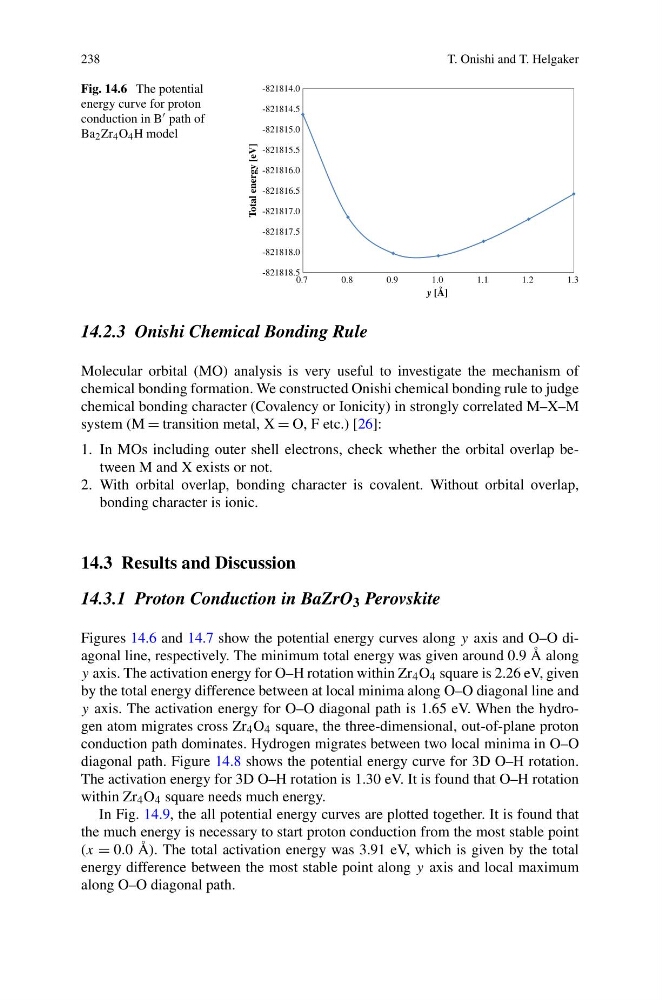
Fig. 14.6 The potential
energy curve for proton
conduction in B path of
Ba 2 Zr 4 O 4 H model
14.2.3 Onishi Chemical Bonding Rule
Molecular orbital (MO) analysis is very useful to investigate the mechanism of
chemical bonding formation. We constructed Onishi chemical bonding rule to judge
chemical bonding character (Covalency or Ionicity) in strongly correlated M–X–M
system (M = transition metal, X = O, F etc.) [26]:
1. In MOs including outer shell electrons, check whether the orbital overlap between M and X exists or not.
2. With orbital overlap, bonding character is covalent. Without orbital overlap,
bonding character is ionic.
14.3 Results and Discussion
14.3.1 Proton Conduction in BaZrO 3 Perovskite
Figures 14.6 and 14.7 show the potential energy curves along y axis and O–O diagonal line, respectively. The minimum total energy was given around 0.9 Å along
y axis. The activation energy for O–H rotation within Zr 4 O 4 square is 2.26 eV, given
by the total energy difference between at local minima along O–O diagonal line and
y axis. The activation energy for O–O diagonal path is 1.65 eV. When the hydrogen atom migrates cross Zr 4 O 4 square, the three-dimensional, out-of-plane proton
conduction path dominates. Hydrogen migrates between two local minima in O–O
diagonal path. Figure 14.8 shows the potential energy curve for 3D O–H rotation.
The activation energy for 3D O–H rotation is 1.30 eV. It is found that O–H rotation
within Zr 4 O 4 square needs much energy.
In Fig. 14.9, the all potential energy curves are plotted together. It is found that
the much energy is necessary to start proton conduction from the most stable point
(x = 0.0 Å). The total activation energy was 3.91 eV, which is given by the total
energy difference between the most stable point along y axis and local maximum
along O–O diagonal path.
T. Onishi and T. Helgaker
Fig. 14.6 The potential
energy curve for proton
conduction in B path of
Ba 2 Zr 4 O 4 H model
14.2.3 Onishi Chemical Bonding Rule
Molecular orbital (MO) analysis is very useful to investigate the mechanism of
chemical bonding formation. We constructed Onishi chemical bonding rule to judge
chemical bonding character (Covalency or Ionicity) in strongly correlated M–X–M
system (M = transition metal, X = O, F etc.) [26]:
1. In MOs including outer shell electrons, check whether the orbital overlap between M and X exists or not.
2. With orbital overlap, bonding character is covalent. Without orbital overlap,
bonding character is ionic.
14.3 Results and Discussion
14.3.1 Proton Conduction in BaZrO 3 Perovskite
Figures 14.6 and 14.7 show the potential energy curves along y axis and O–O diagonal line, respectively. The minimum total energy was given around 0.9 Å along
y axis. The activation energy for O–H rotation within Zr 4 O 4 square is 2.26 eV, given
by the total energy difference between at local minima along O–O diagonal line and
y axis. The activation energy for O–O diagonal path is 1.65 eV. When the hydrogen atom migrates cross Zr 4 O 4 square, the three-dimensional, out-of-plane proton
conduction path dominates. Hydrogen migrates between two local minima in O–O
diagonal path. Figure 14.8 shows the potential energy curve for 3D O–H rotation.
The activation energy for 3D O–H rotation is 1.30 eV. It is found that O–H rotation
within Zr 4 O 4 square needs much energy.
In Fig. 14.9, the all potential energy curves are plotted together. It is found that
the much energy is necessary to start proton conduction from the most stable point
(x = 0.0 Å). The total activation energy was 3.91 eV, which is given by the total
energy difference between the most stable point along y axis and local maximum
along O–O diagonal path.