

14 A Theoretical Study on Proton Conduction Mechanism in BaZrO 3 Perovskite
237
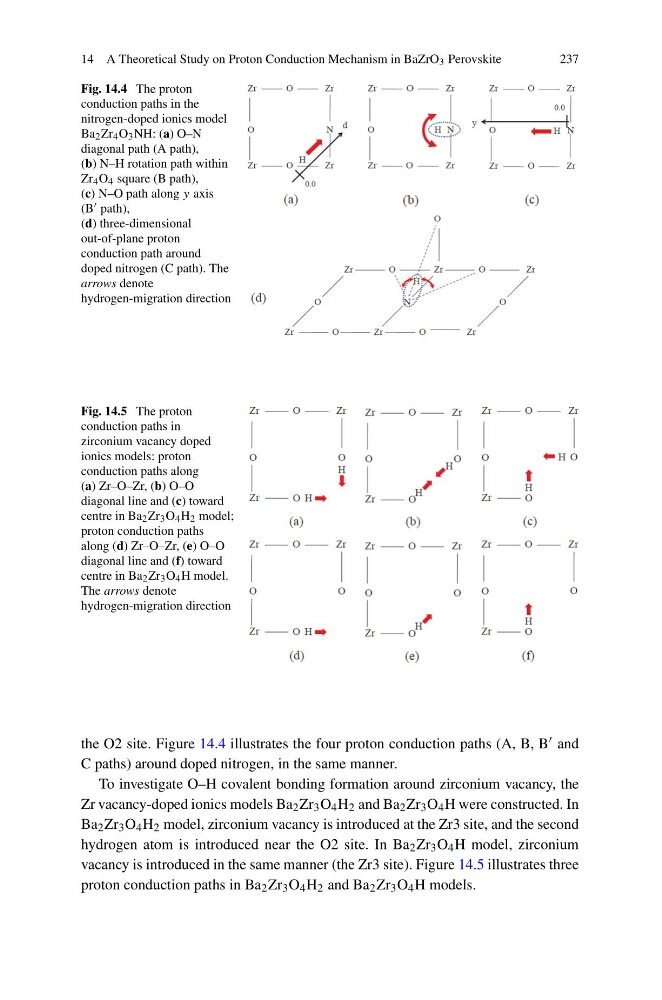
Fig. 14.4 The proton
conduction paths in the
nitrogen-doped ionics model
Ba 2 Zr 4 O 3 NH: (a) O–N
diagonal path (A path),
(b) N–H rotation path within
Zr 4 O 4 square (B path),
(c) N–O path along y axis
(B path),
(d) three-dimensional
out-of-plane proton
conduction path around
doped nitrogen (C path). The
arrows denote
hydrogen-migration direction
Fig. 14.5 The proton
conduction paths in
zirconium vacancy doped
ionics models: proton
conduction paths along
(a) Zr–O–Zr, (b) O–O
diagonal line and (c) toward
centre in Ba 2 Zr 3 O 4 H 2 model;
proton conduction paths
along (d) Zr–O–Zr, (e) O–O
diagonal line and (f) toward
centre in Ba 2 Zr 3 O 4 H model.
The arrows denote
hydrogen-migration direction
the O2 site. Figure 14.4 illustrates the four proton conduction paths (A, B, B and
C paths) around doped nitrogen, in the same manner.
To investigate O–H covalent bonding formation around zirconium vacancy, the
Zr vacancy-doped ionics models Ba 2 Zr 3 O 4 H 2 and Ba 2 Zr 3 O 4 H were constructed. In
Ba 2 Zr 3 O 4 H 2 model, zirconium vacancy is introduced at the Zr3 site, and the second
hydrogen atom is introduced near the O2 site. In Ba 2 Zr 3 O 4 H model, zirconium
vacancy is introduced in the same manner (the Zr3 site). Figure 14.5 illustrates three
proton conduction paths in Ba 2 Zr 3 O 4 H 2 and Ba 2 Zr 3 O 4 H models.
237
Fig. 14.4 The proton
conduction paths in the
nitrogen-doped ionics model
Ba 2 Zr 4 O 3 NH: (a) O–N
diagonal path (A path),
(b) N–H rotation path within
Zr 4 O 4 square (B path),
(c) N–O path along y axis
(B path),
(d) three-dimensional
out-of-plane proton
conduction path around
doped nitrogen (C path). The
arrows denote
hydrogen-migration direction
Fig. 14.5 The proton
conduction paths in
zirconium vacancy doped
ionics models: proton
conduction paths along
(a) Zr–O–Zr, (b) O–O
diagonal line and (c) toward
centre in Ba 2 Zr 3 O 4 H 2 model;
proton conduction paths
along (d) Zr–O–Zr, (e) O–O
diagonal line and (f) toward
centre in Ba 2 Zr 3 O 4 H model.
The arrows denote
hydrogen-migration direction
the O2 site. Figure 14.4 illustrates the four proton conduction paths (A, B, B and
C paths) around doped nitrogen, in the same manner.
To investigate O–H covalent bonding formation around zirconium vacancy, the
Zr vacancy-doped ionics models Ba 2 Zr 3 O 4 H 2 and Ba 2 Zr 3 O 4 H were constructed. In
Ba 2 Zr 3 O 4 H 2 model, zirconium vacancy is introduced at the Zr3 site, and the second
hydrogen atom is introduced near the O2 site. In Ba 2 Zr 3 O 4 H model, zirconium
vacancy is introduced in the same manner (the Zr3 site). Figure 14.5 illustrates three
proton conduction paths in Ba 2 Zr 3 O 4 H 2 and Ba 2 Zr 3 O 4 H models.