

234
T. Onishi and T. Helgaker
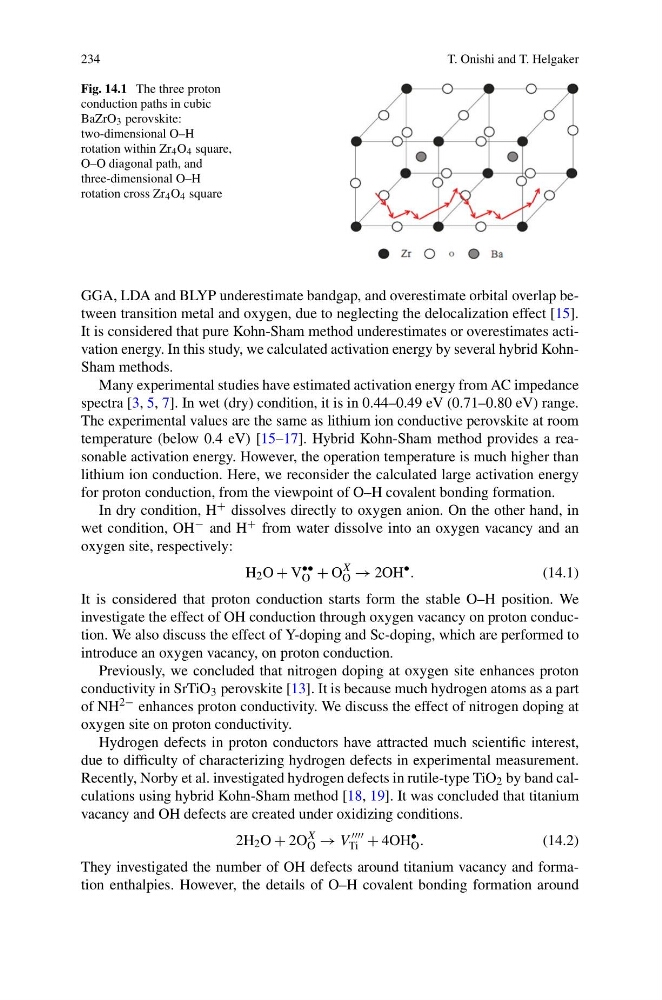
Fig. 14.1 The three proton
conduction paths in cubic
BaZrO 3 perovskite:
two-dimensional O–H
rotation within Zr 4 O 4 square,
O–O diagonal path, and
three-dimensional O–H
rotation cross Zr 4 O 4 square
GGA, LDA and BLYP underestimate bandgap, and overestimate orbital overlap between transition metal and oxygen, due to neglecting the delocalization effect [15].
It is considered that pure Kohn-Sham method underestimates or overestimates activation energy. In this study, we calculated activation energy by several hybrid KohnSham methods.
Many experimental studies have estimated activation energy from AC impedance
spectra [3, 5, 7]. In wet (dry) condition, it is in 0.44–0.49 eV (0.71–0.80 eV) range.
The experimental values are the same as lithium ion conductive perovskite at room
temperature (below 0.4 eV) [15–17]. Hybrid Kohn-Sham method provides a reasonable activation energy. However, the operation temperature is much higher than
lithium ion conduction. Here, we reconsider the calculated large activation energy
for proton conduction, from the viewpoint of O–H covalent bonding formation.
In dry condition, H + dissolves directly to oxygen anion. On the other hand, in
wet condition, OH − and H + from water dissolve into an oxygen vacancy and an
oxygen site, respectively:
H 2 O + V
••
O + O
X
O → 2OH
• .
(14.1)
It is considered that proton conduction starts form the stable O–H position. We
investigate the effect of OH conduction through oxygen vacancy on proton conduction. We also discuss the effect of Y-doping and Sc-doping, which are performed to
introduce an oxygen vacancy, on proton conduction.
Previously, we concluded that nitrogen doping at oxygen site enhances proton
conductivity in SrTiO 3 perovskite [13]. It is because much hydrogen atoms as a part
of NH 2− enhances proton conductivity. We discuss the effect of nitrogen doping at
oxygen site on proton conductivity.
Hydrogen defects in proton conductors have attracted much scientific interest,
due to difficulty of characterizing hydrogen defects in experimental measurement.
Recently, Norby et al. investigated hydrogen defects in rutile-type TiO 2 by band calculations using hybrid Kohn-Sham method [18, 19]. It was concluded that titanium
vacancy and OH defects are created under oxidizing conditions.
2H 2 O + 2O
X
O → V
Ti + 4OH
•
O .
(14.2)
They investigated the number of OH defects around titanium vacancy and formation enthalpies. However, the details of O–H covalent bonding formation around
T. Onishi and T. Helgaker
Fig. 14.1 The three proton
conduction paths in cubic
BaZrO 3 perovskite:
two-dimensional O–H
rotation within Zr 4 O 4 square,
O–O diagonal path, and
three-dimensional O–H
rotation cross Zr 4 O 4 square
GGA, LDA and BLYP underestimate bandgap, and overestimate orbital overlap between transition metal and oxygen, due to neglecting the delocalization effect [15].
It is considered that pure Kohn-Sham method underestimates or overestimates activation energy. In this study, we calculated activation energy by several hybrid KohnSham methods.
Many experimental studies have estimated activation energy from AC impedance
spectra [3, 5, 7]. In wet (dry) condition, it is in 0.44–0.49 eV (0.71–0.80 eV) range.
The experimental values are the same as lithium ion conductive perovskite at room
temperature (below 0.4 eV) [15–17]. Hybrid Kohn-Sham method provides a reasonable activation energy. However, the operation temperature is much higher than
lithium ion conduction. Here, we reconsider the calculated large activation energy
for proton conduction, from the viewpoint of O–H covalent bonding formation.
In dry condition, H + dissolves directly to oxygen anion. On the other hand, in
wet condition, OH − and H + from water dissolve into an oxygen vacancy and an
oxygen site, respectively:
H 2 O + V
••
O + O
X
O → 2OH
• .
(14.1)
It is considered that proton conduction starts form the stable O–H position. We
investigate the effect of OH conduction through oxygen vacancy on proton conduction. We also discuss the effect of Y-doping and Sc-doping, which are performed to
introduce an oxygen vacancy, on proton conduction.
Previously, we concluded that nitrogen doping at oxygen site enhances proton
conductivity in SrTiO 3 perovskite [13]. It is because much hydrogen atoms as a part
of NH 2− enhances proton conductivity. We discuss the effect of nitrogen doping at
oxygen site on proton conductivity.
Hydrogen defects in proton conductors have attracted much scientific interest,
due to difficulty of characterizing hydrogen defects in experimental measurement.
Recently, Norby et al. investigated hydrogen defects in rutile-type TiO 2 by band calculations using hybrid Kohn-Sham method [18, 19]. It was concluded that titanium
vacancy and OH defects are created under oxidizing conditions.
2H 2 O + 2O
X
O → V
Ti + 4OH
•
O .
(14.2)
They investigated the number of OH defects around titanium vacancy and formation enthalpies. However, the details of O–H covalent bonding formation around