

230
T. Onishi
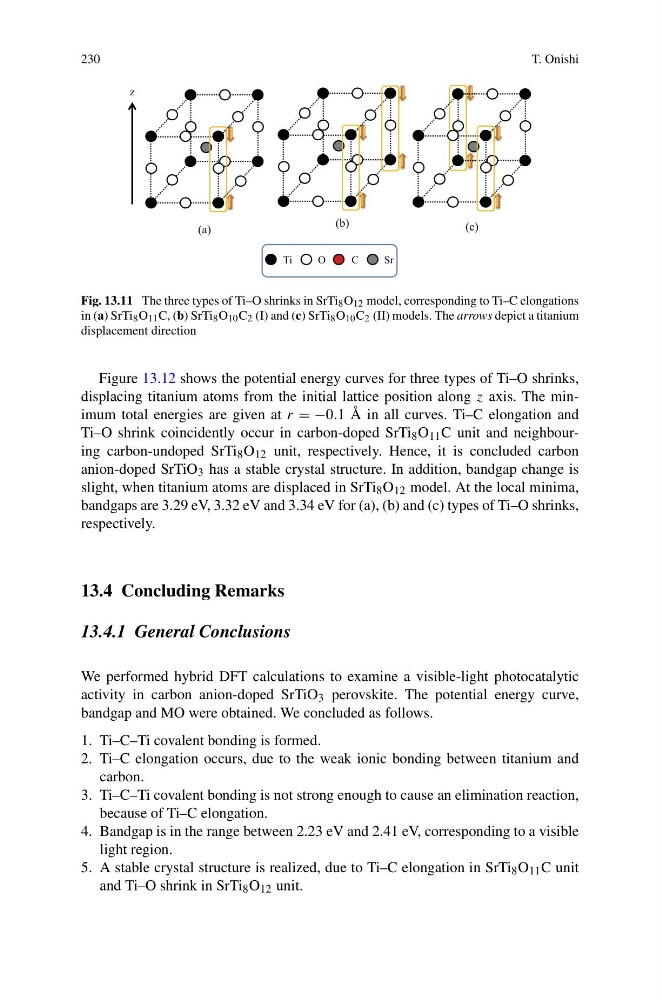
Fig. 13.11 The three types of Ti–O shrinks in SrTi 8 O 12 model, corresponding to Ti–C elongations
in (a) SrTi 8 O 11 C, (b) SrTi 8 O 10 C 2 (I) and (c) SrTi 8 O 10 C 2 (II) models. The arrows depict a titanium
displacement direction
Figure 13.12 shows the potential energy curves for three types of Ti–O shrinks,
displacing titanium atoms from the initial lattice position along z axis. The minimum total energies are given at r = −0.1 Å in all curves. Ti–C elongation and
Ti–O shrink coincidently occur in carbon-doped SrTi 8 O 11 C unit and neighbouring carbon-undoped SrTi 8 O 12 unit, respectively. Hence, it is concluded carbon
anion-doped SrTiO 3 has a stable crystal structure. In addition, bandgap change is
slight, when titanium atoms are displaced in SrTi 8 O 12 model. At the local minima,
bandgaps are 3.29 eV, 3.32 eV and 3.34 eV for (a), (b) and (c) types of Ti–O shrinks,
respectively.
13.4 Concluding Remarks
13.4.1 General Conclusions
We performed hybrid DFT calculations to examine a visible-light photocatalytic
activity in carbon anion-doped SrTiO 3 perovskite. The potential energy curve,
bandgap and MO were obtained. We concluded as follows.
1. Ti–C–Ti covalent bonding is formed.
2. Ti–C elongation occurs, due to the weak ionic bonding between titanium and
carbon.
3. Ti–C–Ti covalent bonding is not strong enough to cause an elimination reaction,
because of Ti–C elongation.
4. Bandgap is in the range between 2.23 eV and 2.41 eV, corresponding to a visible
light region.
5. A stable crystal structure is realized, due to Ti–C elongation in SrTi 8 O 11 C unit
and Ti–O shrink in SrTi 8 O 12 unit.
T. Onishi
Fig. 13.11 The three types of Ti–O shrinks in SrTi 8 O 12 model, corresponding to Ti–C elongations
in (a) SrTi 8 O 11 C, (b) SrTi 8 O 10 C 2 (I) and (c) SrTi 8 O 10 C 2 (II) models. The arrows depict a titanium
displacement direction
Figure 13.12 shows the potential energy curves for three types of Ti–O shrinks,
displacing titanium atoms from the initial lattice position along z axis. The minimum total energies are given at r = −0.1 Å in all curves. Ti–C elongation and
Ti–O shrink coincidently occur in carbon-doped SrTi 8 O 11 C unit and neighbouring carbon-undoped SrTi 8 O 12 unit, respectively. Hence, it is concluded carbon
anion-doped SrTiO 3 has a stable crystal structure. In addition, bandgap change is
slight, when titanium atoms are displaced in SrTi 8 O 12 model. At the local minima,
bandgaps are 3.29 eV, 3.32 eV and 3.34 eV for (a), (b) and (c) types of Ti–O shrinks,
respectively.
13.4 Concluding Remarks
13.4.1 General Conclusions
We performed hybrid DFT calculations to examine a visible-light photocatalytic
activity in carbon anion-doped SrTiO 3 perovskite. The potential energy curve,
bandgap and MO were obtained. We concluded as follows.
1. Ti–C–Ti covalent bonding is formed.
2. Ti–C elongation occurs, due to the weak ionic bonding between titanium and
carbon.
3. Ti–C–Ti covalent bonding is not strong enough to cause an elimination reaction,
because of Ti–C elongation.
4. Bandgap is in the range between 2.23 eV and 2.41 eV, corresponding to a visible
light region.
5. A stable crystal structure is realized, due to Ti–C elongation in SrTi 8 O 11 C unit
and Ti–O shrink in SrTi 8 O 12 unit.