

208
Y.-W. Huang et al.
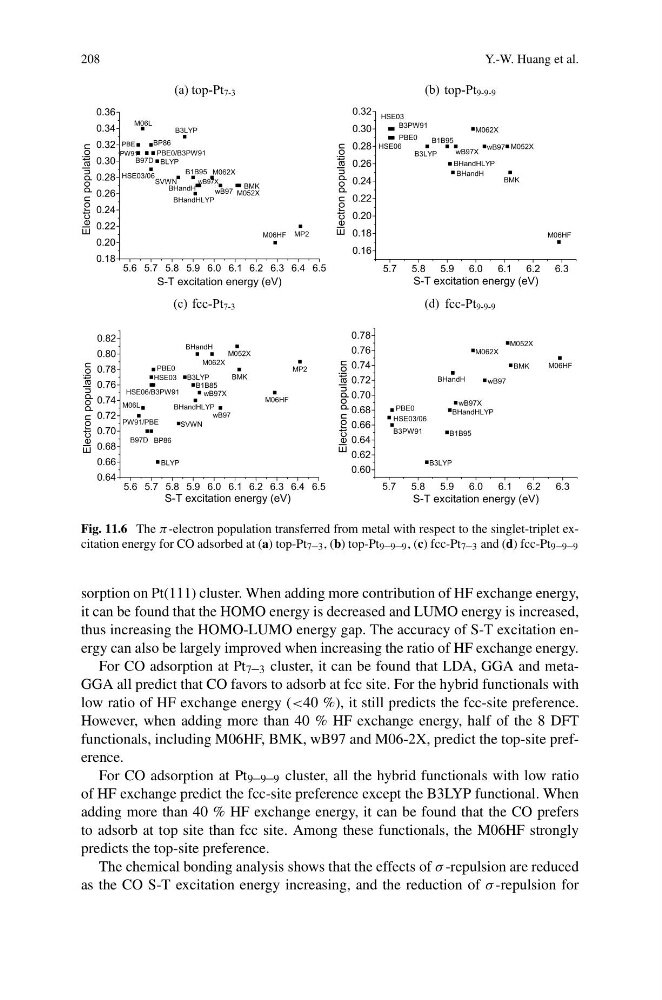
Fig. 11.6 The π -electron population transferred from metal with respect to the singlet-triplet excitation energy for CO adsorbed at (a) top-Pt 7–3 , (b) top-Pt 9–9–9 , (c) fcc-Pt 7–3 and (d) fcc-Pt 9–9–9
sorption on Pt(111) cluster. When adding more contribution of HF exchange energy,
it can be found that the HOMO energy is decreased and LUMO energy is increased,
thus increasing the HOMO-LUMO energy gap. The accuracy of S-T excitation energy can also be largely improved when increasing the ratio of HF exchange energy.
For CO adsorption at Pt 7–3 cluster, it can be found that LDA, GGA and metaGGA all predict that CO favors to adsorb at fcc site. For the hybrid functionals with
low ratio of HF exchange energy (<40 %), it still predicts the fcc-site preference.
However, when adding more than 40 % HF exchange energy, half of the 8 DFT
functionals, including M06HF, BMK, wB97 and M06-2X, predict the top-site preference.
For CO adsorption at Pt 9–9–9 cluster, all the hybrid functionals with low ratio
of HF exchange predict the fcc-site preference except the B3LYP functional. When
adding more than 40 % HF exchange energy, it can be found that the CO prefers
to adsorb at top site than fcc site. Among these functionals, the M06HF strongly
predicts the top-site preference.
The chemical bonding analysis shows that the effects of σ -repulsion are reduced
as the CO S-T excitation energy increasing, and the reduction of σ -repulsion for
Y.-W. Huang et al.
Fig. 11.6 The π -electron population transferred from metal with respect to the singlet-triplet excitation energy for CO adsorbed at (a) top-Pt 7–3 , (b) top-Pt 9–9–9 , (c) fcc-Pt 7–3 and (d) fcc-Pt 9–9–9
sorption on Pt(111) cluster. When adding more contribution of HF exchange energy,
it can be found that the HOMO energy is decreased and LUMO energy is increased,
thus increasing the HOMO-LUMO energy gap. The accuracy of S-T excitation energy can also be largely improved when increasing the ratio of HF exchange energy.
For CO adsorption at Pt 7–3 cluster, it can be found that LDA, GGA and metaGGA all predict that CO favors to adsorb at fcc site. For the hybrid functionals with
low ratio of HF exchange energy (<40 %), it still predicts the fcc-site preference.
However, when adding more than 40 % HF exchange energy, half of the 8 DFT
functionals, including M06HF, BMK, wB97 and M06-2X, predict the top-site preference.
For CO adsorption at Pt 9–9–9 cluster, all the hybrid functionals with low ratio
of HF exchange predict the fcc-site preference except the B3LYP functional. When
adding more than 40 % HF exchange energy, it can be found that the CO prefers
to adsorb at top site than fcc site. Among these functionals, the M06HF strongly
predicts the top-site preference.
The chemical bonding analysis shows that the effects of σ -repulsion are reduced
as the CO S-T excitation energy increasing, and the reduction of σ -repulsion for