

11 An Evaluation of Density Functional Theory for CO Adsorption on Pt(111)
207
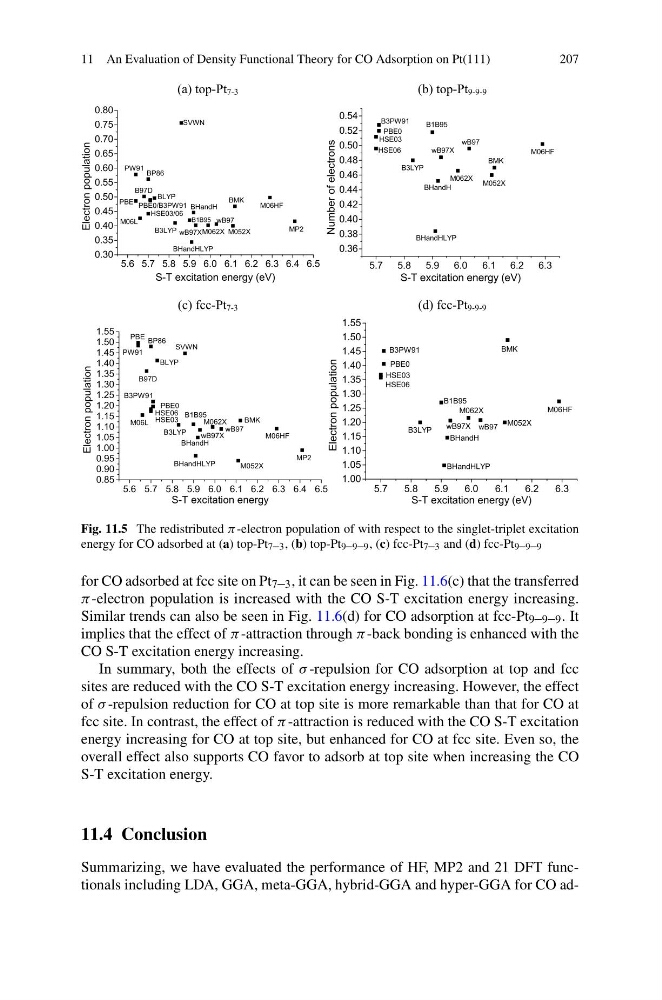
Fig. 11.5 The redistributed π -electron population of with respect to the singlet-triplet excitation
energy for CO adsorbed at (a) top-Pt 7–3 , (b) top-Pt 9–9–9 , (c) fcc-Pt 7–3 and (d) fcc-Pt 9–9–9
for CO adsorbed at fcc site on Pt 7–3 , it can be seen in Fig. 11.6(c) that the transferred
π -electron population is increased with the CO S-T excitation energy increasing.
Similar trends can also be seen in Fig. 11.6(d) for CO adsorption at fcc-Pt 9–9–9 . It
implies that the effect of π -attraction through π -back bonding is enhanced with the
CO S-T excitation energy increasing.
In summary, both the effects of σ -repulsion for CO adsorption at top and fcc
sites are reduced with the CO S-T excitation energy increasing. However, the effect
of σ -repulsion reduction for CO at top site is more remarkable than that for CO at
fcc site. In contrast, the effect of π -attraction is reduced with the CO S-T excitation
energy increasing for CO at top site, but enhanced for CO at fcc site. Even so, the
overall effect also supports CO favor to adsorb at top site when increasing the CO
S-T excitation energy.
11.4 Conclusion
Summarizing, we have evaluated the performance of HF, MP2 and 21 DFT functionals including LDA, GGA, meta-GGA, hybrid-GGA and hyper-GGA for CO ad-
207
Fig. 11.5 The redistributed π -electron population of with respect to the singlet-triplet excitation
energy for CO adsorbed at (a) top-Pt 7–3 , (b) top-Pt 9–9–9 , (c) fcc-Pt 7–3 and (d) fcc-Pt 9–9–9
for CO adsorbed at fcc site on Pt 7–3 , it can be seen in Fig. 11.6(c) that the transferred
π -electron population is increased with the CO S-T excitation energy increasing.
Similar trends can also be seen in Fig. 11.6(d) for CO adsorption at fcc-Pt 9–9–9 . It
implies that the effect of π -attraction through π -back bonding is enhanced with the
CO S-T excitation energy increasing.
In summary, both the effects of σ -repulsion for CO adsorption at top and fcc
sites are reduced with the CO S-T excitation energy increasing. However, the effect
of σ -repulsion reduction for CO at top site is more remarkable than that for CO at
fcc site. In contrast, the effect of π -attraction is reduced with the CO S-T excitation
energy increasing for CO at top site, but enhanced for CO at fcc site. Even so, the
overall effect also supports CO favor to adsorb at top site when increasing the CO
S-T excitation energy.
11.4 Conclusion
Summarizing, we have evaluated the performance of HF, MP2 and 21 DFT functionals including LDA, GGA, meta-GGA, hybrid-GGA and hyper-GGA for CO ad-