

192
Y. Dong et al.
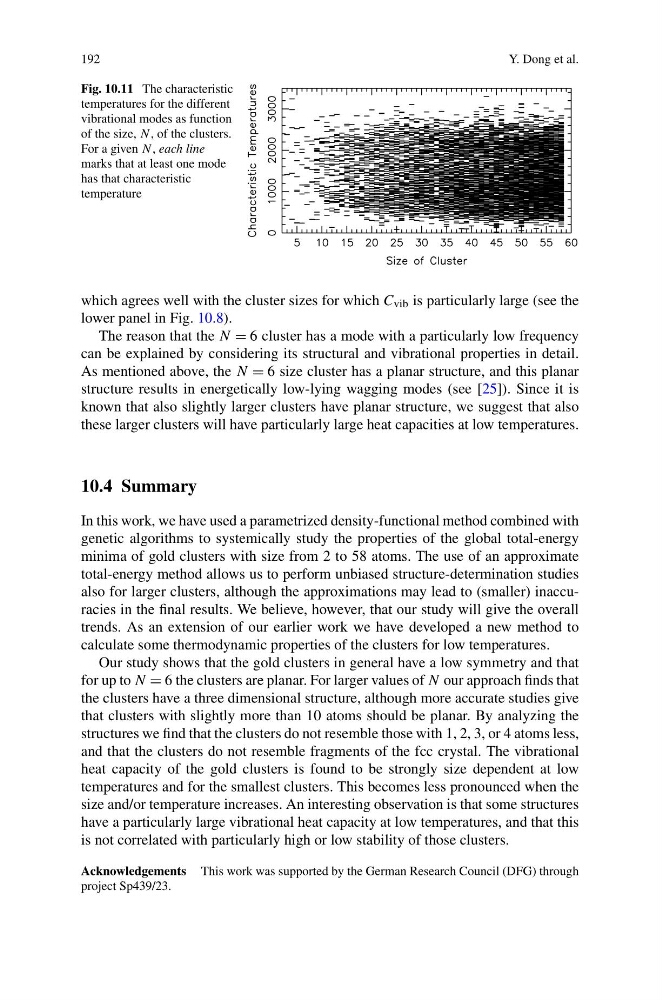
Fig. 10.11 The characteristic
temperatures for the different
vibrational modes as function
of the size, N , of the clusters.
For a given N , each line
marks that at least one mode
has that characteristic
temperature
which agrees well with the cluster sizes for which C vib is particularly large (see the
lower panel in Fig. 10.8).
The reason that the N = 6 cluster has a mode with a particularly low frequency
can be explained by considering its structural and vibrational properties in detail.
As mentioned above, the N = 6 size cluster has a planar structure, and this planar
structure results in energetically low-lying wagging modes (see [25]). Since it is
known that also slightly larger clusters have planar structure, we suggest that also
these larger clusters will have particularly large heat capacities at low temperatures.
10.4 Summary
In this work, we have used a parametrized density-functional method combined with
genetic algorithms to systemically study the properties of the global total-energy
minima of gold clusters with size from 2 to 58 atoms. The use of an approximate
total-energy method allows us to perform unbiased structure-determination studies
also for larger clusters, although the approximations may lead to (smaller) inaccuracies in the final results. We believe, however, that our study will give the overall
trends. As an extension of our earlier work we have developed a new method to
calculate some thermodynamic properties of the clusters for low temperatures.
Our study shows that the gold clusters in general have a low symmetry and that
for up to N = 6 the clusters are planar. For larger values of N our approach finds that
the clusters have a three dimensional structure, although more accurate studies give
that clusters with slightly more than 10 atoms should be planar. By analyzing the
structures we find that the clusters do not resemble those with 1, 2, 3, or 4 atoms less,
and that the clusters do not resemble fragments of the fcc crystal. The vibrational
heat capacity of the gold clusters is found to be strongly size dependent at low
temperatures and for the smallest clusters. This becomes less pronounced when the
size and/or temperature increases. An interesting observation is that some structures
have a particularly large vibrational heat capacity at low temperatures, and that this
is not correlated with particularly high or low stability of those clusters.
Acknowledgements This work was supported by the German Research Council (DFG) through
project Sp439/23.
Y. Dong et al.
Fig. 10.11 The characteristic
temperatures for the different
vibrational modes as function
of the size, N , of the clusters.
For a given N , each line
marks that at least one mode
has that characteristic
temperature
which agrees well with the cluster sizes for which C vib is particularly large (see the
lower panel in Fig. 10.8).
The reason that the N = 6 cluster has a mode with a particularly low frequency
can be explained by considering its structural and vibrational properties in detail.
As mentioned above, the N = 6 size cluster has a planar structure, and this planar
structure results in energetically low-lying wagging modes (see [25]). Since it is
known that also slightly larger clusters have planar structure, we suggest that also
these larger clusters will have particularly large heat capacities at low temperatures.
10.4 Summary
In this work, we have used a parametrized density-functional method combined with
genetic algorithms to systemically study the properties of the global total-energy
minima of gold clusters with size from 2 to 58 atoms. The use of an approximate
total-energy method allows us to perform unbiased structure-determination studies
also for larger clusters, although the approximations may lead to (smaller) inaccuracies in the final results. We believe, however, that our study will give the overall
trends. As an extension of our earlier work we have developed a new method to
calculate some thermodynamic properties of the clusters for low temperatures.
Our study shows that the gold clusters in general have a low symmetry and that
for up to N = 6 the clusters are planar. For larger values of N our approach finds that
the clusters have a three dimensional structure, although more accurate studies give
that clusters with slightly more than 10 atoms should be planar. By analyzing the
structures we find that the clusters do not resemble those with 1, 2, 3, or 4 atoms less,
and that the clusters do not resemble fragments of the fcc crystal. The vibrational
heat capacity of the gold clusters is found to be strongly size dependent at low
temperatures and for the smallest clusters. This becomes less pronounced when the
size and/or temperature increases. An interesting observation is that some structures
have a particularly large vibrational heat capacity at low temperatures, and that this
is not correlated with particularly high or low stability of those clusters.
Acknowledgements This work was supported by the German Research Council (DFG) through
project Sp439/23.