

188
Y. Dong et al.
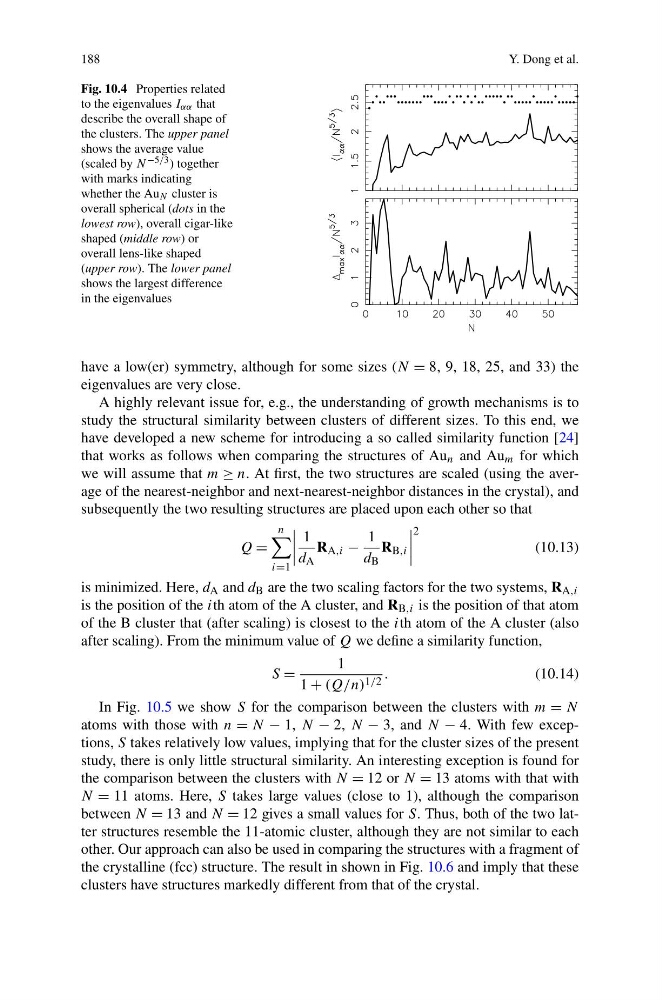
Fig. 10.4 Properties related
to the eigenvalues I αα that
describe the overall shape of
the clusters. The upper panel
shows the average value
(scaled by N −5/3 ) together
with marks indicating
whether the Au N cluster is
overall spherical (dots in the
lowest row), overall cigar-like
shaped (middle row) or
overall lens-like shaped
(upper row). The lower panel
shows the largest difference
in the eigenvalues
have a low(er) symmetry, although for some sizes (N = 8, 9, 18, 25, and 33) the
eigenvalues are very close.
A highly relevant issue for, e.g., the understanding of growth mechanisms is to
study the structural similarity between clusters of different sizes. To this end, we
have developed a new scheme for introducing a so called similarity function [24]
that works as follows when comparing the structures of Au n and Au m for which
we will assume that m ≥ n. At first, the two structures are scaled (using the average of the nearest-neighbor and next-nearest-neighbor distances in the crystal), and
subsequently the two resulting structures are placed upon each other so that
Q =
n
i=1
1
d A
R A,i −
1
d B
R B,i
2
(10.13)
is minimized. Here, d A and d B are the two scaling factors for the two systems, R A,i
is the position of the ith atom of the A cluster, and R B,i is the position of that atom
of the B cluster that (after scaling) is closest to the ith atom of the A cluster (also
after scaling). From the minimum value of Q we define a similarity function,
S =
1
1 + (Q/n) 1/2 .
(10.14)
In Fig. 10.5 we show S for the comparison between the clusters with m = N
atoms with those with n = N − 1, N − 2, N − 3, and N − 4. With few exceptions, S takes relatively low values, implying that for the cluster sizes of the present
study, there is only little structural similarity. An interesting exception is found for
the comparison between the clusters with N = 12 or N = 13 atoms with that with
N = 11 atoms. Here, S takes large values (close to 1), although the comparison
between N = 13 and N = 12 gives a small values for S. Thus, both of the two latter structures resemble the 11-atomic cluster, although they are not similar to each
other. Our approach can also be used in comparing the structures with a fragment of
the crystalline (fcc) structure. The result in shown in Fig. 10.6 and imply that these
clusters have structures markedly different from that of the crystal.
Y. Dong et al.
Fig. 10.4 Properties related
to the eigenvalues I αα that
describe the overall shape of
the clusters. The upper panel
shows the average value
(scaled by N −5/3 ) together
with marks indicating
whether the Au N cluster is
overall spherical (dots in the
lowest row), overall cigar-like
shaped (middle row) or
overall lens-like shaped
(upper row). The lower panel
shows the largest difference
in the eigenvalues
have a low(er) symmetry, although for some sizes (N = 8, 9, 18, 25, and 33) the
eigenvalues are very close.
A highly relevant issue for, e.g., the understanding of growth mechanisms is to
study the structural similarity between clusters of different sizes. To this end, we
have developed a new scheme for introducing a so called similarity function [24]
that works as follows when comparing the structures of Au n and Au m for which
we will assume that m ≥ n. At first, the two structures are scaled (using the average of the nearest-neighbor and next-nearest-neighbor distances in the crystal), and
subsequently the two resulting structures are placed upon each other so that
Q =
n
i=1
1
d A
R A,i −
1
d B
R B,i
2
(10.13)
is minimized. Here, d A and d B are the two scaling factors for the two systems, R A,i
is the position of the ith atom of the A cluster, and R B,i is the position of that atom
of the B cluster that (after scaling) is closest to the ith atom of the A cluster (also
after scaling). From the minimum value of Q we define a similarity function,
S =
1
1 + (Q/n) 1/2 .
(10.14)
In Fig. 10.5 we show S for the comparison between the clusters with m = N
atoms with those with n = N − 1, N − 2, N − 3, and N − 4. With few exceptions, S takes relatively low values, implying that for the cluster sizes of the present
study, there is only little structural similarity. An interesting exception is found for
the comparison between the clusters with N = 12 or N = 13 atoms with that with
N = 11 atoms. Here, S takes large values (close to 1), although the comparison
between N = 13 and N = 12 gives a small values for S. Thus, both of the two latter structures resemble the 11-atomic cluster, although they are not similar to each
other. Our approach can also be used in comparing the structures with a fragment of
the crystalline (fcc) structure. The result in shown in Fig. 10.6 and imply that these
clusters have structures markedly different from that of the crystal.