

184
Y. Dong et al.
set of M initial structures (which define the first generation) for the (N + 1)-atom
system by randomly adding one Au atom and afterward letting each of these structures relax to its nearest total-energy minimum. Subsequently, the next generation
of M new (N + 1)-atomic clusters is formed by cutting each of the original clusters
randomly into two parts that are interchanged and requiring that no atom should
be too close to any other atom or too far from all the other ones. Also these structures are relaxed to their nearest total-energy minima. Out of the total set of 2M
structures, those M of the lowest total energy define the next generation. This procedure is repeated until the lowest total energy is unchanged for a large number of
generations. We add that even if this unbiased structure-optimization is reliable and
efficient, there is no absolute certainty that the global total-energy minimum has
been identified.
10.2.3 Jellium Model
Because the jellium model has been intensively used for metal clusters, we considered that model, too. Within this model we assumed that the total charge formed by
all but the 5d and 6s valence electrons of each gold atom as well as of the nuclei is
smeared out to a spherical medium (jellium) with a constant density within which
the valence electrons are moving. The value of the density of the jellium is taken as
that of crystalline Au, and a local-density approximation within density-functional
theory is assumed valid for the valence electrons. The resulting one-dimensional,
single-particle equations are then solved numerically and self-consistently.
10.2.4 Thermodynamics Calculations
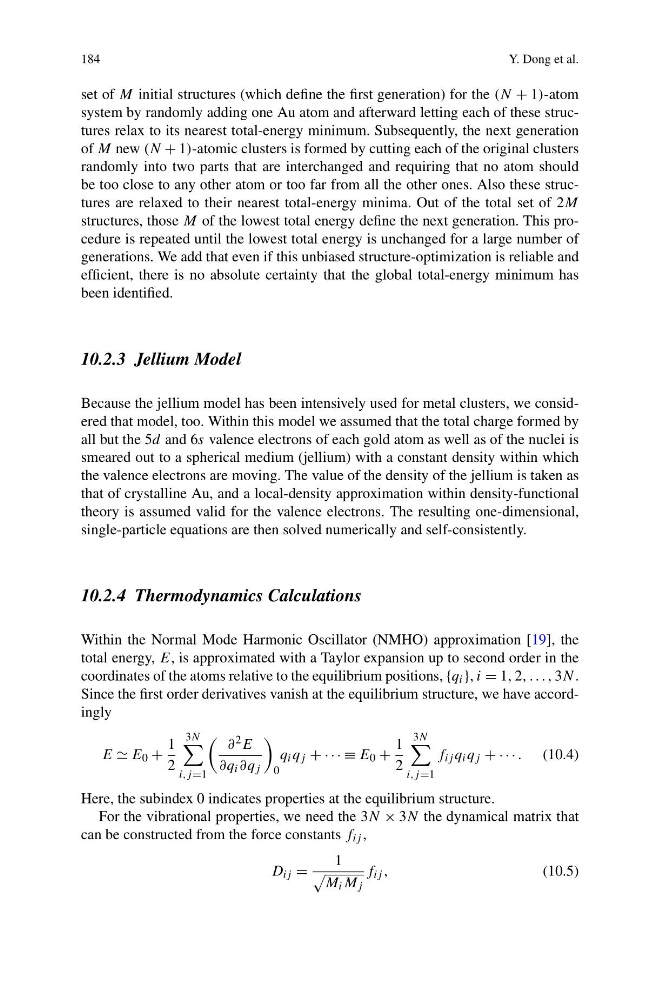
Within the Normal Mode Harmonic Oscillator (NMHO) approximation [19], the
total energy, E, is approximated with a Taylor expansion up to second order in the
coordinates of the atoms relative to the equilibrium positions, {q i }, i = 1, 2, . . . , 3N .
Since the first order derivatives vanish at the equilibrium structure, we have accordingly
E E 0 +
1
2
3N
i,j =1
∂ 2 E
∂q i ∂q j
0
q i q j + · · · ≡ E 0 +
1
2
3N
i,j =1
f ij q i q j + · · · . (10.4)
Here, the subindex 0 indicates properties at the equilibrium structure.
For the vibrational properties, we need the 3N × 3N the dynamical matrix that
can be constructed from the force constants f ij ,
D ij =
1
M i M j
f ij ,
(10.5)
Y. Dong et al.
set of M initial structures (which define the first generation) for the (N + 1)-atom
system by randomly adding one Au atom and afterward letting each of these structures relax to its nearest total-energy minimum. Subsequently, the next generation
of M new (N + 1)-atomic clusters is formed by cutting each of the original clusters
randomly into two parts that are interchanged and requiring that no atom should
be too close to any other atom or too far from all the other ones. Also these structures are relaxed to their nearest total-energy minima. Out of the total set of 2M
structures, those M of the lowest total energy define the next generation. This procedure is repeated until the lowest total energy is unchanged for a large number of
generations. We add that even if this unbiased structure-optimization is reliable and
efficient, there is no absolute certainty that the global total-energy minimum has
been identified.
10.2.3 Jellium Model
Because the jellium model has been intensively used for metal clusters, we considered that model, too. Within this model we assumed that the total charge formed by
all but the 5d and 6s valence electrons of each gold atom as well as of the nuclei is
smeared out to a spherical medium (jellium) with a constant density within which
the valence electrons are moving. The value of the density of the jellium is taken as
that of crystalline Au, and a local-density approximation within density-functional
theory is assumed valid for the valence electrons. The resulting one-dimensional,
single-particle equations are then solved numerically and self-consistently.
10.2.4 Thermodynamics Calculations
Within the Normal Mode Harmonic Oscillator (NMHO) approximation [19], the
total energy, E, is approximated with a Taylor expansion up to second order in the
coordinates of the atoms relative to the equilibrium positions, {q i }, i = 1, 2, . . . , 3N .
Since the first order derivatives vanish at the equilibrium structure, we have accordingly
E E 0 +
1
2
3N
i,j =1
∂ 2 E
∂q i ∂q j
0
q i q j + · · · ≡ E 0 +
1
2
3N
i,j =1
f ij q i q j + · · · . (10.4)
Here, the subindex 0 indicates properties at the equilibrium structure.
For the vibrational properties, we need the 3N × 3N the dynamical matrix that
can be constructed from the force constants f ij ,
D ij =
1
M i M j
f ij ,
(10.5)