

10 Structural and Thermodynamic Properties of Au 2–58 Clusters
183
with i and m being an orbital and an atom index, respectively) augmented with pair
potentials,
E tot =
i
ε i −
m
i
ε im +
m 1 ,m 2
U m 1 m 2
|R m 1 − R m 2 |
.
(10.1)
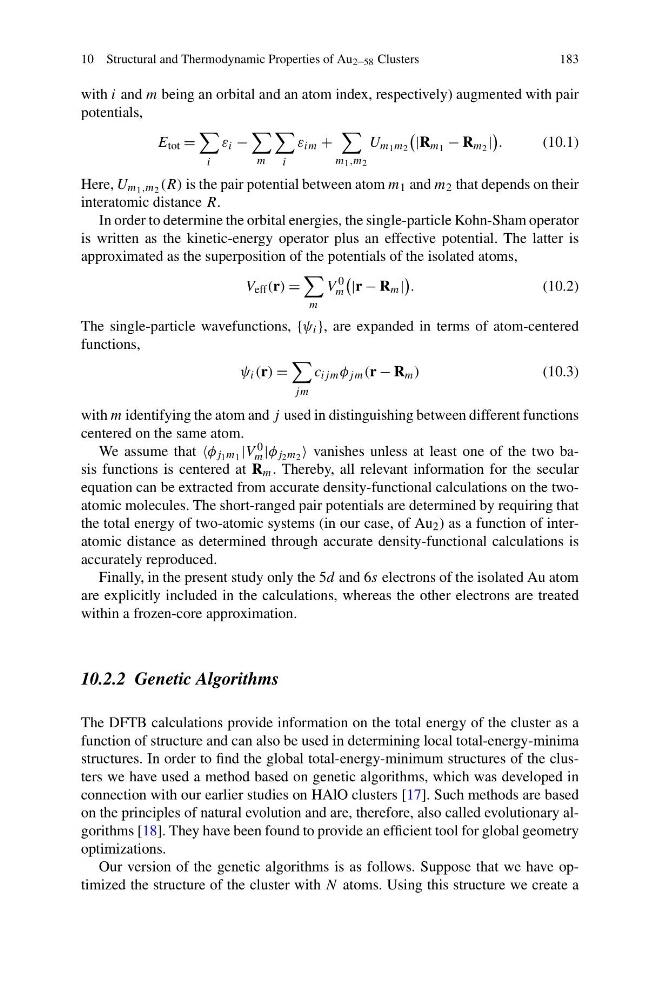
Here, U m 1 ,m 2 (R) is the pair potential between atom m 1 and m 2 that depends on their
interatomic distance R.
In order to determine the orbital energies, the single-particle Kohn-Sham operator
is written as the kinetic-energy operator plus an effective potential. The latter is
approximated as the superposition of the potentials of the isolated atoms,
V eff (r) =
m
V
0
m
|r − R m |
.
(10.2)
The single-particle wavefunctions, {ψ i }, are expanded in terms of atom-centered
functions,
ψ i (r) =
jm
c ij m φ jm (r − R m )
(10.3)
with m identifying the atom and j used in distinguishing between different functions
centered on the same atom.
We assume that φ j 1 m 1 |V 0
m |φ j 2 m 2 vanishes unless at least one of the two basis functions is centered at R m . Thereby, all relevant information for the secular
equation can be extracted from accurate density-functional calculations on the twoatomic molecules. The short-ranged pair potentials are determined by requiring that
the total energy of two-atomic systems (in our case, of Au 2 ) as a function of interatomic distance as determined through accurate density-functional calculations is
accurately reproduced.
Finally, in the present study only the 5d and 6s electrons of the isolated Au atom
are explicitly included in the calculations, whereas the other electrons are treated
within a frozen-core approximation.
10.2.2 Genetic Algorithms
The DFTB calculations provide information on the total energy of the cluster as a
function of structure and can also be used in determining local total-energy-minima
structures. In order to find the global total-energy-minimum structures of the clusters we have used a method based on genetic algorithms, which was developed in
connection with our earlier studies on HAlO clusters [17]. Such methods are based
on the principles of natural evolution and are, therefore, also called evolutionary algorithms [18]. They have been found to provide an efficient tool for global geometry
optimizations.
Our version of the genetic algorithms is as follows. Suppose that we have optimized the structure of the cluster with N atoms. Using this structure we create a
183
with i and m being an orbital and an atom index, respectively) augmented with pair
potentials,
E tot =
i
ε i −
m
i
ε im +
m 1 ,m 2
U m 1 m 2
|R m 1 − R m 2 |
.
(10.1)
Here, U m 1 ,m 2 (R) is the pair potential between atom m 1 and m 2 that depends on their
interatomic distance R.
In order to determine the orbital energies, the single-particle Kohn-Sham operator
is written as the kinetic-energy operator plus an effective potential. The latter is
approximated as the superposition of the potentials of the isolated atoms,
V eff (r) =
m
V
0
m
|r − R m |
.
(10.2)
The single-particle wavefunctions, {ψ i }, are expanded in terms of atom-centered
functions,
ψ i (r) =
jm
c ij m φ jm (r − R m )
(10.3)
with m identifying the atom and j used in distinguishing between different functions
centered on the same atom.
We assume that φ j 1 m 1 |V 0
m |φ j 2 m 2 vanishes unless at least one of the two basis functions is centered at R m . Thereby, all relevant information for the secular
equation can be extracted from accurate density-functional calculations on the twoatomic molecules. The short-ranged pair potentials are determined by requiring that
the total energy of two-atomic systems (in our case, of Au 2 ) as a function of interatomic distance as determined through accurate density-functional calculations is
accurately reproduced.
Finally, in the present study only the 5d and 6s electrons of the isolated Au atom
are explicitly included in the calculations, whereas the other electrons are treated
within a frozen-core approximation.
10.2.2 Genetic Algorithms
The DFTB calculations provide information on the total energy of the cluster as a
function of structure and can also be used in determining local total-energy-minima
structures. In order to find the global total-energy-minimum structures of the clusters we have used a method based on genetic algorithms, which was developed in
connection with our earlier studies on HAlO clusters [17]. Such methods are based
on the principles of natural evolution and are, therefore, also called evolutionary algorithms [18]. They have been found to provide an efficient tool for global geometry
optimizations.
Our version of the genetic algorithms is as follows. Suppose that we have optimized the structure of the cluster with N atoms. Using this structure we create a