

1 The Potential Energy Surface in Molecular Quantum Mechanics
5
We wish to emphasize that the paper is about a difficult technical problem; it is
not a contribution to the philosophy of science. In the traditional picture, (1.15) is
widely held to be exact in principle, so if the adiabatic approximation is found to be
inadequate we would expect to do ‘better’ by including coupling terms. Our analysis
implies that belief is not well founded because (1.15) is not well founded a priori
in quantum mechanics; it requires an extra ingredient put in by hand. It might work,
or it might not; in other words it is not a sure-fire route to a better account. While
we can’t offer a better alternative, that information is surely important for chemical
physics.
1.2 Classical Origins
The idea of a Potential Energy Surface can be glimpsed in the beginnings of chemical reaction rate theory that go beyond the purely thermodynamic considerations of
van ’t Hoff and Duhem more than a century ago, and in the first attempts to understand molecular (‘band’) spectra in dynamical terms in the same period. Thereafter
progress was rapid as the newly emerging ideas of a ‘quantum theory’ were developed; by the time that quantum mechanics was finalized (1925/6) ideas about the
separability of electronic and nuclear motions in molecules were common currency,
and were carried forward into the new era. In this section we describe how this
development took place.
1.2.1 Rates of Chemical Reactions—René Marcelin
The idea of basing a theory of chemical reactions (chemical dynamics) on an energy
function that varies with the configurations of the participating molecules seems to
be due to Marcelin. In his last published work, his thesis, [5], Marcelin showed
how the Boltzmann distribution for a system in thermal equilibrium and statistical
mechanics can be used to describe the rate, v, of a chemical reaction. The same work
was republished in the Annales de Physique [6] shortly after his death. 1 The main
conclusions of the thesis were summarized in two short notes published in Comptes
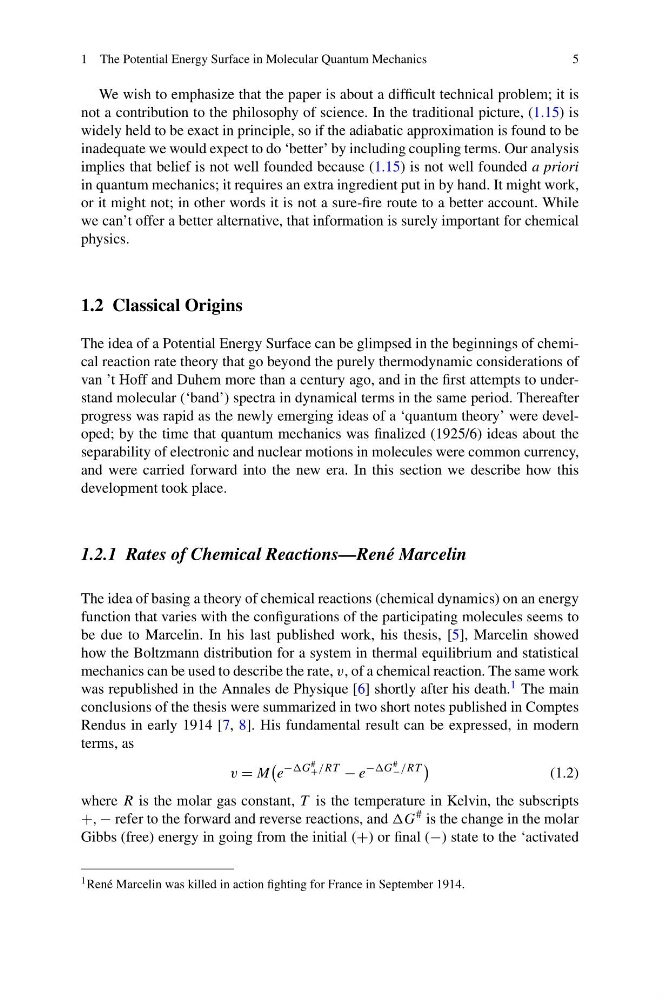
Rendus in early 1914 [7, 8]. His fundamental result can be expressed, in modern
terms, as
v = M
e
−G #
+ /RT
− e
−G #
− /RT
(1.2)
where R is the molar gas constant, T is the temperature in Kelvin, the subscripts
+, − refer to the forward and reverse reactions, and G # is the change in the molar
Gibbs (free) energy in going from the initial (+) or final (−) state to the ‘activated
1 René Marcelin was killed in action fighting for France in September 1914.
5
We wish to emphasize that the paper is about a difficult technical problem; it is
not a contribution to the philosophy of science. In the traditional picture, (1.15) is
widely held to be exact in principle, so if the adiabatic approximation is found to be
inadequate we would expect to do ‘better’ by including coupling terms. Our analysis
implies that belief is not well founded because (1.15) is not well founded a priori
in quantum mechanics; it requires an extra ingredient put in by hand. It might work,
or it might not; in other words it is not a sure-fire route to a better account. While
we can’t offer a better alternative, that information is surely important for chemical
physics.
1.2 Classical Origins
The idea of a Potential Energy Surface can be glimpsed in the beginnings of chemical reaction rate theory that go beyond the purely thermodynamic considerations of
van ’t Hoff and Duhem more than a century ago, and in the first attempts to understand molecular (‘band’) spectra in dynamical terms in the same period. Thereafter
progress was rapid as the newly emerging ideas of a ‘quantum theory’ were developed; by the time that quantum mechanics was finalized (1925/6) ideas about the
separability of electronic and nuclear motions in molecules were common currency,
and were carried forward into the new era. In this section we describe how this
development took place.
1.2.1 Rates of Chemical Reactions—René Marcelin
The idea of basing a theory of chemical reactions (chemical dynamics) on an energy
function that varies with the configurations of the participating molecules seems to
be due to Marcelin. In his last published work, his thesis, [5], Marcelin showed
how the Boltzmann distribution for a system in thermal equilibrium and statistical
mechanics can be used to describe the rate, v, of a chemical reaction. The same work
was republished in the Annales de Physique [6] shortly after his death. 1 The main
conclusions of the thesis were summarized in two short notes published in Comptes
Rendus in early 1914 [7, 8]. His fundamental result can be expressed, in modern
terms, as
v = M
e
−G #
+ /RT
− e
−G #
− /RT
(1.2)
where R is the molar gas constant, T is the temperature in Kelvin, the subscripts
+, − refer to the forward and reverse reactions, and G # is the change in the molar
Gibbs (free) energy in going from the initial (+) or final (−) state to the ‘activated
1 René Marcelin was killed in action fighting for France in September 1914.